Research · Agents · Lean
How they did it
Last updated: 2026-08-12
The model, the swarm, the clock
❓ What system produced the proof, and on what timeline?
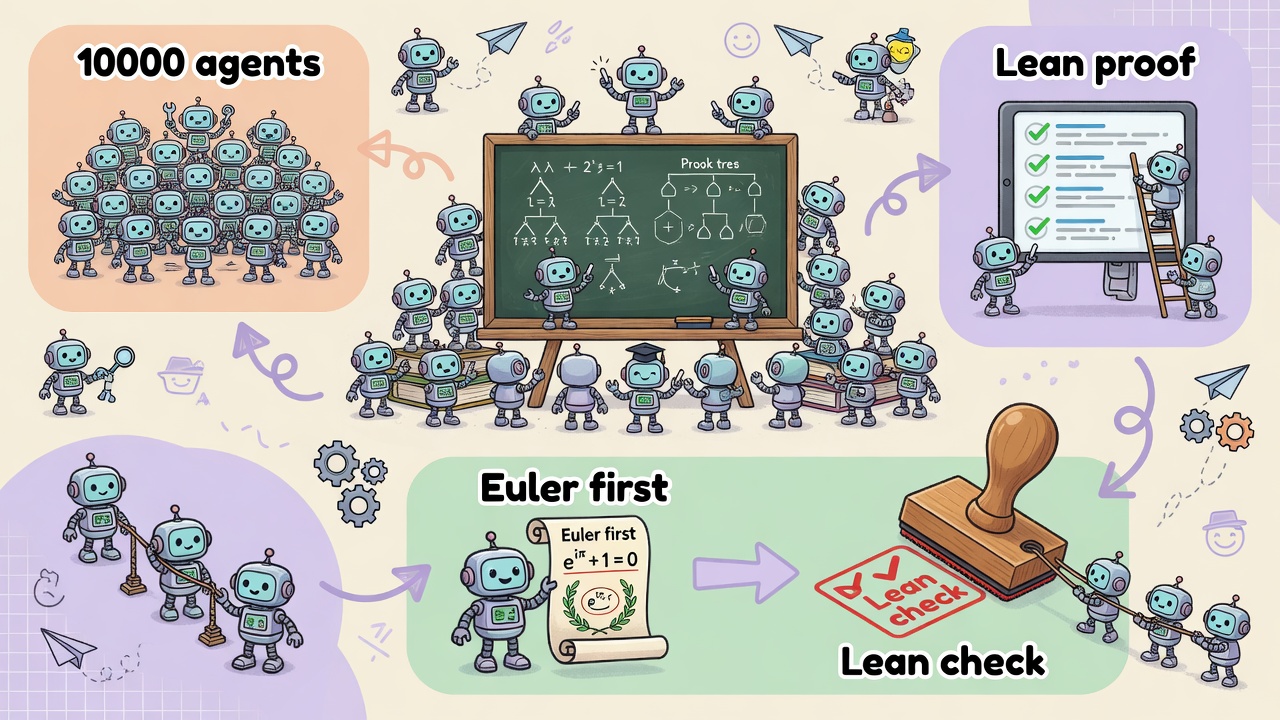
OpenAI says it had been training a new internal model since 28 August 2026, with unprecedented benchmark performance, including mathematics, and that training was still improving. The model is not named. It is described only as significantly more capable than GPT-6 Astra, which had been positioned days earlier as a public generation.
On Tuesday 1 September 2026, after rumors that two Millennium problems had been resolved, the lab launched coordinating agents at all open Millennium problems and some other high-impact problems. Agents could read a cached internet and run code. They were grouped; groups could talk inside the group. The Navier–Stokes group was of order 10,000 concurrent agents. Frontier evaluation safeguards, including monitoring and isolation, are said to have remained in place.
For Navier–Stokes, separate groups received variants A, B, C, and D. Easier cousins were also assigned. One cousin was Euler regularity (viscosity off). Agents produced an unforced Euler blowup: nearly 100 agents, about 50 hours. OpenAI then shifted resources onto Navier–Stokes, prompted those agents with the Euler resolution, and updated agents when a further-trained checkpoint became available. Codex was used to consolidate useful insights across groups and to write follow-up prompts from the agents’ own intermediates.
The Navier–Stokes resolution is dated Saturday 5 September 2026, about 88 hours after launch. Lean formalization and verification took about 17 hours via GPT-6 Astra. Across all attempted problems that week: about 4.9 million messages and 300 billion output tokens. On Navier–Stokes specifically: about 2.7 million messages and 130 billion output tokens.
New Scientist reports a press-conference figure of about $15 million if a customer ran the same problem, and a 1,000-agent Euler stage then 10,000-agent Navier–Stokes extension finishing in 11 hours after Euler. TechCrunch reports 300 billion tokens as $22.5 million at Astra rates. Axios reports “millions.” These are the same event measured three ways. This package treats cost as millions of dollars, not a single audited ledger.
Why this is a method, not a magician
❓ What in the workflow is load-bearing, and what is theatre?
Three pieces are load-bearing.
- A model above the public frontier on long mathematical constructions. Without that, 10,000 copies of a 2024 chatbot do not write a 165-page fluids paper that Lean accepts.
- Decomposition into official variants and into easier cousins. Launching A–D separately, and Euler as a stepping stone, is how you avoid asking one prompt to invent the entire twentieth century of PDE.
- A proof assistant as the acceptance test. GPT-6 Astra’s 17 hours are not “the discovery.” They are the conversion of a candidate argument into kernel-checkable Lean 4 (reported toolchain: 4.34.0-rc2, Mathlib, Lake).
Cross-pollination via Codex is the piece that most resembles ordinary research management: harvest the good lemmas, kill the dead ends, restart groups on the surviving plan.
Definition: A coordinating agent swarm here means many instances of the same (or checkpointed) model, partitioned into communicating groups, with tools, aimed at a theorem.
Explanation: Search is parallel. Criticism is partly parallel (groups) and partly serial (Codex consolidation). The Lean kernel is the non-negotiable critic.
Different from: A single chat transcript, and also different from a human collaboration that uses an LLM as a copy-editor.
Hard-to-vary test: Remove Lean and you have an unreadable 165-page claim. Remove the swarm and you have a model that may not have found the cancellation construction in 88 hours. Remove the Euler stepping stone and OpenAI’s own narrative says they would not have concentrated resources.
Refutability: An independent group reproducing a comparable theorem with a public model at far lower cost would weaken “10,000 agents were essential.” A Lean failure would weaken everything.
Reach example: The same pattern — cousin problems, variant split, formal kernel — is how one would attack other analysis constructions, not how one would attack an experimental science.
Criticism note: Buckmaster’s account of the 6 September calls says “very little human input” unravelled once it emerged that a team had worked the problem, started from Euler, and even the displayed prompt had been written by prompting Codex. OpenAI’s blog already describes those human steering moves. The disagreement is less “were there humans?” than “who had the idea of the route?”
The public certificate
❓ What can a third party actually check today?
Public objects:
- Blog post, 8 September 2026: openai.com/index/navier-stokes-solution
- Analytical PDF: Finite Time Blowup for Navier–Stokes
- Euler PDF linked from the same post
- GitHub: openai/NavierStokesAndEuler — Lean for both results, Apache-2.0, Comparator challenge files
The README states the two Navier–Stokes theorems (whole space with bounded energy; torus) as Clay (C) and (D), and the Euler theorem as unforced compactly supported blowup. Independent checking instructions point at Comparator.
Until outside groups report a clean lake build and a reading of the theorem statements against Fefferman, the certificate is public but not yet socially verified. That is the normal state of a day-old proof, amplified by length and by corporate authorship.
Compute as a mathematical instrument
❓ Is this “AI doing math” or “money doing math”?
Both. Terence Tao, commenting on the Buckmaster–Alpöge program before OpenAI’s full NS post, wrote that he would not be surprised if an extension to Navier–Stokes could be battered out by pouring enormous compute and AI assistance at the task. That is a mechanism, not a taunt: once a route exists in the literature-of-the-week, search cost dominates insight cost.
Trend classification for landmark analysis theorems closed by AI:
- Class: stepwise (discrete jumps: contest math → research lemmas → Euler cousins → claimed Clay C/D).
- Metric: not a clean doubling time. Tokens and agent counts are reported for one week, not a decade.
- Mechanism: better models × tool use × formal checkers × parallel search.
- Bottleneck: human understanding bandwidth; access to the unreleased model; remaining unforced problem.
- Next paradigm: if unforced (A)/(B) falls the same way, the step is “AI closes supercritical PDE constructions as a class.” If it fails, the step was specific to forced cancellation constructions.
Do not call this double-exponential. One week is not a curve.