Research · And what it does not
What it unlocks
Last updated: 2026-08-12
Core mechanism
❓ What single causal chain is the whole story about?
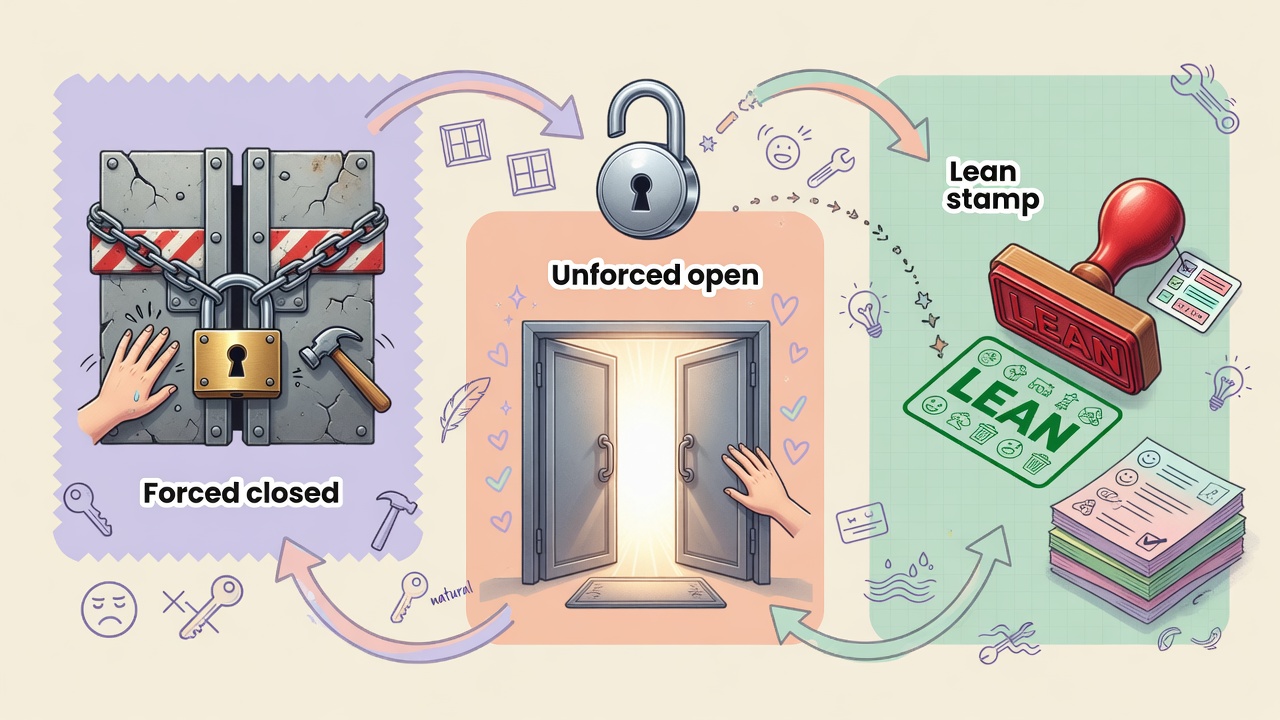
If a continuum fluid model can concentrate motion faster than viscosity can smooth it, and if the leftover force can still be arranged to stay smooth, then global smoothness is false for Clay’s doors (C) and (D). OpenAI’s claim is that an agent swarm found such a concentrating vortex and a Lean kernel accepted the argument. Everything else — headlines, prizes, aircraft, credit fights — is downstream of that chain.
Unlocks in mathematics
❓ If the certificate holds, what new work becomes possible?
- A negative well-posedness theorem for official forced 3D Navier–Stokes. Textbooks would have to stop saying the problem is fully open. They would say: forced breakdown is constructed; unforced remains open.
- A new singular solution to interrogate. Numerical analysts can try to see the spaghetti vortex at finite resolution. Theorists can ask which estimates must fail on this example.
- Pressure on (A) and (B). Tao’s remark that nothing in principle blocked extension, plus OpenAI’s unforced Euler, make unforced viscous NS the obvious next siege.
- Formal fluids analysis as a living Mathlib-adjacent artifact. Future papers in this area will be asked, fairly or not, “where is the Lean?”
None of this is a turbulence theory. None of it derives Kolmogorov exponents.
Unlocks in AI and the scientific method
❓ What does this change about what AI systems are for?
OpenAI’s explicit motive in the post is not the million dollars (they say they will not claim it). It is to show the pace of internal models relative to GPT-6 Astra, and to argue that the world is in a “next period” of AI progress. Sébastien Bubeck called it a spectacular culmination of a twelve-month arc of AI mathematics.
That is a capability milestone: original research-level analysis, not a contest problem, with a machine-checked certificate produced on a long weekend.
Tao’s counter-unlock, given to New Scientist, is the decoupling of getting answers from getting understanding. If 10,000 agents can emit a 165-page proof faster than a field can digest it, mathematics gains theorems and loses the slow conversation that makes theorems into knowledge. Five days before this week’s fluids burst, Tao had already used Navier–Stokes as a worked example of how an AI-generated solution could damage a field. That essay is now a live experiment.
Definition: Understanding, in Tao’s usage here, is the community’s ability to vary, teach, and criticise the mechanism — not the kernel’s ability to accept a term.
Explanation: Lean checks local logical steps. It does not check that the theorem is the theorem you cared about, or that a graduate student can rebuild the idea. Those are social.
Different from: Formal verification of a CPU, where “the spec is the spec.” Clay’s spec is a PDF plus a century of taste.
Hard-to-vary test: If the field reads, rebuilds, and teaches the vortex cancellation in a year, Tao’s damage scenario weakens. If the proof remains an unread oracle, it strengthens.
Refutability: A short conceptual rewrite by humans, independently formalized, would show that understanding can catch up.
Reach example: The same decoupling will hit protein design, cryptography proofs, and legal argument if agent swarms outrun institutions.
Criticism note: “Damage” is not automatic. Perelman’s papers were also hard. The new ingredient is rate plus corporate control of the search model.
Unlocks in the physical world
❓ What becomes newly possible in atoms, not bits?
A certified continuum blowup is a license to treat “the PDE failed” as a theorem rather than a superstition. Hybrid models that switch to particle or kinetic descriptions near extreme concentration have a sharper existence proof of the regime they are built for.
It does not, by itself, improve a weather code. It does not cut aircraft drag. Silvester’s nicety still holds for applications on a short horizon.
The second-order physical unlock is attention. Fluids groups that were not on the Córdoba–Martínez-Zoroa forcing line now are. PINN-based Euler work (Anandkumar and collaborators, 7 September 2026) and DeepMind’s 2025 unstable-singularity families show a broader AI-fluids wave. OpenAI’s claim is the loudest crest.
Unlocks in institutions
❓ What new problems does the method create?
- Priority at compute speed. A two-person academic collaboration using lab tools can be overtaken in 88 hours once a rumor exists. That is a new kind of scoop.
- Tool-trust. If unpublished drafts live in Codex, the lab that owns Codex is now a party to every rumor. OpenAI denies looking up user data and cannot rule out de-identified training effects.
- Authorship. A blog byline “OpenAI” and a GitHub identity
balexeev-oaido not fit Clay’s human-solver template or journal conventions. - Prize process. Clay’s two-year clock and qualifying-outlet rule are a deliberately slow institution meeting a weekend-scale machine.
These are not reasons the math is wrong. They are reasons the event is larger than the math.
What remains locked
❓ What does a responsible reader still not have?
Unforced 3D Navier–Stokes. A Clay decision. An independent rebuild. A turbulence theory. A public name for the search model. A clean moral of “AI stole” or “AI independently found.” Those stay closed or contested on 8 September 2026.