A long-form essay
Inside the Box, Against the Grain
TRIZ, Systematic Inventive Thinking, and SCAMPER — structured methods against fixedness.
Last updated: 2026-07-29
Karl Duncker did not set out to invent a metaphor for every stuck product team of the next eighty years. He set out to watch people fail at a simple task.
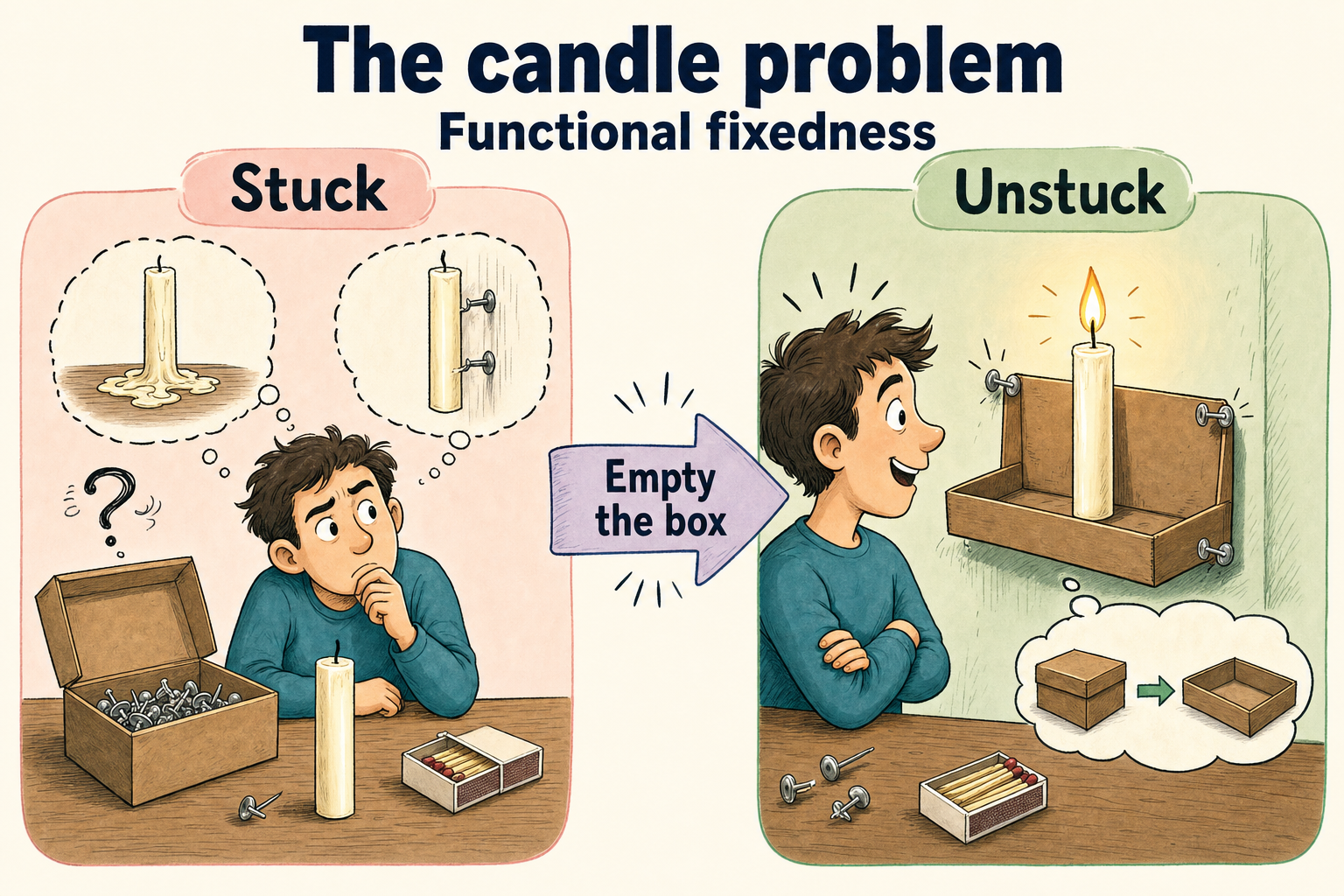
On the table: a candle, a book of matches, a box of thumbtacks. The assignment sounds almost childish. Affix the candle to the wall so that, once lit, wax will not drip onto the table below.
Most adults stall. They try to melt the candle into the wall. They try to tack the candle itself. They see the box only as a container for the tacks — its “job” already assigned — and so they never empty it, pin it to the wall, and stand the candle in the tray they have just created.
That blindness has a name. Functional fixedness is the mind’s habit of locking an object to its familiar function and refusing, for a dangerous stretch of time, to see any other. Duncker’s candle problem, published in the mid-twentieth century, is still the cleanest laboratory version of a boardroom disease: the feature that can only be what it already is, the module that cannot be removed, the process step that cannot change jobs.
Creativity consultants will tell you the cure is “thinking outside the box.” Duncker’s experiment suggests something ruder. The box is already on the table. The failure is not insufficient imagination about distant galaxies. The failure is an unexamined assignment of roles among nearby parts.
That is the single bottleneck this book is about.
Three families of method grew up to attack it. They do not share a single inventor, a single country, or even a single century of origin. They share a refusal to wait for inspiration like weather.
TRIZ — the Theory of Inventive Problem Solving — grew from Soviet patent analysis beginning in 1946. It treats many hard problems as contradictions: improve A and you harm B. Inventive work, in this framing, does not optimize the trade-off. It restructures the problem so the trade-off dissolves.
Systematic Inventive Thinking, or SIT, grew in Israel in the mid-1990s as a learnable descendant of TRIZ. It keeps the idea that inventive solutions share patterns, then strips the engineering cathedral down to five templates and a strict rule: work inside a Closed World of nearby resources.
SCAMPER sits on a parallel branch entirely. It is a seven-letter checklist — Substitute, Combine, Adapt, Modify, Put to another use, Eliminate, Reverse — compressed by educator Bob Eberle in 1971 from the idea-spurring questions of advertising executive Alex Osborn. It does not require Closed World. It does not speak the language of contradictions. It forces a walk across under-sampled transformation axes before the group collapses into fluent clichés.
They are not three logos for the same workshop. They are three search policies over the space of possible ideas.
SCAMPER changes the schedule of prompts.
SIT changes the legal inventory of parts and the allowed edits.
TRIZ changes the problem model from compromise to contradiction, then retrieves patterned operators from the history of invention.
None of them manufactures genius. All of them can be turned into sticky-note theater. Used honestly, they raise the odds that a team will notice the empty box on the table.
The chapters ahead take each method in turn, then set them side by side on one ordinary object, then listen to the skeptics, then ask what generative machines do to the old craft. The last practical chapter is a Monday-morning chooser. An appendix keeps the full map of questions that organized the underlying research, so nothing important is lost to magazine compression.
One more plain definition before the story deepens. When this book says structured innovation method, it means a repeatable procedure that constrains how you search for ideas — not a personality type, not a culture slogan, and not a guarantee of breakthrough.
The candle is still on the table. The tacks are still in the box. The question is whether your next meeting will empty the box on purpose.
What follows is one argument in nine movements: creativity stalls on fixedness; TRIZ, SIT, and SCAMPER are different search policies — not three logos for the same workshop ritual.
All chapters
Chapter 1 is above. Jump ahead anytime.
Go deeper in the source dossier
TRIZ, SIT, SCAMPER, comparison and chooser, mechanisms/limits/AI, sources, and the master question ledger.