Last updated: 2026-07-29
05 — One Bicycle, Three Maps
Imagine a bicycle on the workshop floor. Same object. Same afternoon. Three methods. The differences are not aesthetic. They are differences in what counts as a legal move.
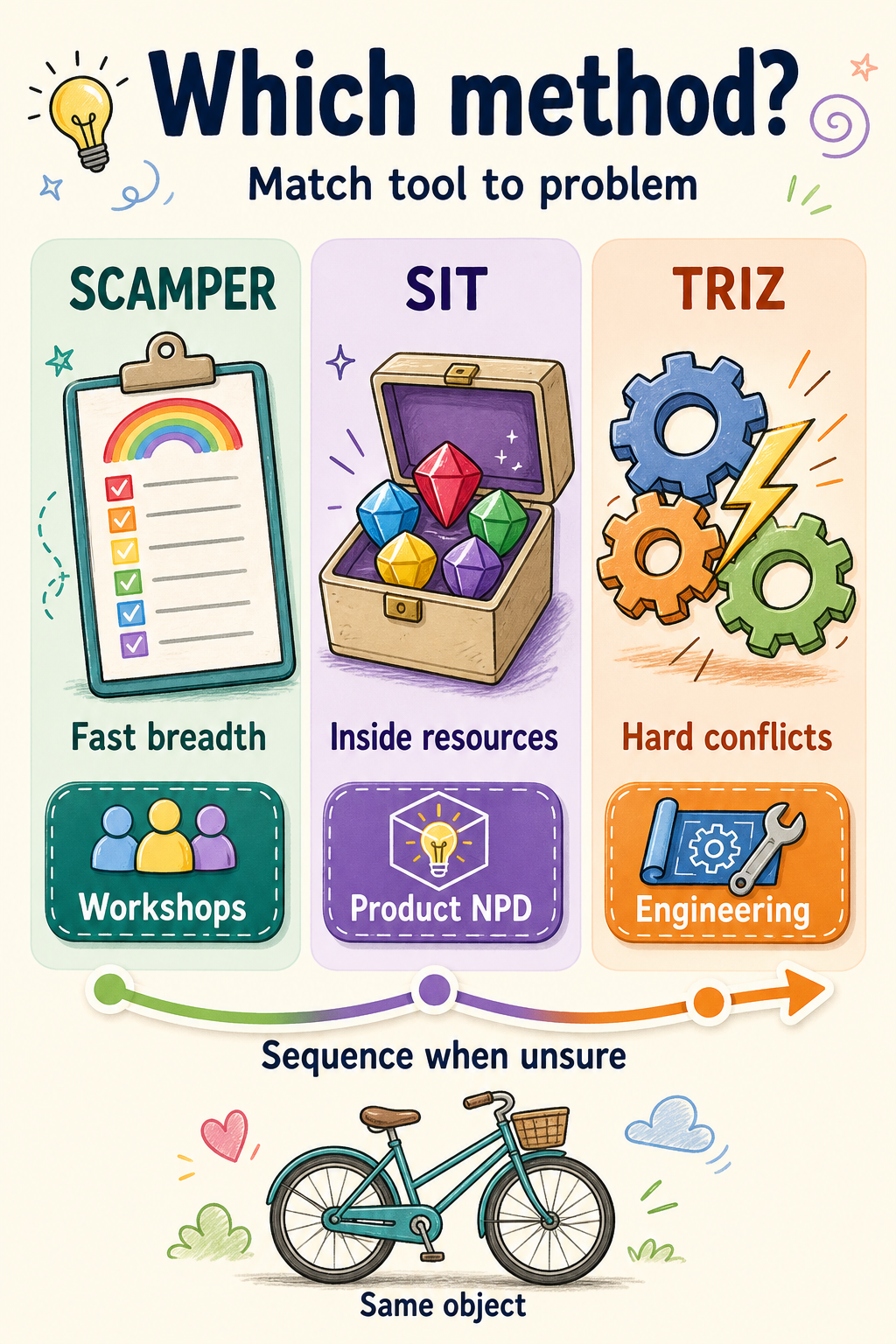
Start with SCAMPER, the wide shallow net.
Substitute the chain with a belt. Combine the frame with a cargo platform. Adapt motorcycle lighting logic. Modify wheel size. Put the frame to gym use off the road. Eliminate gears. Reverse the assumed direction of pedaling assistance. In an hour a mixed group can cover the alphabet of transforms. Many ideas will be shallow. A few will be seeds. The method’s job was coverage and inclusion, not depth.
Now run SIT on the same bike under Closed World rules. The legal inventory is roughly: frame, wheels, drivetrain, saddle, handlebars, brakes, rider, road, gravity, weather nearby. No free import of a jet engine.
Subtraction removes the seat and forces standing, balance, and delivery concepts into view. Task unification makes the wheels generate power for lights while they roll. Attribute dependency ties assist level to heart rate or slope. Division might split propulsion from storage across time or space. Multiplication might add a second, differently geared rear sprocket behavior rather than a clone. Each virtual product is strange on purpose. Market and safety filters arrive after the form exists on the whiteboard.
Now run TRIZ. The painful sentence might be: we need the bike lighter for portability and speed, but lighter frames lose strength and crash safety. That is a technical contradiction. Ideal Final Result whispers that protection and stiffness should appear when needed and vanish when not. Principles such as composite materials, segmentation, local quality — reinforce only high-stress zones — and dynamization — geometry that changes with load — become candidates. The method’s job was not seven letters of divergence. It was dissolving a named conflict without a dishonest compromise.
The bicycle does not prefer a religion. The problem type does.
| Dimension | SCAMPER | SIT | TRIZ |
|---|---|---|---|
| Origin | Osborn → Eberle 1971 | Israel mid-1990s from TRIZ | Altshuller from 1946 |
| Core move | Seven prompt axes | Five templates in Closed World | Contradiction → inventive patterns |
| Resource rule | Open world OK | Closed World preferred | Prefer existing resources / ideality |
| Typical unit | Product, process, campaign | Component / attribute system | Technical or abstracted contradiction |
| Learning curve | Minutes | Days of practice | Weeks to months for depth |
| Best first win | Inclusive breadth | Nearby-resource novelty | Stubborn multi-parameter conflicts |
| Failure mode | Creativity theater | Incrementalism / wrong boundary | Cargo-cult matrix; tool overload |
A practical chooser, used as an ordered test rather than a personality quiz:
- Sharp technical contradiction in a complex system? Start TRIZ, or hire TRIZ-literate help. Light version: IFR + contradiction + short principles pass before full ARIZ.
- Existing product or service that needs inventive variants without a junk drawer of new parts? Run SIT.
- Fast inclusive coverage with mixed audiences? Run SCAMPER, then filter ruthlessly.
- Unsure? SCAMPER for an hour, promote structural ideas into SIT for a second hour, escalate residual hard conflicts to TRIZ.
Sequencing beats monogamy. A defensible pipeline is frame and metric, then SCAMPER breadth, then SIT Closed World depth on the shortlist, then TRIZ only where trade-offs still block value, then evidence filters, then experiments. Design Thinking, Lean Startup, and stage-gate processes are containers. These three methods are ideation engines that plug into the ideate and hypothesis stages. They do not replace empathy research or market tests.
Sibling names will appear in any honest search. ASIT and USIT are other simplified inventive-thinking relatives of the TRIZ family. Synectics and lateral thinking are more associative traditions. Design Thinking is a human-centered process umbrella with weak native contradiction tools, often paired with SCAMPER. Liberating Structures “TRIZ” is a name collision.
Organizational shortcuts, used carefully:
- School or intro workshop → SCAMPER
- Marketing refresh → SCAMPER, then SIT
- Physical or digital product development → SIT
- Cost-down without killing function → SIT Subtraction plus TRIZ ideality
- Safety-critical mechanical conflict → TRIZ
- Software latency versus feature richness → TRIZ-style contradiction, translated, plus SIT task unification
- Executive offsite energy → SCAMPER with explicit filter time
- Patent-oriented R&D culture → TRIZ
- AI-assisted ideation → all three as prompt scaffolds, with human audits
How do you know the afternoon was not costume jewelry? Track novelty to the team against a baseline brainstorm, Closed World compliance for SIT concepts, contradiction-removal claims validated by engineering review for TRIZ, advance rate into an experiment backlog within thirty days, and kill rate with learning — discarded ideas that still changed the brief. If none of those move versus a time-matched control, the method was theater.
One object. Three maps. The skill is choosing the map that matches the terrain, not flying the flag of the map you learned first.
The next chapter is the room where skeptics get the microphone. Every sticky method deserves one.