Last updated: 2026-07-29
04 — Seven Letters from an Ad Man
Alex Osborn was not a patent examiner in Baku. He was a partner in the American advertising agency that became BBDO, and in the middle of the twentieth century he became the person most associated with a word that still empties conference rooms of courage: brainstorming.
In How to Think Up and then, more famously, in Applied Imagination (1953), Osborn argued that idea generation is a skill you can prompt. He published long lists of idea-spurring questions — Put to other uses? Adapt? Modify? Eliminate? — the raw material of a thousand later worksheets. The cultural wager was Anglo-American and commercial: defer judgment, raise quantity, let combination do surprising work.
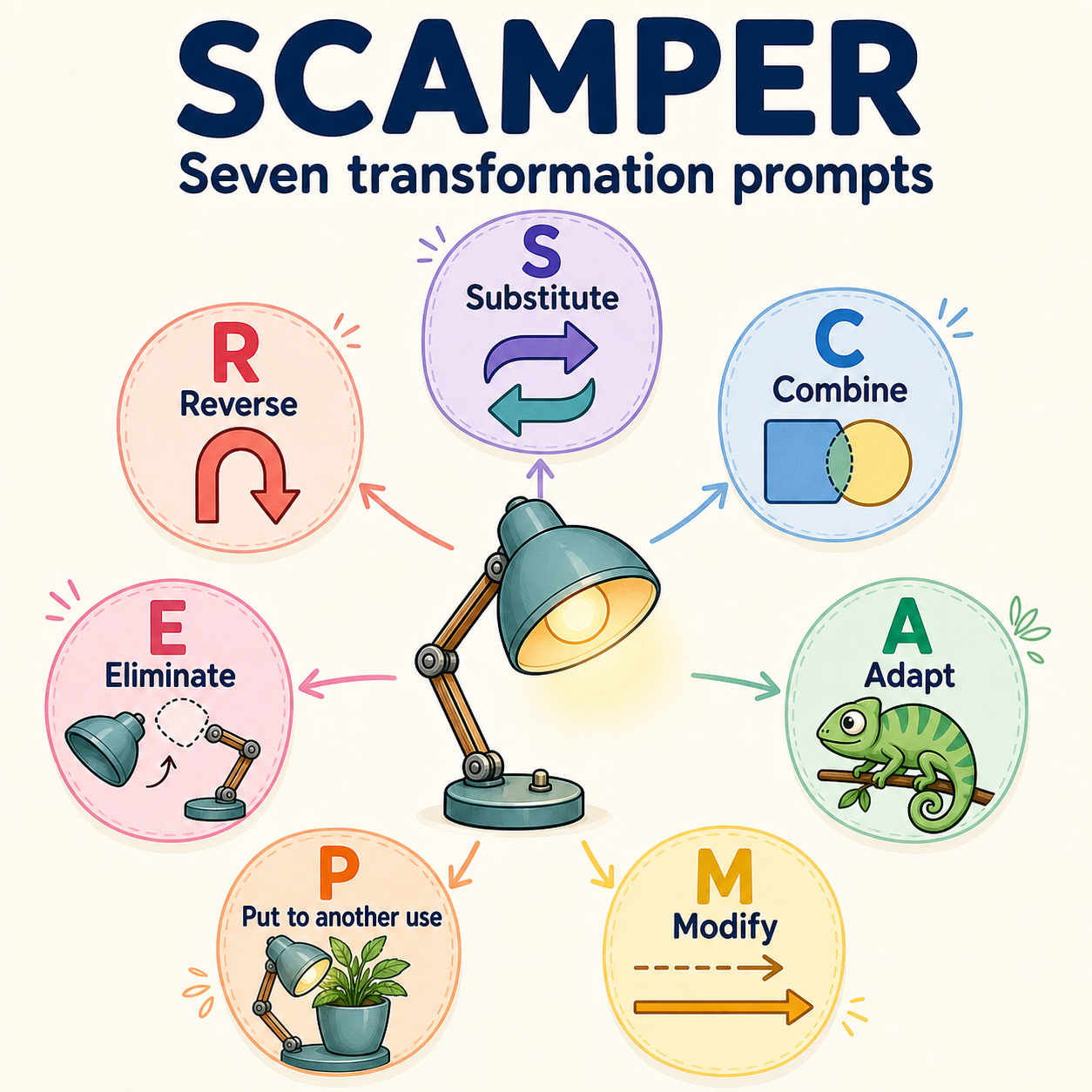
In 1971, educator Bob Eberle performed a compression that made the wager teachable to children and, later, to every corporate offsite on Earth. In SCAMPER: Games for Imagination Development, he folded the checklist spirit into seven letters:
Substitute
Combine
Adapt
Modify (often stretched to magnify and minify)
Put to another use
Eliminate
Reverse or rearrange
SCAMPER is not a TRIZ descendant. Say that twice if you must, because search engines and slide decks constantly marry the families. SCAMPER inherits brainstorming’s divergent, question-led spirit. TRIZ and SIT inherit patent-pattern and system-manipulation spirit. They can sit in the same afternoon. They do not share a bloodline.
What does each letter force?
Substitute asks what can be replaced — material, person, rule, channel, payment rail.
Combine asks what happens if two offers, audiences, or features merge.
Adapt asks what else is like this and what can be borrowed across contexts.
Modify asks what can be emphasized, scaled, or reshaped.
Put to another use asks who else could use this and what other job it could do.
Eliminate asks what can be removed or deliberately under-provided.
Reverse asks what happens if sequence, hierarchy, or roles flip.
A minimal honest session is almost boring in its discipline. Anchor on a specific object — a product, a journey step, a policy, a lesson plan. Optionally inventory components and users. Walk every letter and forbid the group from skipping Eliminate and Reverse, the two adults avoid. Capture raw moves without premature taste. Then — and this step is not inside the acronym — filter for feasibility, desirability, and strategy. Prototype the shortlist. Teams that treat the seventh letter as the finish line drown in colored paper.
SCAMPER does not require Closed World. External substitutions and adaptations are welcome. That is a feature when you need exploration and inclusion. It is a bug when resource discipline is the actual scarce virtue.
A public library card shows the method’s everyday reach. Substitute the plastic with a phone pass. Combine with transit and museum access. Adapt holds-queue logic from streaming watchlists. Modify the design for teens and the bureaucracy for seniors. Put the credential to local-business discounts. Eliminate late fees. Reverse delivery so the library brings holds to you. None of these seeds is a strategy. Each is a transformation axis the team can no longer pretend it “didn’t have time” to consider.
SCAMPER thrives in schools, mixed workshops, marketing refreshers, and the ideate slot inside Design Thinking loops. It onboards non-specialists in minutes. Its failure modes are as popular as its successes. Letters produce obvious swaps without structural insight. Multi-parameter engineering conflicts stay underspecified. Open-world drift invites trendy add-ons. Finishing the acronym feels like coverage even when the problem was misframed. Teaching literature is large; rigorous head-to-head proof of superior commercial outcomes is thinner than the method’s fame.
The hard-to-vary core is simple. Human ideation is biased toward fluent, familiar completions. An externally paced multi-axis walk interrupts fluency and forces attention onto under-sampled transforms. Drop the forced walk and you are back to free brainstorming. Add Closed World and contradiction tools and you are no longer “just SCAMPER” — which is fine, if you admit the hybrid.
Osborn wanted advertising people to think up on demand. Eberle wanted children’s imagination to have a game board. Enterprise strategy later borrowed the game board and sometimes forgot the filter. Popularity is not proof. It is distribution.
The next chapter puts all three methods on one ordinary machine with two wheels. The point is not which method “wins.” The point is how problem type chooses the tool.