Last updated: 2026-07-29
03 — Five Cards Inside the Box
In the 1970s, a student of Altshuller’s world named Ginadi Filkovsky brought TRIZ teaching into Israel and began adapting it for companies that were not Soviet design bureaus. Two doctoral researchers, Jacob Goldenberg and Roni Horowitz, pushed the adaptation further. By the mid-1990s their line of work had a public name that still confuses search engines: Systematic Inventive Thinking, sometimes written Systemic Inventive Thinking, almost always abbreviated SIT.
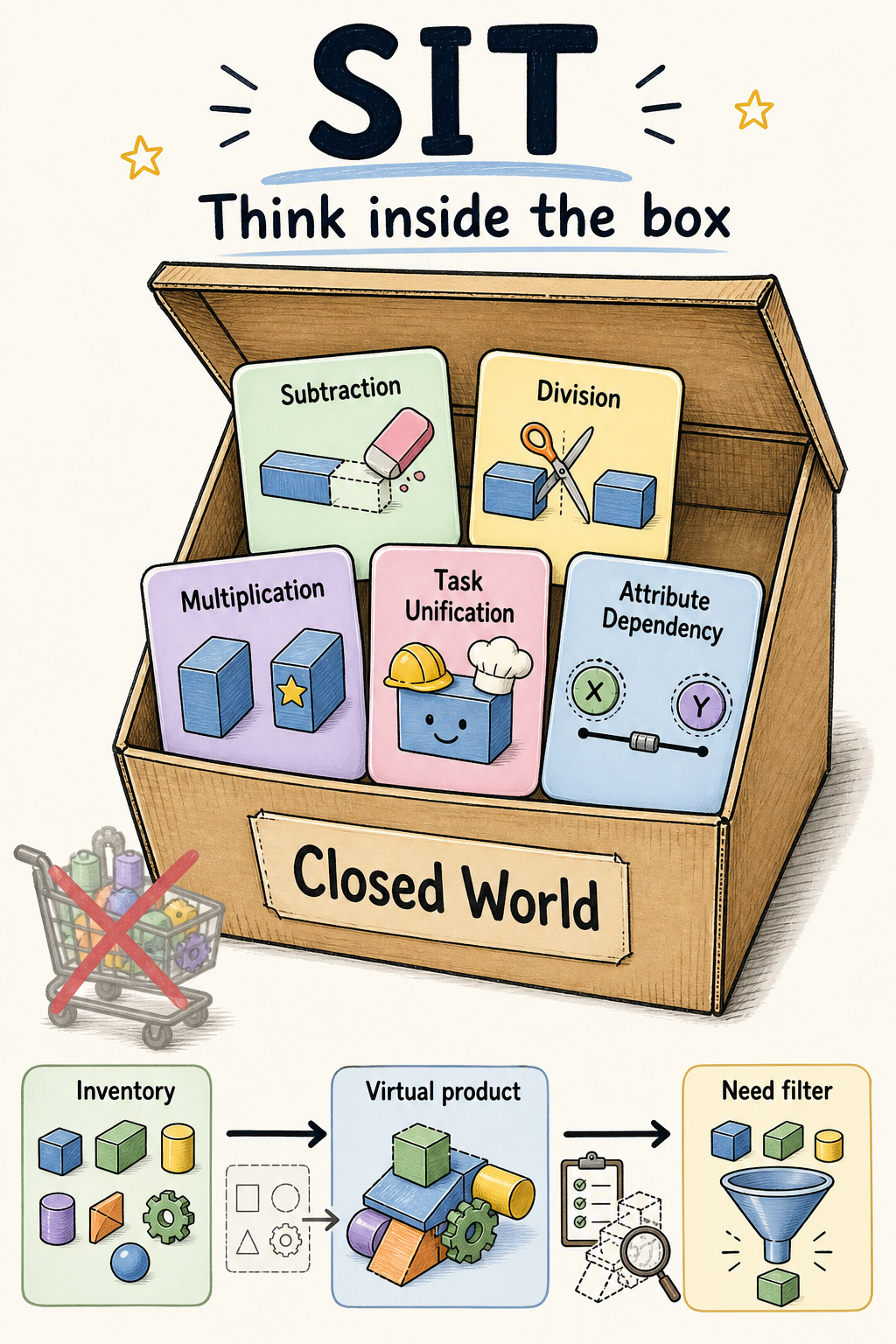
SIT keeps TRIZ’s deepest bet — inventive solutions share patterns that can become tools — and throws overboard much of the engineering furniture. The redesign goals were explicit in the standard histories. Fewer rules, so people retain the method after the workshop ends. Less engineering specificity, so marketers and service designers can use it. A stricter discipline about resources, so solvers stop importing unbudgeted magic from outside the problem.
That discipline is the Closed World principle, closely associated with Horowitz. When you invent or solve, prefer elements that already exist in the product, the problem, or the immediate environment. Do not freely summon a new sensor, a new platform, a new budget line, a new species of feature simply because the sentence “what if we add…” is easy to say. Unlimited search spaces feel creative. They also produce the same three clichés in every industry: add an app, add AI, add gamification.
Closed World is “thinking inside the box” as a technical rule, not a poster. It collides head-on with functional fixedness. If you may not import a new part, you are forced to reassign jobs among the parts you already paid for.
SIT’s generation sequence often runs Function Follows Form. The phrase, linked to cognitive work associated with Ronald Finke, sounds backwards on purpose. First manipulate the structure. Obtain what SIT calls a virtual product — a configuration that does not yet have a market story. Only then ask what need it might serve. Customer needs are not ignored. They are delayed as a filter so they cannot veto a strange form before the form has a chance to exist in the mind.
Two companion principles keep the method from collapsing into polite tweaks. The Path of Most Resistance steers toward moves that feel slightly wrong to everyday fluency. Qualitative change asks whether the problematic factor can be eliminated or reversed, not merely dampened.
Inside the Closed World sit five thinking tools. They are operators on structure and variables, not free-association prompts.
Subtraction removes a component that seems essential, then explores the remainder. Many categories have been redefined by a missing “must-have.” The tool’s power is emotional as well as structural: teams defend sacred modules until someone is licensed to delete them on paper.
Multiplication adds a copy of an existing component and then changes the copy along a parameter. The keywords are “more” and “different.” Mere duplication is not the point. A second battery with a different duty cycle is multiplication. A second identical battery is just inventory.
Division splits a product or component in space, time, or scale, then rearranges the pieces. What was glued into one object can be redistributed across a journey. A function that always happened at the counter can happen partly at home and partly in the branch.
Task unification assigns an additional job to a resource already in the Closed World. Affluent design cultures love new parts. Task unification asks the door lock to set the climate profile, the receipt to carry the loyalty state, the packaging to become the display.
Attribute dependency creates or dissolves a relationship between variables. As loyalty tier changes, interface density changes. As slope increases, assist level rises. As time of day shifts, price or permission shifts. “As X changes, Y changes” becomes intentional design rather than accidental correlation.
A hotel key card makes the five tools legible in one minute. Subtract the physical card and the room must recognize the guest another way. Multiply into guest and cleaner credentials. Divide unlock from identity across time. Unify the lock with energy metering. Tie door experience to floor or status. Each row is a form change first. Security review and market sense come after.
English-language teaching of SIT was shaped hard by Drew Boyd and Jacob Goldenberg’s book Inside the Box (2013) and by the earlier Harvard Business Review piece “Finding Your Innovation Sweet Spot” (Goldenberg, Horowitz, Levav, Mazursky, 2003). Commercial practice lives in workshops and firms associated with the method. SIT is strongest at structured front-end novelty. It does not replace customer evidence, unit economics, or risk review.
How does SIT differ from its parent and its cousin? Against TRIZ, it carries fewer tools, less matrix machinery, Closed World as a primary principle, and a broader non-engineering frame. Against SCAMPER, it carries a tighter operator set, stronger resource law, and a virtual-product-then-validate sequence rather than an open checklist.
The hard-to-vary test is blunt. Remove Closed World and SIT slides toward generic prompting. Remove the templates and it becomes constrained brainstorming without pattern leverage. The main uncertainty is empirical and honest: whether Closed World systematically underperforms on true category creation, when the right move really is an external scientific effect or a new platform. That question is still under-tested at scale.
SIT’s gift to a modern organization is almost moral. It makes “we already have what we need” a creative stance instead of a budget excuse. In a world drowning in optional features, that stance is not small.
The next chapter leaves the Closed World and opens the door Osborn left unlocked: a checklist that invites the outside in, seven letters at a time.