Last updated: 2026-07-29
02 — The Letter That Cost a Freedom
In the late 1940s, a young Soviet naval officer named Genrich Altshuller sat in an inventions-inspection post that would have bored a lesser mind into paperwork. His job was to evaluate proposals, refine them, and help prepare patent applications for the Caspian Sea flotilla. Day after day he watched the same pattern: someone improved strength and lost weight performance, or gained speed and lost stability, or added a feature and created a new failure mode. Engineers called the result a compromise. Altshuller began to call the underlying structure a contradiction.
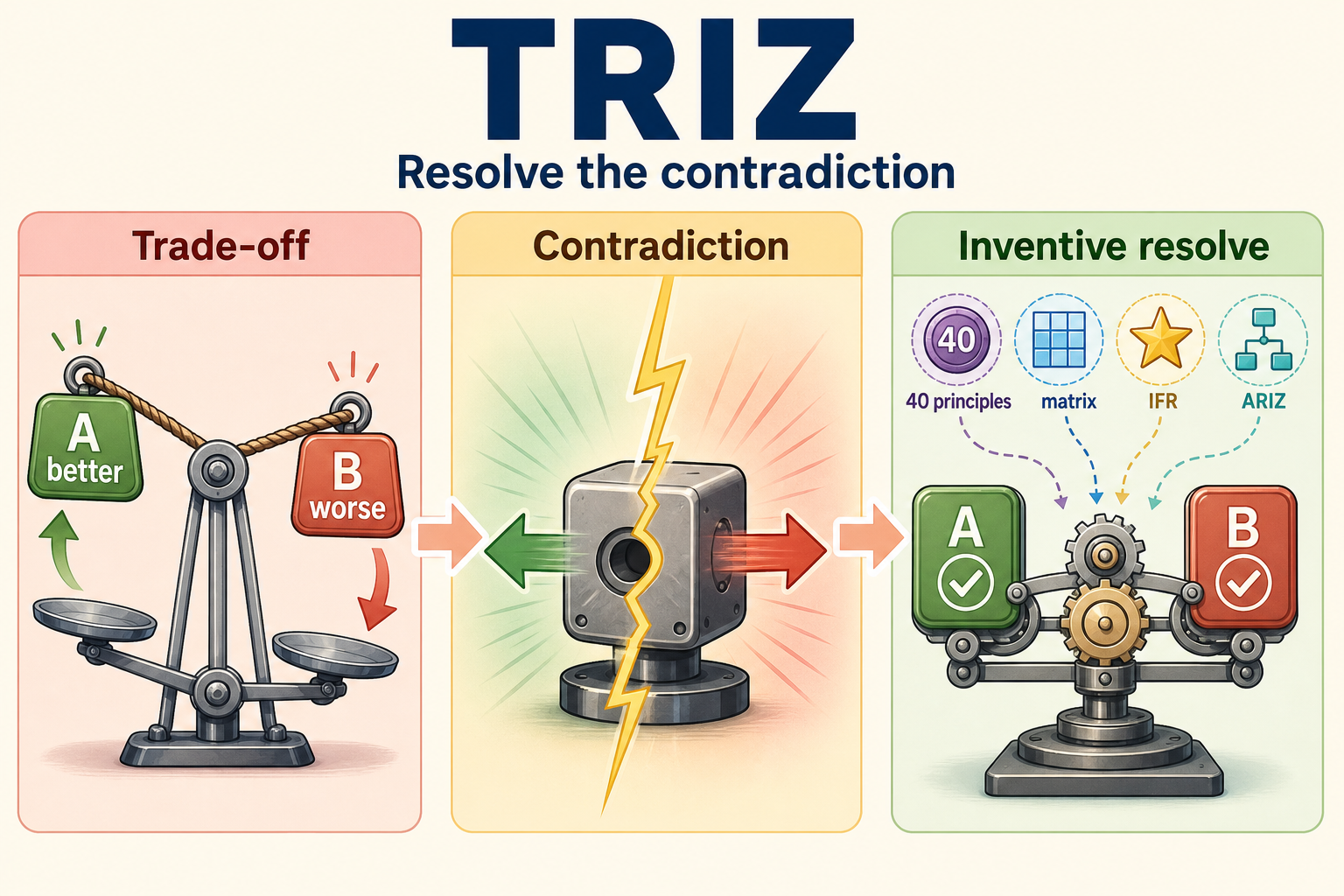
A technical contradiction is the familiar seesaw. Parameter A gets better; parameter B gets worse. A physical contradiction is sharper still: the same object is asked to be hot and cold, large and small, present and absent. Ordinary design searches for the least painful point on the curve. Altshuller’s wager was different. Truly inventive solutions, he argued, do not live on the curve. They change the geometry so both sides of the conflict can be served — or so the conflict ceases to exist in that form.
He and colleagues did not invent that claim from philosophy alone. They read patents the way a naturalist reads shells: looking for recurrence. Secondary sources disagree on the exact count — tens of thousands in careful early accounts, larger figures in later popular retellings — but the finding structure is stable enough to state plainly. Problems and solutions repeat across industries. Patterns of technical evolution repeat. Scientific effects discovered in one field often solve problems in another.
From those observations grew TRIZ — in Russian, teoriya resheniya izobretatelskikh zadach, the Theory of Inventive Problem Solving. Development is conventionally dated from 1946. The method’s first academic paper in the lineage, on the psychology of inventive creation, appeared in 1956. Between those dates lies a rupture that still startles people who meet TRIZ only as a corporate workshop brand.
Altshuller and his associate Refael Shapiro wrote to the highest levels of Soviet leadership, including a letter framed for Stalin’s attention, criticizing how the state handled invention and innovation. The political weather of the late Stalin years did not reward that kind of memo. In 1950 Altshuller was arrested. He spent years in the camp system, including time associated with Vorkuta. Camp lore around TRIZ circles says he kept thinking through inventive patterns while logging and mining — using constraint the way a mathematician uses axioms. What can be verified without romance is simpler and hard enough: the work was interrupted by political imprisonment, resumed after the thaw that followed Stalin’s death, and then matured into a public method with tools, schools, and eventually international associations.
What are those tools, stripped of mystique?
The 40 Inventive Principles are a catalogue of recurring moves — segmentation, taking out, local quality, dynamization, composite materials, and dozens more. They are not magic words. They are compressed memories of how inventors have broken contradictions before.
The classical Contradiction Matrix indexes engineering parameters against one another and suggests which principles historically helped for a given conflict pair. It is a retrieval aid, not a proof engine. Its mid-twentieth-century parameter list needs translation when the “system” is software, a platform, or a service.
The Ideal Final Result, or IFR, is a forcing function. Imagine the desired function achieved with almost no harmful side effects, almost no mass, almost no cost — ideally “by itself.” The point is not fantasy. The point is to stop the mind from optimizing a clumsy mechanism before it has named the real job.
ARIZ, the algorithm for inventive problem solving, is the heavy multi-step path when lighter tools stall. Substance-field models abstract a problem into interacting substances and fields, then apply standard transformations. Laws of technical system evolution offer directional forecasts — ideality, dynamization, transition into a super-system — useful more as disciplined questions than as prophecy. Levels of invention rough-sort outcomes from routine parameter tuning to discovery-scale leaps.
A practical industrial stack is often thinner than the full cathedral: name the contradiction, aim at an ideal result, retrieve a short list of principles, and only then open the deeper algorithms.
This is what TRIZ is not. It is not brainstorming with a Russian accent. Brainstorming tries to raise idea volume. Classical optimization tries to find the best trade-off. TRIZ tries to restructure the problem model so the trade-off is no longer the only honest move.
The hard-to-vary core is a three-step chain. Inventive history is compressible into operators. Hard problems often hide parameter conflicts. Mapping a live conflict onto prior operators transfers non-local solution structure into the current domain. Drop the operators and you have facilitation. Drop the contradiction and you have a principle buffet. Drop ideality and you polish local patches.
Industry has noticed. Secondary accounts associate TRIZ practice with names that impress procurement slides — Samsung, GE, Intel, Boeing, NASA, Procter & Gamble, major automakers. Packaging stories, manufacturing stories, semiconductor productivity stories circulate with large ROI figures. Treat those figures as directional case lore unless you can see primary finance verification in detail. Evidence is strong on history and tool structure, medium on comparative efficacy, mixed on universal return on investment.
Name collisions make the evidence messier. Classical and association-linked TRIZ is one thing. Commercial repackagings — I-TRIZ, TOP-TRIZ, and others — are related but not identical. The Liberating Structures exercise also called “TRIZ” is a workshop game about stopping counterproductive habits. It is only loosely inspired by Altshuller. When someone says “we did TRIZ,” ask which stack they mean.
Adoption itself is not an exponential EmTech curve. It has moved in institutional waves: post-Soviet emigration, corporate programs, periodic academic fashion, and now a possible new wave as software and language models make principle retrieval cheap. That last wave is a hypothesis about tooling, not a measured doubling time.
Altshuller’s life supplies the emotional irony that sticky stories need. A method built to dissolve contradictions was forged inside a system that answered criticism with a camp. The intellectual claim survives without the biography. The biography makes the claim harder to forget.
The next chapter leaves the contradiction matrix and enters a cardboard box with five cards inside. The question that pulls forward is practical: if TRIZ is powerful and heavy, can most product teams carry a lighter kit without losing the inventive edge?