Last updated: 2026-07-29
06 — When the Methods Lie
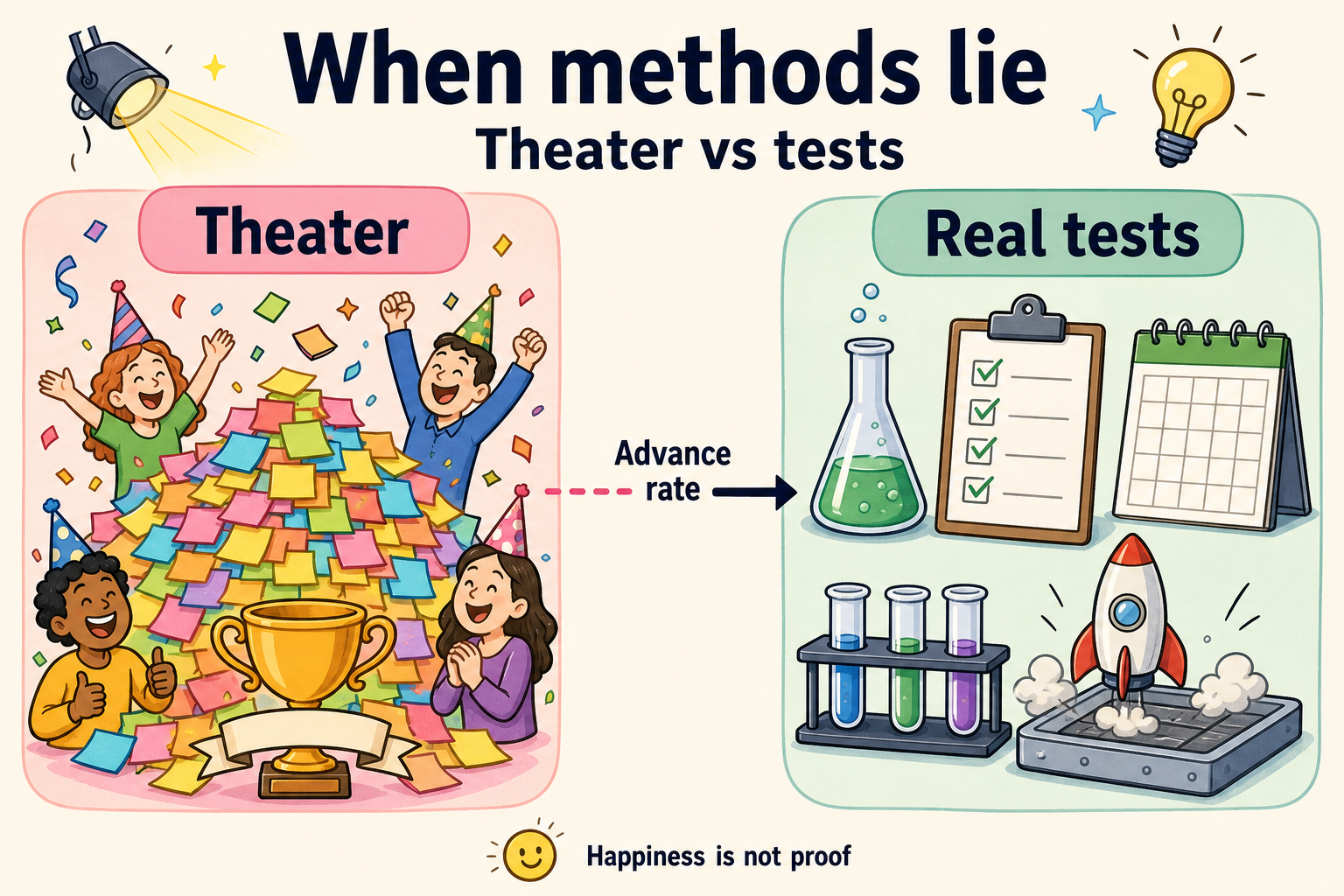
Structured methods improve average search behavior under fixedness. They do not print breakthroughs. The strongest integrated criticism is that simple, and teams forget it the moment a facilitator uncapping a marker feels like progress.
Start with TRIZ. Full training is a complexity tax smaller firms may never recover. The classical contradiction matrix is rooted in mid-century engineering parameters; pure software, data platforms, and service businesses need skilled abstraction or the tool becomes cosplay. Successful projects get labeled “TRIZ” after the fact. Schools fragment — MATRIZ-linked paths, I-TRIZ, TOP-TRIZ — and buyers cannot tell canonicity from branding. Case lore is vivid. Independent multi-site experimental literature is thinner than marketing implies.
SIT’s Closed World can block category creation when the right move truly is an external platform or a scientific effect — ironically the kind of transfer classical TRIZ sometimes enables through effects knowledge. Teams overfit the five templates and miss problem redefinition. Commercial packaging can outrun critical evaluation. Starting from today’s product privileges near-in innovation. Incrementalism is not a rumor. It is a structural pull.
SCAMPER’s failure mode is the most democratic because SCAMPER is the most distributed. Finishing the acronym feels like completion. Substitute and combine without a system model produce shallow novelty. A children’s imagination mnemonic gets stretched into enterprise strategy without filters. Experimental comparisons with other ideation treatments cut both ways depending on task and scoring. Popularity is distribution, not proof.
Against the whole category, three blows land cleanly. No method repairs a wrong problem frame, toxic incentives, or missing domain expertise. Facilitation skill often dominates method brand. Organizations adopt methods as identity signals — we are innovative — rather than as measured search tools.
Design Thinking deserves a special boundary note. It is strong on empathy, framing, and iteration. It is often weak on systematic ideation mechanics and defaults to brainstorming. Some university assessments of design methods find TRIZ-like structured approaches scoring higher on feasibility and transfer for certain challenges, while Design Thinking improves with participant experience. The practical synthesis is not a holy war. Keep Design Thinking’s human loop. Swap or augment the ideate step with SCAMPER, SIT, or TRIZ. Do not treat a journey map as a substitute for inventive structure.
When is unstructured exploration still superior? When the frame is genuinely unknown, when the team needs contact with a foreign domain before any inventory is honest, when political safety requires open conversation before constrained tools, or when the cost of a false Closed World is higher than the cost of a messy hour. Methods are search policies. Sometimes the right policy is still a walk outside without a checklist.
Evidence quality for the whole field should stay adult. History and tool structure are strong. Comparative efficacy is medium. Universal ROI is mixed and often vendor-colored. Unresolved on purpose: controlled multi-site trials comparing TRIZ, SIT, and SCAMPER on identical problems with blinded scoring and implementation follow-through; a single canonical boundary for modern TRIZ toolsets versus commercial variants; longitudinal proof about Closed World and radical category creation.
A method lies when it promises what only contact with users, physics, regulation, and economics can deliver. A method tells the truth when it admits it is a better flashlight, not a shorter night.
The next chapter hands the flashlight to machines that can run all seven letters and all five templates before the coffee cools — and asks what humans must still refuse to outsource.