Last updated: 2026-07-29
07 — Machines That Scamper
Large language models are fluent at checklists. That single sentence rearranges the economics of structured ideation.
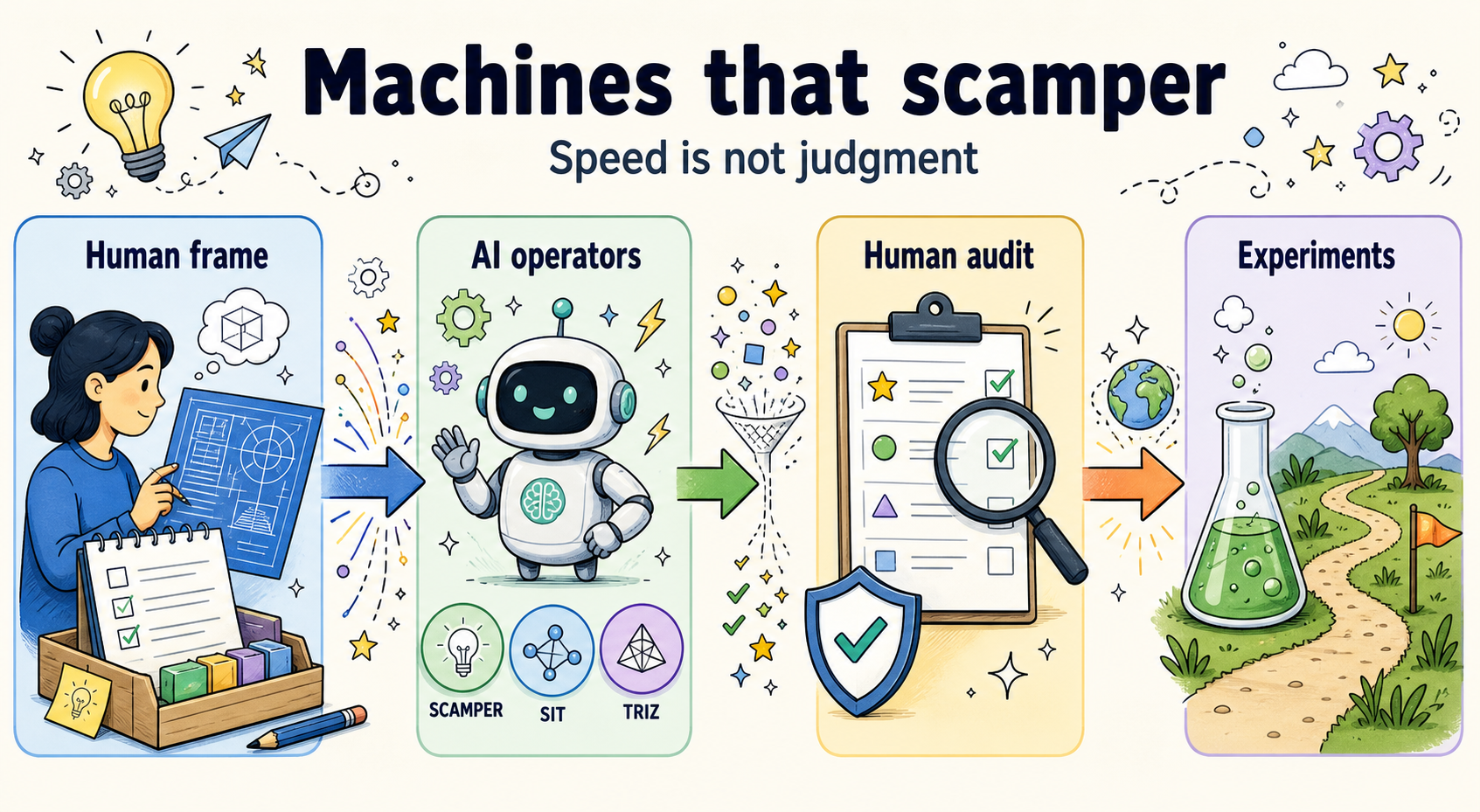
Ask a model to apply SCAMPER to a product inventory and it will obediently walk Substitute through Reverse. Ask it to run SIT’s five tools inside a Closed World list and it will emit virtual products at industrial speed. Ask it for TRIZ principles against a named contradiction and it will retrieve, remix, and polish. The floor of idea generation rises. The cost of a mediocre workshop facilitator’s first draft collapses.
What the models do not remove is more important than what they accelerate.
They do not own the problem. A fluent paragraph is not a true constraint set.
They do not dissolve fixedness in the human who selects the final three ideas from a hundred sleek options.
They do not validate physics, regulation, customers, or unit economics.
They do not practice contradiction honesty. A model will “resolve” a fake conflict with elegant nonsense if you let it.
A defensible hybrid workflow is almost boring in its sequencing.
Human defines system inventory, real contradictions, constraints, and kill criteria.
AI runs SCAMPER, SIT tools, and a TRIZ principle sweep at volume.
Human performs Closed World audit, contradiction check, ethics and risk review, strategy fit.
AI stress-tests and expands only the shortlist.
Human and field run experiments.
Optimize for auditability — which operator produced which idea — not for raw idea count. Count is the vanity metric of the generative age.
Picture the failure mode that is already common enough to feel like folklore. A team feeds a sacred legacy product into an LLM-SCAMPER loop. Two hundred concepts arrive in ten minutes, each slide-ready. None ships. Then a human forces a SIT Closed World pass and subtracts the untouchable module everyone had been decorating. One ugly concept remains. Customers notice that one.
Emerging technologies raise option volume and coupling complexity at the same time. When a new capability becomes cheap — models, robots, sensors, gene tools — teams drown in open-world clichés: add the new thing. Closed World SIT and TRIZ ideality ask ruder questions. What can be removed? What can be unified? Which contradiction must dissolve so the new capability becomes a clean system rather than a barnacle? SCAMPER remains the on-ramp that gets non-specialists generating before specialists deepen.
In the language of emerging-technology maps, these methods are not emerging technologies themselves. They are cognitive tooling for shaping applications when capabilities become abundant. The trend of AI-assisted structured ideation is best classified as stepwise and early-logistic, not as a measured exponential with a clean metric. The mechanism is software substitution of facilitation labor plus falling inference cost. The bottleneck is evaluation quality and organizational absorption, not tokens.
Machines that scamper are wonderful. Machines that decide which subtraction is sacred are not yet on the org chart — and should not be.
The next chapter is for the person who has to choose training budgets, workshop designs, and Monday priorities without becoming a methodologist.