Last updated: 2026-09-24
The newest doubling dominates
Look at the sequence 1, 2, 4, 8, 16. Each number is larger than the sum of every number before it: 8 is greater than 1 + 2 + 4, and 16 is greater than 1 + 2 + 4 + 8.
This is a property of doubling, not a coincidence. Every new step equals the entire previous total plus one more unit of that same size. As a result, the newest step is more than half of the cumulative total.
On a chessboard, the first square in the second half holds more grain than every square in the first half together. Almost all the wheat is concentrated near the end.
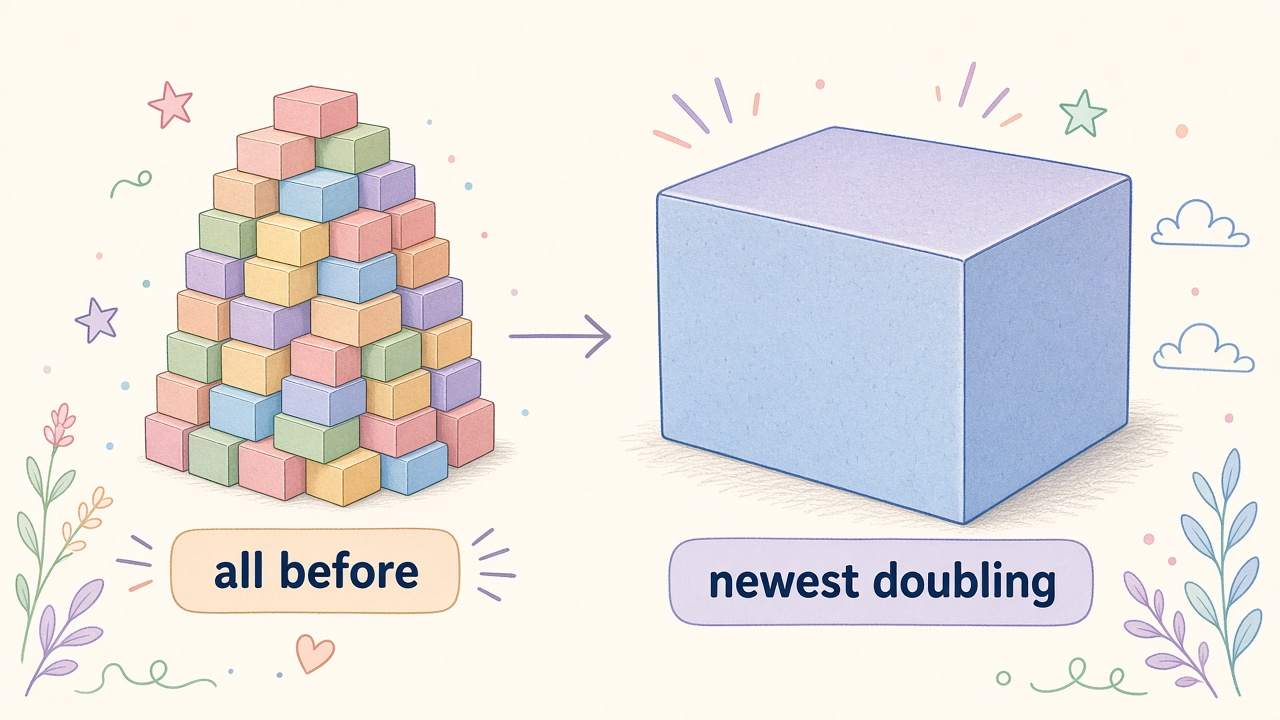
That is why a rapidly growing problem can seem manageable until very late. The final period is not a small addition to the past. It contains most of the total.
There is another useful way to see the same fact: start at the finish and work backwards.