Last updated: 2026-09-24
Why doubling feels unfamiliar
Most everyday changes are gradual. You walk a mile one step at a time. A household budget rises or falls by a manageable amount. Even when nature contains compounding processes, we rarely experience them as a visible, useful form of progress.
Fog offers a different example. As light travels through haze, each equal distance removes roughly the same fraction of the light that remains. If half remains after one stretch, a quarter remains after two, then an eighth. Physicists describe this with the Beer–Lambert law. It is exponential decay: light disappears faster than an equal-step intuition expects.
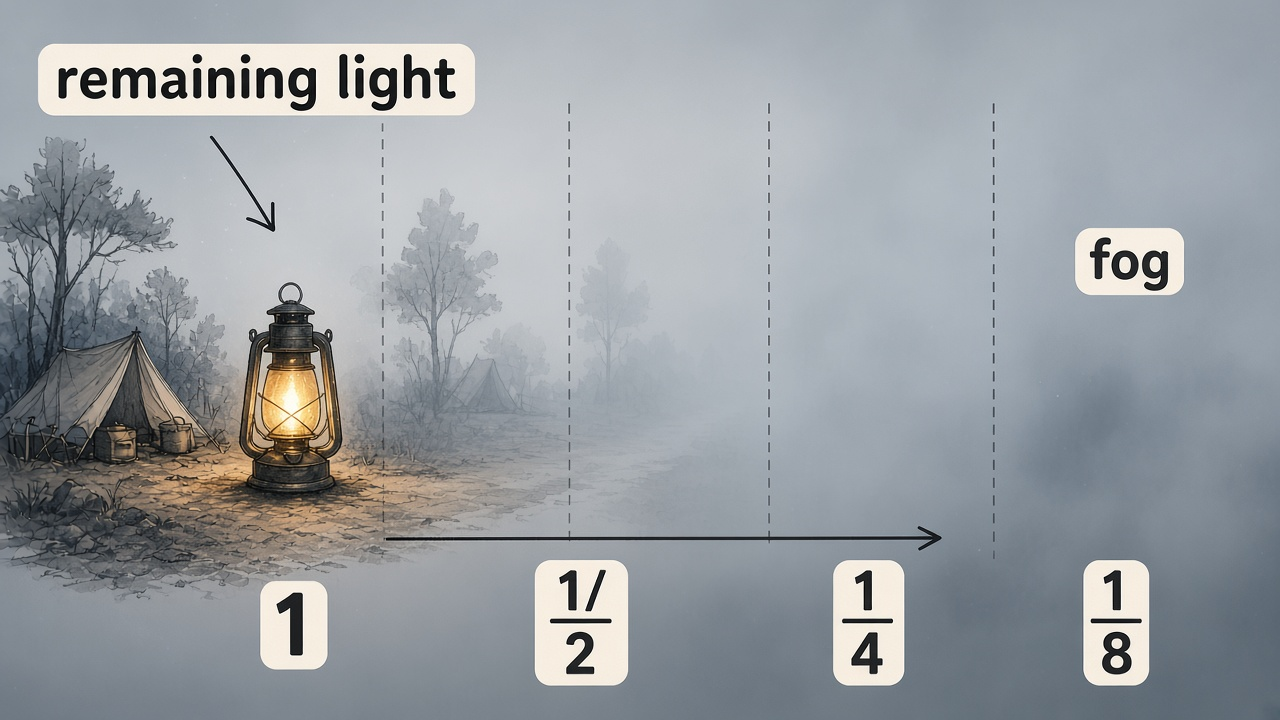
That is not the same as learning to recognize a process that doubles. The familiar examples—lily pads, yeast, or grains on a chessboard—are usually presented as puzzles precisely because the answer is counterintuitive.
So when Dev sees a few extra cases on the clinic fridge, the safe-looking interpretation is understandable. The numbers do not yet feel like the beginning of a much larger problem.
The chessboard makes the arithmetic impossible to ignore.