Last updated: 2026-09-24
Keep folding
A sheet of paper is roughly 0.1 millimetres thick. One fold makes a stack 0.2 millimetres thick; the next makes it 0.4. Every fold doubles the thickness.
No one can fold an ordinary sheet fifty times. The paper becomes too small and too stiff. Treat the example as a calculation: what would happen if the doubling could continue?
After thirty folds, the stack would be about 107 kilometres thick—roughly the height at which space begins by one common convention. After fifty folds, it would extend much of the way from Earth to the Sun.
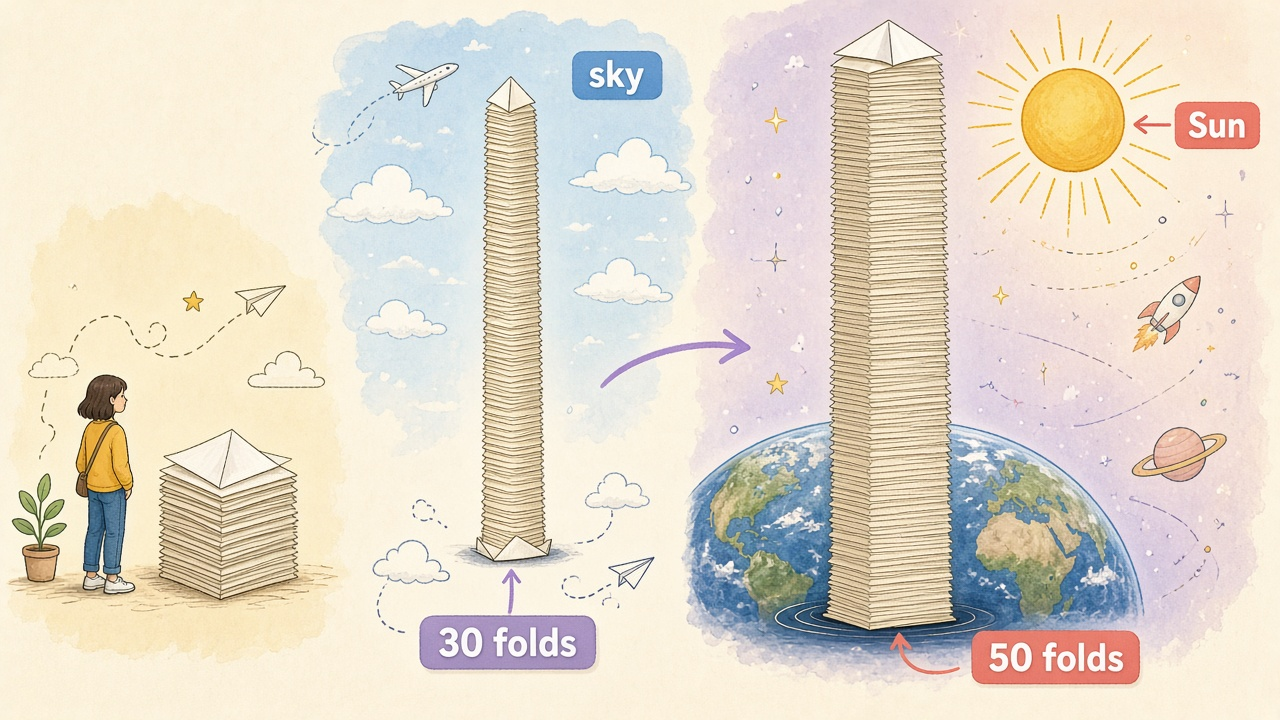
The mechanism is not mysterious. The starting thickness is simply multiplied by two again and again. The surprising result comes from letting that ordinary operation run for enough steps.
That makes one further fact easier to see: in a doubling series, the latest step contributes more than all the earlier steps combined.