Last updated: 2026-07-23
05 — Enablers and next milestones: batteries and beyond
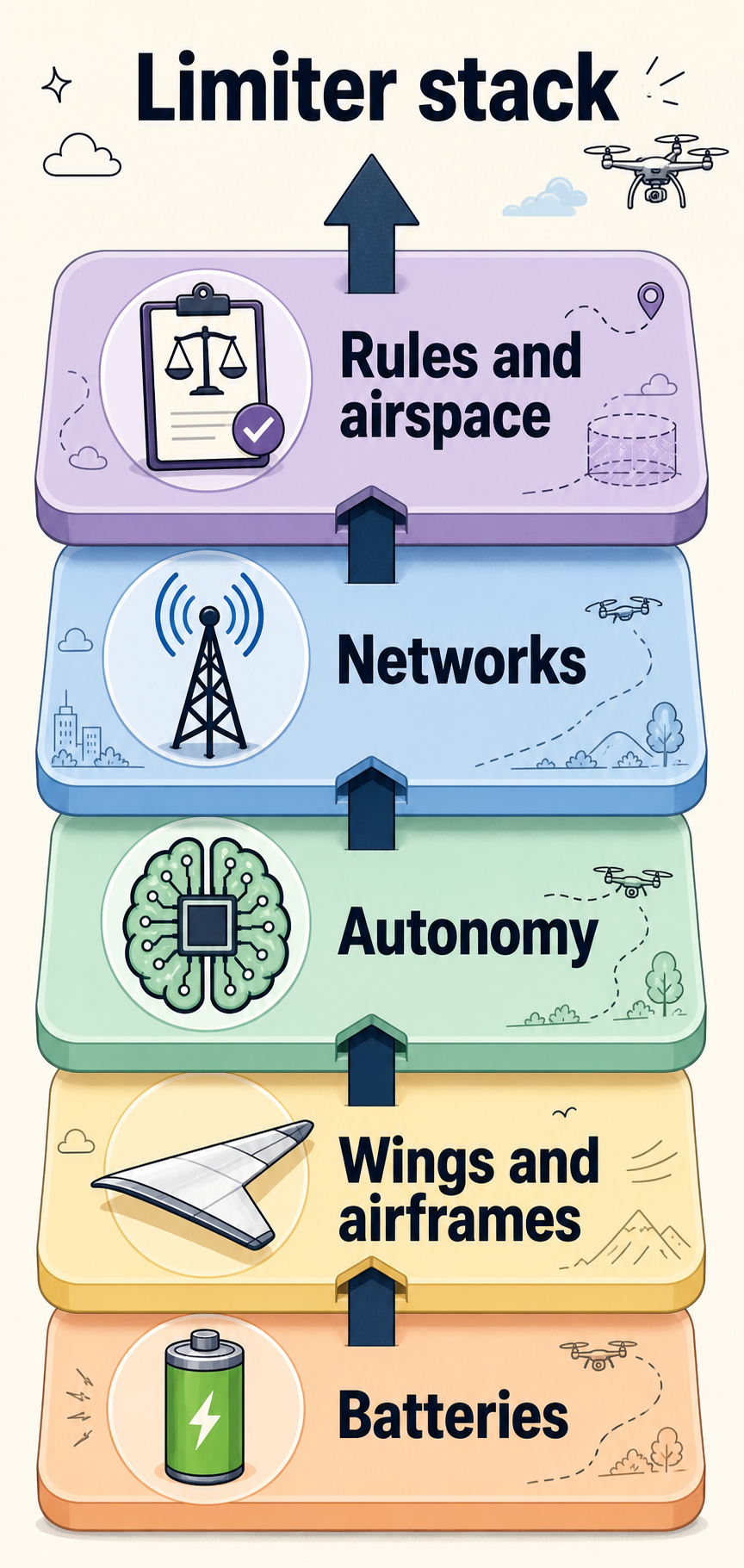
Is battery density the whole story?
❓ Do we mainly need better batteries to unlock the next drone and eVTOL milestones?
Batteries are a central bottleneck — especially for pure-electric hover and passenger eVTOL — but they are not the only gate. A fair answer is: energy storage is necessary for many headlines; autonomy, links, aerodynamics, manufacturing, and law are co-equal for others.
What battery density actually means
Gravimetric energy density is energy per mass, usually watt-hours per kilogram (Wh/kg). Higher Wh/kg means more flight energy for the same battery weight — or the same energy at less weight, freeing mass for payload or structure.
Distinguish:
- Cell-level Wh/kg — the bare electrochemical cell (higher number, lab-friendly).
- Pack-level Wh/kg — cells plus structure, cooling, wiring, battery management, crash protection (the number the aircraft feels). Packs often land roughly in a ~70–85% band of cell energy density depending on design, but the ratio varies.
As of mid-2020s practice:
- Mainstream high-discharge drone Li-ion/LiPo cells commonly sit near ~250–300 Wh/kg class.
- Automotive-derived eVTOL packs are often discussed in the ~200–300 Wh/kg pack conversation depending on chemistry and conservatism.
- Silicon-anode, lithium-metal, and some solid-state claims in 2025–2026 discourse advertise ~450–550 Wh/kg cell territory (company and research claims; verify per datasheet). Production volume, cycle life, charge rate, cold performance, and certification lag the press release.
Trend classification (cells): multi-decade rising curve with chemistry paradigm shifts; recent years show stepwise jumps in specialty cells more than a clean universal doubling every N years at pack-certified aviation grade.
Mechanism: materials science + manufacturing learning + enormous EV R&D spillover into aviation-adjacent packs.
Bottlenecks: thermal runaway risk, cycle life under high C-rate drone profiles, cold weather, supply of lithium/nickel/etc., and aviation certification conservatism.
Next paradigms: advanced Li-ion variants, semi/solid-state, Li-S research, and non-battery energy (hybrid generators, hydrogen fuel cells, liquid fuels for long military endurance).
Reach: the same pack physics gates electric cars, tools, and robots — drones inherit EV progress but suffer more because flight has no “pull over and wait” as easily as a car, and hover wastes energy.
Why eVTOL economics care so much
Passenger missions need reserves, diversion energy, degraded modes, and still enough payload for humans and seats. Below rough conceptual bands often cited in industry debate (~400+ Wh/kg meaningful pack-class performance for comfortable short urban electric VTOL economics — exact thresholds are model-dependent), designs get payload-starved or range-starved. That is why hybrid-electric and hydrogen concepts keep returning for longer missions.
Why battlefield FPV may care less about peak Wh/kg
Attritable attack drones optimize cost, thrust, availability, and seeker performance. A cheap high-C pack that dies after limited cycles can still win a war of mass. Endurance still helps, but dollar-per-effect dominates.
Non-battery enablers that unlock milestones
❓ If not only batteries, what else must happen?
1. Aerodynamics and configuration
Wings beat pure hover for distance. Hybrid VTOL, efficient propellers, lighter composites, and better thermal design multiply any given battery.
2. Autonomy and perception
GPS-denied navigation, reliable detect-and-avoid, precision landing, and onboard target recognition turn a radio airplane into a labor-saving system. AI inference at the edge (small NPUs) is a real 2020s enabler.
3. Connectivity and contested spectrum
Command-and-control needs RF links, mesh relays, or satellite. Jamming and spoofing are first-class design constraints in military use and increasingly in critical infrastructure security analysis.
4. Airspace integration and regulation
BVLOS (beyond visual line of sight), remote ID, UTM/U-space, and powered-lift certification determine whether technology can be a business. As of 2025–2026 commentary, comprehensive U.S. BVLOS rulemaking has been slower than industry wanted; operations continue under waivers and patchwork approvals in many places.
5. Ground infrastructure
Chargers, vertiports, spare batteries, maintenance techs, spare props, and weather services. Aircraft without ops networks are demos.
6. Manufacturing and supply chain
Scaling carbon structures, motors, flight controllers, and secure firmware. Geopolitical decoupling from dominant suppliers is a policy project with cost.
7. Counter-UAS as a coupled milestone
Offense scaled; defense authorities and tech lag in many civil settings. The milestone for safe dense airspace includes mitigation, not only more drones.
Milestone map (capability language)
| Milestone | Unlocks | Status (mid-2026, coarse) |
|---|---|---|
| Cheap stable multirotor control | Consumer/pro imaging | Achieved |
| Useful onboard vision obstacle sense | Safer consumer/enterprise | Widely productized, not perfect |
| Routine BVLOS logistics in mixed airspace | Delivery at scale | Partial — US Part 108 NPRM (2025; comments into early 2026); final rule/effective dates still the watch item; waiver-heavy until implementation |
| Pack energy for profitable short eVTOL hops | Air taxi unit economics | Emerging; contested; pack≠cell |
| Type-certified passenger eVTOL in commercial service | AAM networks | Approaching — e.g. Joby conforming TIA aircraft flying (company: Mar 2026); TC ≠ networks |
| Robust GPS-denied swarm tactics at scale | Military mass autonomy | Mass + fiber-FPV + assists fielded; adaptive multi-agent still uneven |
| Heavy-lift ratios DARPA seeks | Construction/logistics step change | Challenge-driven, not commodity |
| Sustainable C-UAS cost exchange | Defense vs cheap offense | Layered cheap effectors rising; missile-only defense uneconomic |
Round-2 update: BVLOS and energy decision rules
❓ Did round-2 change the “not batteries alone” claim?
Strengthened it. FAA Part 108 BVLOS normalization is real proposed rulemaking (docket FAA-2025-1908), not vapor — but as of mid-2026 sources it was still pre-final / pre-implementation. That is the textbook soft bottleneck with hard commercial teeth.
Energy decision rule of thumb:
- Short quiet frequent → batteries + multirotor
- Long endurance / thin logistics → hybrid and/or wings
- Long loiter with H2 ground support → fuel cell niche
- Passenger eVTOL → pack energy and noise siting and utilization
Deep dive: 10-follow-up-deep-dives.
Good explanation: the real limiter stack
Definition: A flight milestone is reached when energy, control, link, airframe, and legal constraints are jointly satisfied for a mission.
Explanation: Removing only the battery limit still leaves a craft that may not be allowed to fly the route, may lose link, or may be too inefficient in hover.
Different from: Single-factor tech brochures (“500 Wh/kg changes everything overnight”).
Hard-to-vary test: If battery density doubled but detect-and-avoid and rules stayed frozen, urban BVLOS fleets would still stall.
Refutability: A pure battery jump that alone produced nationwide drone delivery without regulatory or autonomy work would refute the stack view.
Reach: Same multi-constraint stack appears in self-driving cars (sensors + AI + law + energy).
Criticism note: For some pure remote sensing missions already legal under VLOS, batteries really are the main user complaint (flight time). Context matters.
Practical takeaway
Yes, explain batteries — they are physics you cannot regulate away. Then immediately add: wings, autonomy, radios, factories, and law. The next iconic milestones (city delivery fleets, everyday air taxis, trustworthy swarms) are system milestones, not cell press releases.