Last updated: 2026-07-23
10 — Follow-up deep dives (research round 2)
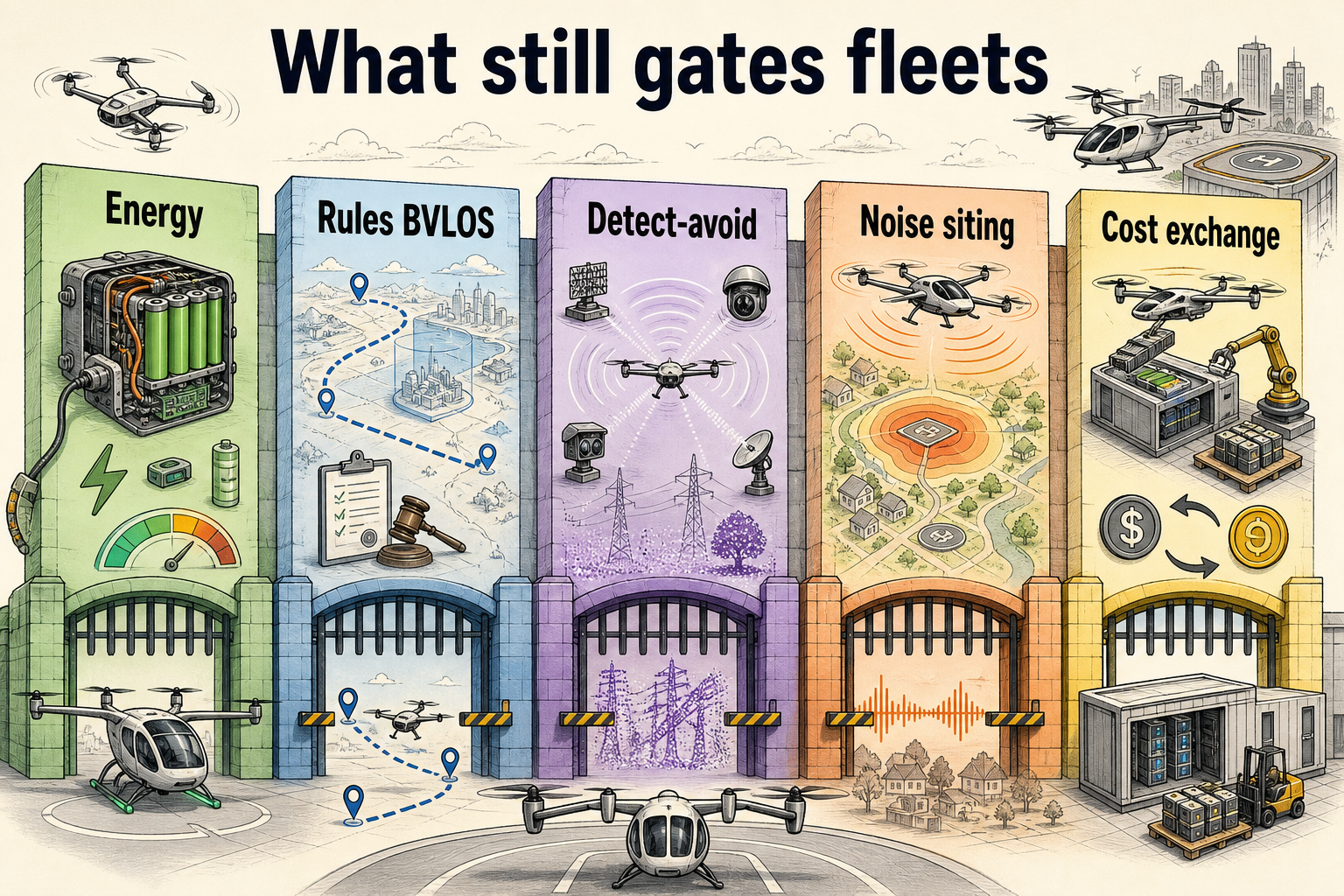
This chapter answers the v2 ledger questions that round 1 left thin: regulation with teeth, unit economics, energy alternatives, certification facts, mass-vs-swarm observables, and cost-exchange warfare. Guiding questions sit under each heading.
BVLOS is real rulemaking — not yet routine freedom
❓ What is the actual US status of Part 108 / BVLOS normalization as of mid-2026?
Answer: The FAA published an NPRM to normalize certain BVLOS UAS operations under a proposed Part 108 framework (docket FAA-2025-1908, RIN 2120–AL82), with Federal Register publication path in August 2025 and a reopened comment period into February 2026. Industry still described Part 108 as in rulemaking through early–mid 2026 — not a finished, fully effective “fly anywhere BVLOS” rule. Executive-order pressure targeted finalization on compressed timelines (industry blogs floated spring 2026 final-rule hopes after shutdown-related slips); treat final effective dates as uncertain until the final rule text and compliance dates publish.
What the proposal aims to do (from FAA materials and secondary analyses of the NPRM):
- Move many low-altitude BVLOS missions out of pure waiver-by-waiver toward performance-based design and operating rules
- Distinguish pathways such as operating permits vs operating certificates under proposed Part 108 subparts
- Touch adjacent parts (security, maintenance, right-of-way debates — including contested proposals about UAS vs manned priority)
- Enable scaled commercial uses: delivery, inspection, agriculture, public safety — if operators meet the package
Implication: Round-1’s claim that BVLOS is a co-equal bottleneck with batteries holds. Capital can build docks and aircraft faster than law can finish and implement. Waivers still train the industry; rules of the road are what multiply fleet density.
❓ How do waivers vs rules scale economics differently?
Waivers are bespoke safety cases — slow, lawyer-heavy, hard to clone across cities. A stable Part 108 (or equivalent) is a productizable compliance recipe. Until final rule + implementation lag complete, unit economics models that assume nationwide autonomous delivery density are scenario analysis, not baseline.
Falsifier: A published final Part 108 with clear effective dates and early large-scale approvals without equivalent waivers would upgrade BVLOS from “soft bottleneck” to “solved gate” for those mission classes.
Delivery economics: when drones beat vans
❓ For which missions does drone delivery win on total cost?
Public secondary estimates in 2024–2026 still disagree by an order of magnitude, which itself is evidence the market is early:
- Operator/analyst bands often cite roughly $5–$30 per delivery at current volumes depending on density and distance
- Optimistic operator narratives talk about paths below $5 and customer willingness above $20 in some niches
- Some market notes claim sharper declines toward low single-digit dollars — treat as forward-looking, not audited universal cost
Where drones structurally win:
- Sparse last meters with bad roads — islands, rural clinics, disaster zones (Zipline-class medical logistics logic).
- Time-critical small payload — blood, AEDs, spare parts for halted lines — value of time >> energy cost.
- High vertical friction — towers, ships, multi-story campuses where elevator/van loops are slow.
Where vans still win: dense grocery bags, bulk, weather-heavy markets, doorstep handoff complexity, multi-stop route density.
❓ Why medical corridors before pizza?
Willingness-to-pay and liability framing differ. A blood unit’s value density is extreme; pizza’s is not. Regulators and hospitals also accept narrow corridor concepts earlier than city-wide consumer airspace.
Docked autonomy (nests that charge and auto-launch) attacks pilot OPEX, which often dominates hobbyist-style one-pilot-one-drone delivery more than airframe price.
Energy decision rules (battery vs hybrid vs hydrogen)
❓ When do hybrids or hydrogen beat better batteries alone?
Battery multirotor: wins on simplicity and cost for short, frequent, quiet missions. C-rate and cycle life under climb/hover profiles trash naive lab Wh/kg.
Hybrid-electric / gas-electric VTOL cargo: wins when hours of endurance or poor charging logistics dominate (pipeline patrol, long island hops). Architecture (wings) still usually beats chemistry.
Hydrogen fuel cell UAV: public demos repeatedly show multi-hour endurance for ISR/logistics niches. The tax is ground logistics (H2 storage, refill, certification, leak/safety culture). Choose hydrogen when energy per mass on long loiter beats the base footprint — not for backyard delivery.
eVTOL air taxi: pack Wh/kg + reserves + noise + utilization co-gate. A cell breakthrough that does not survive pack integration and certification does not move ticket prices.
❓ What would falsify “batteries gate urban air taxis forever”?
Sustained commercial passenger networks with healthy utilization and ticket prices competitive with premium ground options using only incremental Li-ion packs would falsify strong battery-gating claims. Conversely, repeated slips blamed primarily on energy/reserves while certification paperwork is done would strengthen them.
Passenger eVTOL: certification with primary anchors
❓ Where is Joby, with company-primary evidence?
Joby Aviation (company news, 2025–2026):
- Progressed conforming aircraft toward Type Inspection Authorization (TIA) — described by the company as part of the final stage of type certification
- November 2025: power-on of first FAA-conforming TIA aircraft
- March 11, 2026: first FAA-conforming TIA aircraft in flight (N547JX); Joby pilots first; FAA pilots expected later in 2026 for for-credit TIA
- Multiple conforming aircraft planned for the TIA fleet
This upgrades round-1’s “deep in Stage 4” narrative to a sharper primary fact: conforming metal is flying; type certificate is still not the same as commercial networks.
Archer and peers remain on related powered-lift paths; compare with their own primary releases rather than scoreboard blogs.
❓ Is noise a certification footnote or a product killer?
Both. Regulators are writing noise criteria for VTOL-capable aircraft (e.g. EASA NPA activity; national proposals such as ANAC criteria processes for specific types). Metrics in the helicopter/airplane tradition use EPNL / EPNdB-style evaluations for takeoff, overflight, approach — often mass-dependent formulas in rotorcraft regs, with VTOL-specific adaptations emerging.
Community acceptance studies (including OEM-partnered perception work) treat close-in urban repetition as the hard problem: one demo flight ≠ 40 ops/hour at a vertiport. Siting and curfews can kill a business case that clears type design.
Military: mass, fiber FPV, and cost exchange
❓ What observables separate swarm from salvo or mass FPV?
Use this field test:
| Observable | Mass / salvo / many pilots | Stronger swarm claim |
|---|---|---|
| Loss of N vehicles | Mission ends or humans retask each unit | Remaining agents reallocate tasks |
| C2 | One link per vehicle or pre-briefed waves | Shared state, multi-hop, role election |
| EW hit | Fleet blinds | Local autonomy or non-RF links continue |
| Operator ratio | ~1:1 or small teams | One intent → many effectors |
Ukraine 2024–2026 shows industrial mass plus rapid autonomy/seeker assists, not only science-fiction clouds. Production scales cited in open analyses run to millions of units per year class targets — that is a factory story.
❓ How did EW change the stack?
Fiber-optic FPV (physical fiber spool, no RF C2 to jam) became a major subset of munitions delivery in jammed sectors. Open reporting describes Russian and Ukrainian adoption cycles, ranges to tens of km class on long fiber, and sector shares where fiber is a large fraction of FPV ops. Tradeoff: cable snag, spool mass, logistics — but RF silence is decisive where jammers win.
That is a strong convergence of cheap multirotors + materials + EW pressure — not a battery story.
❓ Who wins the cost-exchange ratio?
Against $20k–$50k one-way attack drones, million-dollar-class missile intercepts produce attacker-favorable ratios (often cited from tens:1 to thousands:1 depending on interceptor). Sustainable defense trends toward:
- cheap interceptor drones
- guns / directed energy where geometry allows
- EW (until fiber/autonomy blunt it)
- layered architectures
This is why C-UAS is a first-class EmTech neighbor to drones themselves.
Flying cars: what Alef’s certificate actually is
❓ Did Alef get “certified as a flying car for consumers”?
No. In 2023, FAA issued a special airworthiness certificate in the experimental family for Alef’s program aircraft — enabling limited purposes such as research and development and exhibition, not unrestricted commercial passenger carriage or a production type certificate. Company and press language sometimes blurs “FAA approval to fly experimentally” into “certified flying car.”
General rule (FAA): special airworthiness (Form 8130-7 categories including experimental) ≠ standard category type certificate for production airline-like ops.
Road legality is a separate motor-vehicle regime. Concurrent production road + production aircraft certificates at scale remains the dual-mode falsifier from the v2 ledger — still unresolved.
ASKA hybrid long-range claims require believing the generator + battery energy story and eventual dual-domain compliance; keep them in the vendor claim bucket until flight-test and cert primary docs show otherwise.
BlackFly-class ultralight-adjacent paths trade training burden for mass/endurance limits and jurisdiction-specific legality — externalities (noise, overflight of people) do not vanish because marketing says “easy.”
Where value accrues (moat map)
❓ Is the moat airframes, sensors, software, or data?
| Layer | Moat strength 2026 | Notes |
|---|---|---|
| Commodity multirotor airframe | Weak | China scale, clones |
| Integrated camera drone UX | Strong for leader | DJI-class systems engineering |
| Enterprise payloads + RTK/LiDAR stack | Medium–strong | Workflow lock-in |
| Dock + fleet software | Rising | Recurring revenue |
| Inspection models/data | Rising | Vertical AI |
| Certified passenger eVTOL | Very strong if achieved | Regulatory moat |
| Military mass production + EW-resilient C2 | National-industrial | Not a startup toy |
Bits vs atoms (P12): If the decision only needs information, sense and transmit (drone as IoT) beats flying the atom (delivery). Delivery must clear a higher economic bar every time.
CFO checklist 2026–2028
❓ What would a skeptical CFO fund vs avoid?
Fund / pilot: docked inspection fleets under clear airspace; medical/logistics corridors with paid customers; hybrid long-endurance survey; C-UAS layered defense for critical sites; software that cuts pilot ratio.
Avoid / haircut hard: nationwide pizza drones assuming final BVLOS and perfect weather; dual-mode flying-car volume production before dual certificates; passenger eVTOL unit sales models that ignore utilization and noise siting; “swarm” products that are waypoint scripts.
Unresolved after round 2
| ID | Item | Status |
|---|---|---|
| U1 | Pack Wh/kg on conforming eVTOL | Still thin publicly — cell≠pack |
| U2 | Fielded true adaptive lethal swarms counts | Still OSINT-limited |
| U3 | Single global commercial TAM | Still analyst-divergent — use bands |
| U4 | Steady-state air-taxi fare vs rideshare | Model-dependent |
| U5 | Dual-mode production road+air certificates | Still open |
| U6 | Part 108 final effective date | Watch item — NPRM done; final pending |
| U7 | Audited $ per delivery by operator | Sparse primary disclosure |
Round-2 core mechanism addendum
Scaling uncrewed aviation is less “better quadcopters” than closing a stack: energy architecture × detect-and-avoid × finished rules × cost-exchange defense × noise-compatible siting. Round 1 explained the machines; round 2 explains why fleets lag demos.