Last updated: 2026-07-23
01 — What drones, UAVs, and eVTOLs are
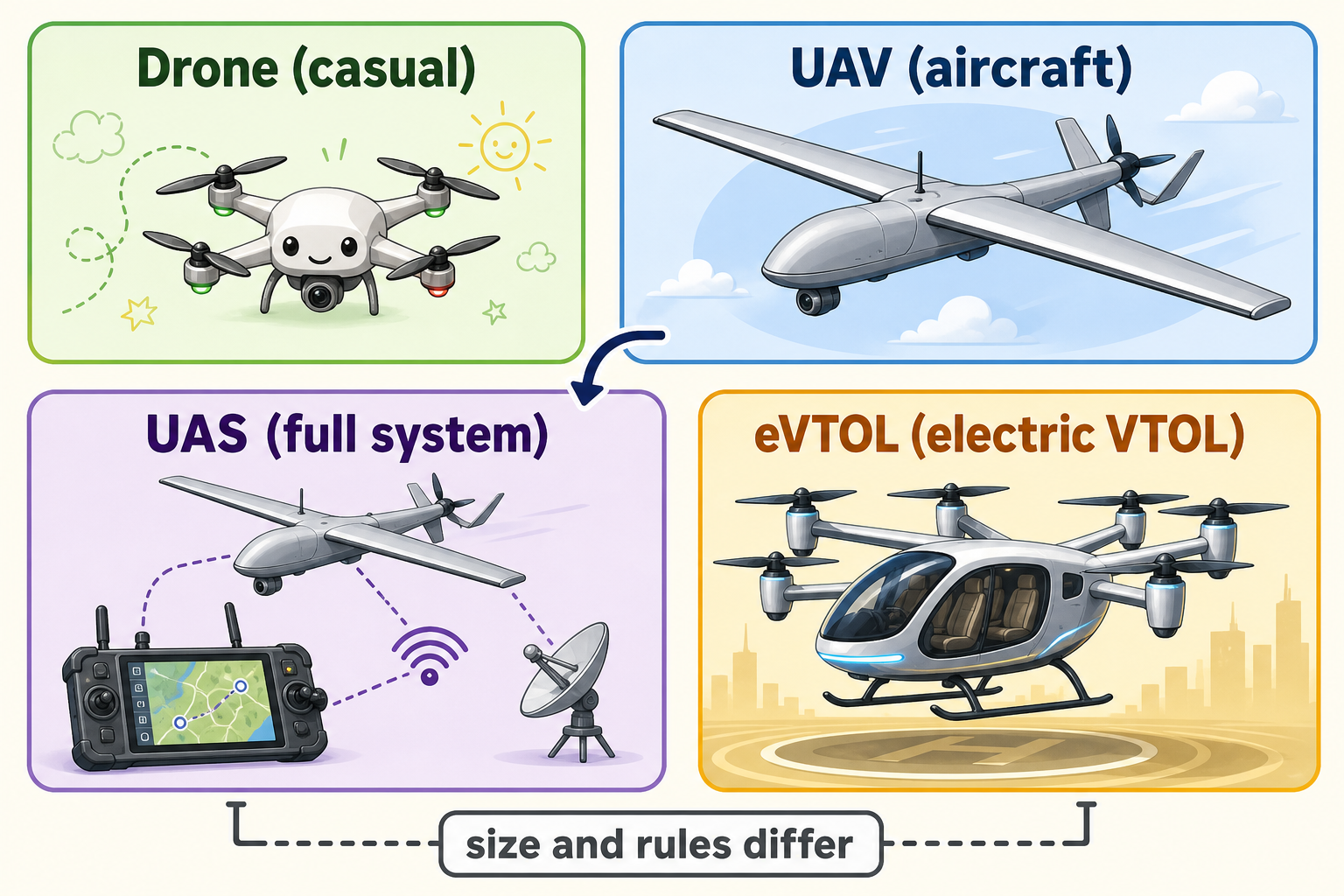
Three labels for related machines
❓ What is a drone, how does it relate to UAV and UAS, and where do eVTOLs fit?
Drone is the everyday word. It covers almost any flying machine without a person on board — a toy, a cinema hexacopter, a one-way attack munition people still call a “kamikaze drone,” or a high-altitude military spy plane. The word is convenient and imprecise.
UAV (unmanned aerial vehicle) is the technical name for the aircraft itself: a powered flying machine that uses aerodynamic lift, has no onboard human pilot, and can be recovered or expended while carrying some payload. Military and regulatory documents prefer UAV (or “uncrewed aircraft”) because it is narrower than “drone.”
UAS (unmanned aircraft system) is the whole package: UAV + ground control station + data links + launch/recovery and support gear. Regulators emphasize UAS because safety depends as much on the pilot interface and the radio link as on the airframe. Related terms include RPAS (remotely piloted aircraft system) when a human is always in the loop.
A clean mental model: the UAV is the car; the UAS is car + keys + GPS + mechanic + radio. “Drone” is saying “ride.”
Why this is a good explanation
Definition: UAV = uncrewed aircraft; UAS = aircraft + control and support system; drone = informal superordinate.
Explanation: Missions fail from lost links, bad geofencing, or ground-station errors as often as from broken propellers — so the system boundary is not decorative.
Different from: Calling every multirotor an “eVTOL product” collapses size, manning, and certification.
Hard-to-vary test: If you drop “ground station and link,” you cannot explain why BVLOS rules, spectrum, and pilot training dominate commercial scaling.
Refutability: Falsified if regulators certified only bare airframes with no system-level requirements (they do not).
Reach: Same pattern appears in robotics (robot vs robot system) and spacecraft (probe vs ground segment).
Criticism note: Casual speech will keep saying “drone”; pedantry helps only when law or architecture is at stake.
eVTOL is a propulsion-and-mission label, not a synonym for drone
❓ How is an eVTOL different from a drone or UAV?
eVTOL means electric vertical take-off and landing: electric (or primarily electric) power, and the ability to leave and return without a runway. Many camera multirotors literally are small eVTOL UAVs. In industry and media, though, “the eVTOL sector” almost always means large advanced air mobility (AAM) aircraft — often designed to carry people — aiming at type certification comparable in spirit to helicopters or small airliners.
| Axis | Typical small drone / UAV | Typical passenger eVTOL narrative |
|---|---|---|
| Mass | Grams to tens of kg (often <25 kg / <55 lb class) | Order of 1,000+ kg class aircraft |
| People onboard | None | Pilot and/or passengers (some paths target later autonomy) |
| Safety bar | Hobby / Part 107-like small UAS rules | Powered-lift type certification, airline-like residual risk targets |
| Job | See, sense, spray, deliver small parcels, fight | Move people (or large cargo) in city/regional corridors |
| Unit price | Hundreds to low tens of thousands USD | Millions USD per aircraft (OEM target economics, not toy pricing) |
Overlap is real: unmanned cargo eVTOLs and heavy multirotors sit in the middle. Category collapse is wrong: a 249 g selfie quadcopter and a five-seat air taxi share motors and batteries the way a bicycle and a bus share “wheels.”
An eVTOL can be uncrewed; a UAV can use eVTOL lift. The distinguishing questions are who is onboard, how heavy, and which safety case.
A journalist photographs a Joby prototype and a DJI Mini on the same tarmac and captions both “electric flying cars of the future.” One is chasing type inspection authorization; the other is a sub-250 g camera. Same physics family, different civilization of rules.
Lift families inside the drone world
❓ What airframe types hide under the single word “drone”?
- Multirotor — hover-native, agile, short endurance (most consumer units).
- Fixed-wing — airplane-like; needs space to launch/land or a catapult/net; long range.
- Single-rotor helicopter UAV — efficient hover and heavy lift for size; more mechanics.
- Hybrid VTOL — vertical takeoff then wing-borne cruise (tailsitters, tilt-rotors, lift+cruise).
- Lighter-than-air / exotic — niche persistence platforms.
Military systems add jet MALE/HALE (medium/high altitude long endurance) and one-way attack designs that blur into cruise missiles and loitering munitions. A recoverable ISR UAV is not the same legal or technical object as an expendable munition, even when both are called drones on television.
Practical takeaway
When someone says “drone,” ask four follow-ups: manned or not, how heavy, how it makes lift, and under which rule set. Those four answers place the machine on the map from toy to air taxi to weapon — and stop eVTOL marketing from being confused with the multirotor in a holiday catalog.