Last updated: 2026-07-23
02 — Why a drone is not just an electric helicopter
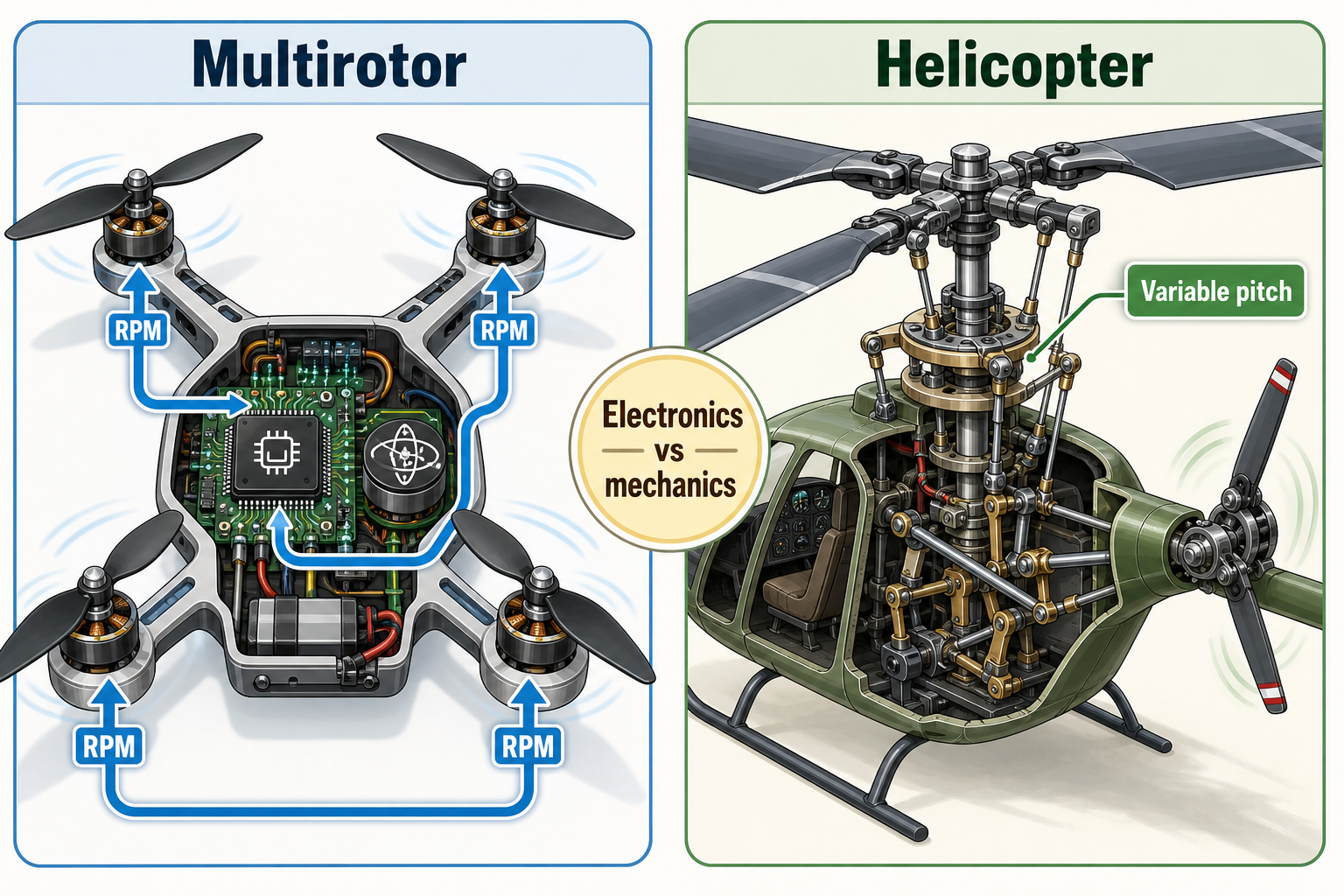
The tempting mistake
❓ If both hover with rotors and many drones are electric, why aren’t multirotor drones simply small electric helicopters?
They both fight gravity with spinning blades and can hang still in the air. That is where the similarity mostly ends. A conventional helicopter and a quadcopter solve control and mechanical design in almost opposite ways. Confusing them hides why drones exploded in price-performance and why they still lose to helicopters (and airplanes) on efficiency at larger scales.
Helicopters: variable pitch, mechanical cleverness
❓ How does a classic helicopter steer and stay efficient?
A typical helicopter uses one large main rotor (sometimes two) whose blades change pitch — the angle of attack — many times per revolution through a swashplate and linkages (collective and cyclic control). A tail rotor or other anti-torque system counters the fuselage’s desire to spin. Lift and thrust vectoring are largely mechanical. The large, slow(er) disk is aerodynamically efficient in hover: big rotors move a lot of air a little bit, which costs less power than small rotors blasting air downward hard (momentum theory / induced power).
Electric power can drive a helicopter rotor; “electric helicopter” is a real category. The defining helicopter trait is variable-pitch rotorcraft mechanics, not the fuel type.
Multirotors: fixed pitch, electronic bandwidth
❓ What actually steers a quadcopter?
Most consumer and many commercial multirotors use fixed-pitch propellers. Each motor’s speed (RPM) is the control knob. To roll right, opposite motors speed up or slow down in a coordinated pattern; yaw uses torque imbalance between clockwise and counterclockwise props; climb is “all motors harder.” There is no swashplate on a Phantom-class quad.
That only works if you can measure orientation and correct it fast. Cheap MEMS inertial measurement units (tiny gyros and accelerometers), barometers, magnetometers, GNSS, and later vision/optical-flow sensors feed a flight controller that adjusts motor commands hundreds to thousands of times per second. Brushless outrunner motors and ESCs (electronic speed controllers) made the actuators cheap and responsive.
Hoffmann and colleagues summarized the design bet clearly in early quadrotor research: skip complex rotor linkages; use multiple smaller fixed-pitch rotors and motor-speed control; accept different efficiency and safety tradeoffs (including lower per-rotor kinetic energy than one giant blade in some regimes).
Definition: A multirotor drone is a rotorcraft that primarily modulates motor thrust on multiple fixed-pitch rotors under high-rate feedback control.
Explanation: Digital control bandwidth substitutes for mechanical pitch articulation.
Different from: A helicopter UAV that still uses collective/cyclic on a main rotor.
Hard-to-vary test: Swap “variable pitch” back in as the only control and you recreate helicopter complexity and cost; remove high-rate sensing and a fixed-pitch quad cannot stabilize.
Refutability: If fixed-pitch quads could hover stably with open-loop motor settings alone, the IMU/computer story would be wrong.
Reach: The same “replace mechanisms with sensors + software” pattern appears in camera gimbals, balancing robots, and many modern actuators.
Criticism note: Some advanced multirotors and eVTOLs do use variable pitch or complex tilt mechanisms — hybrids exist; the mass-market story is still fixed-pitch + electronics.
Why the swap mattered economically
❓ Why did this architecture unlock consumer drones?
Variable-pitch heads are precision machines: machining, bearings, maintenance, failure modes. Fixed-pitch props are injection-molded commodities. Once phones and game controllers drove MEMS sensor cost toward cents-to-dollars, and lithium batteries plus brushless motors rode the same consumer electronics curve, a stable hover machine became a bill of materials problem, not a lifetime rotorcraft apprenticeship.
That is the abundance mechanism: not “electricity” alone, but digitization of flight control.
Why it is still not a free lunch
❓ If multirotors are simpler, why don’t we fly airliners that way?
Hovering on small rotors is power-hungry. Endurance of pure multirotors is often measured in tens of minutes, not hours, unless the craft is huge, hybrid, or lightly loaded. As vehicles scale toward passenger mass, designers migrate toward:
- Larger rotors / helicopter-like disks for hover efficiency,
- Wings for cruise (lift+cruise, tilt-rotor, tilt-wing),
- Distributed electric propulsion that may still look “multi-rotor” at takeoff but behaves like an airplane in cruise.
So passenger eVTOLs often look like cousins of drones at a glance — many props — yet their mission physics are “helicopter takeoff, airplane cruise, certified transport,” not “hovering camera.”
Single-rotor helicopter UAVs remain attractive for heavy lift, wind tolerance, and endurance in niches where the mechanical complexity pays for itself.
Side-by-side
| Feature | Typical multirotor drone | Typical helicopter (incl. many RUAV helis) |
|---|---|---|
| Blade pitch | Fixed (common) | Variable (collective/cyclic) |
| Control | Differential RPM | Swashplate geometry + throttle |
| Parts count (rotor head) | Low | High |
| Hover efficiency at small size | Good enough | Often better disk loading design space |
| Hover efficiency at large size / heavy | Poor unless many/large rotors | Strong traditional solution |
| Cruise | Weak without wings | Better with speed; still rotor-limited vs airplane |
| Maintenance skill | Electronics + props | Full rotorcraft mechanics |
| Path to cheap toys | Yes | Rare |
Practical takeaway
Call a quadcopter an electric multirotor under feedback control, not a miniature Robinson R22. The helicopter comparison is useful for hover intuition and for efficiency limits; it is misleading for how the machine is built and priced. eVTOL air taxis then re-introduce airplane and helicopter lessons at certified scale — which is why they are expensive, slow to approve, and not “the same product category as a Mavic.”