Last updated: 2026-07-23
03 — History: from balloons to FPV wars
Pre-history and the first uncrewed weapons
❓ When did “unmanned air attack” begin, long before the word drone?
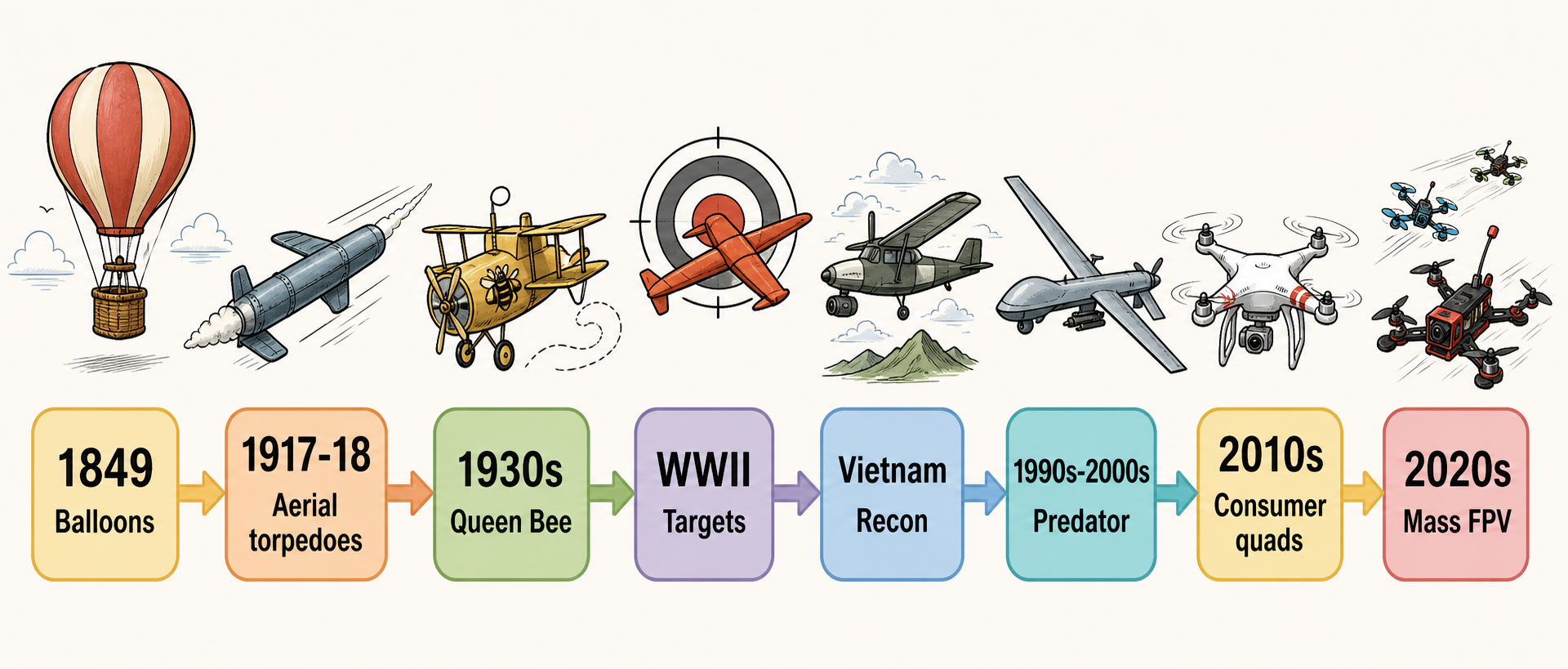
In July 1849, Austrian forces besieging Venice launched explosive balloons — an early attempt to deliver harm without a pilot. Guidance was weather, not radio. The episode matters as a reminder: the dream of striking from the air without risking an aircrew is older than airplanes.
World War I: radio, gyros, aerial torpedoes
❓ What did the first pilotless airplanes actually try to do?
In 1917–1918, Britain and the United States raced toward radio-controlled and gyro-stabilized flying weapons. Britain’s experiments (including work associated with A. M. Low’s radio guidance) and the U.S. Hewitt-Sperry Automatic Airplane and Kettering Bug aimed at “aerial torpedoes” — ancestors of cruise missiles more than of recoverable scouts. None reshaped that war’s outcome; the components (radio control, autopilot gyros, airframes) seeded everything later.
The Kettering Bug was meant to fly a pre-set course and dive on a target. Recoverability was not the point. Today’s one-way attack drones rhyme with that idea more than a return-to-home quadcopter does.
Interwar and WWII: the word “drone” and mass targets
❓ Where did the word “drone” come from, and what scaled in WWII?
In the 1930s, Britain’s de Havilland DH.82B Queen Bee radio-controlled target aircraft helped popularize “drone” (a male bee serving the queen — a linguistic wink at the pilotless follower). The U.S. built large numbers of Radioplane target drones (Reginald Denny’s line; the OQ-2 and successors). Hollywood footnote: Marilyn Monroe was photographed in war work at Radioplane — a cultural breadcrumb, not a technical milestone.
WWII also saw assault drone and television-guided experiments (e.g., U.S. Navy TDR-1 concepts). Results were mixed; television guidance and remote control practice mattered more than tonnage sunk.
Cold War to Vietnam: reconnaissance at scale
❓ When did UAVs become serious intelligence tools?
Jet target drones evolved into reconnaissance platforms. In Vietnam, modified Firebee-family drones flew thousands of sorties for surveillance, with recovery rates high enough to prove operational value (Smithsonian and standard histories cite on the order of tens of thousands of missions for the broader family over the Southeast Asia years). The lesson: uncrewed aircraft excel at dull, dirty, dangerous collection when links and recovery work.
1970s–1990s: doctrine and the road to Predator
❓ What changed between target drones and modern MALE UAVs?
Israel’s operational use of UAVs (including Scout-class systems in the early 1980s) advertised battlefield reconnaissance without manned risk. The U.S. path ran through programs like Amber toward the MQ-1 Predator (significant operational use from the mid-1990s) and later the larger, armed MQ-9 Reaper. Satellite communications enabled remote split operations — pilots in one country, aircraft over another — a systems revolution as much as an airframe one.
2006–2016: civil airspace and the consumer multirotor boom
❓ When did drones leave the base and enter the shopping cart?
Civil milestones clustered in the 2000s–2010s: early FAA disaster and commercial authorizations (mid-2000s onward), film industry waivers, and then a flood of small multirotors. DJI and peers productized GPS hold, stabilized cameras, and app control. The Phantom generation turned aerial video from helicopter-charter budget into weekend gear. By the mid-2010s, smart obstacle sensing and computer vision (e.g., Phantom 4 era marketing of vision features) began the onboard-autonomy consumer arc.
Regulators responded with registration, line-of-sight rules, weight thresholds (including the culturally huge sub-250 g class in some regimes), and remote ID debates.
2020s: industrial war and the eVTOL certification crawl
❓ What does the present era add that earlier decades lacked?
Two parallel stories dominate the 2020s:
-
Mass attritable drones in high-intensity war — especially the Russia–Ukraine conflict — normalized FPV attack craft, one-way strike UAVs, and frantic counter-UAS innovation. Quantity, electronic warfare, and rapid iteration outran exquisite multi-million-dollar platforms for many tactical jobs.
-
Advanced air mobility — Joby, Archer, and others grind through powered-lift certification while cities experiment with corridors, vertiports, and public acceptance. Schedules slip; the engineering is real; the operational utility is still emerging.
Meanwhile commercial inspection, agriculture, mapping, and delivery pilots matured under still-fragmented BVLOS rules.
Tech-tree spine (compressed)
- Unpowered free balloons → guided only by wind
- Radio + gyro aerial torpedoes (WWI)
- Target drones and mass production (WWII)
- Recoverable jet recon drones (Cold War/Vietnam)
- Tactical battlefield UAVs and satcom MALE (1980s–2000s)
- MEMS + LiPo + brushless multirotors (consumer 2010s)
- Vision/AI assistance and enterprise fleets
- Attritable FPV / one-way mass + swarm research (2020s)
- Certified electric VTOL transport (in progress)
Each step creates a new problem: jamming, airspace integration, battery limits, ethics of remote force, counter-drone arms races.
Practical takeaway
Drones are not a 2013 invention. They are a century of guidance and airframe experiments that suddenly met phone-era electronics and, later, wartime mass production. Consumer history is a late chapter; military recovery and expendability debates are the long novel.