Last updated: 2026-07-23
04 — Trends: price, range, speed, payload
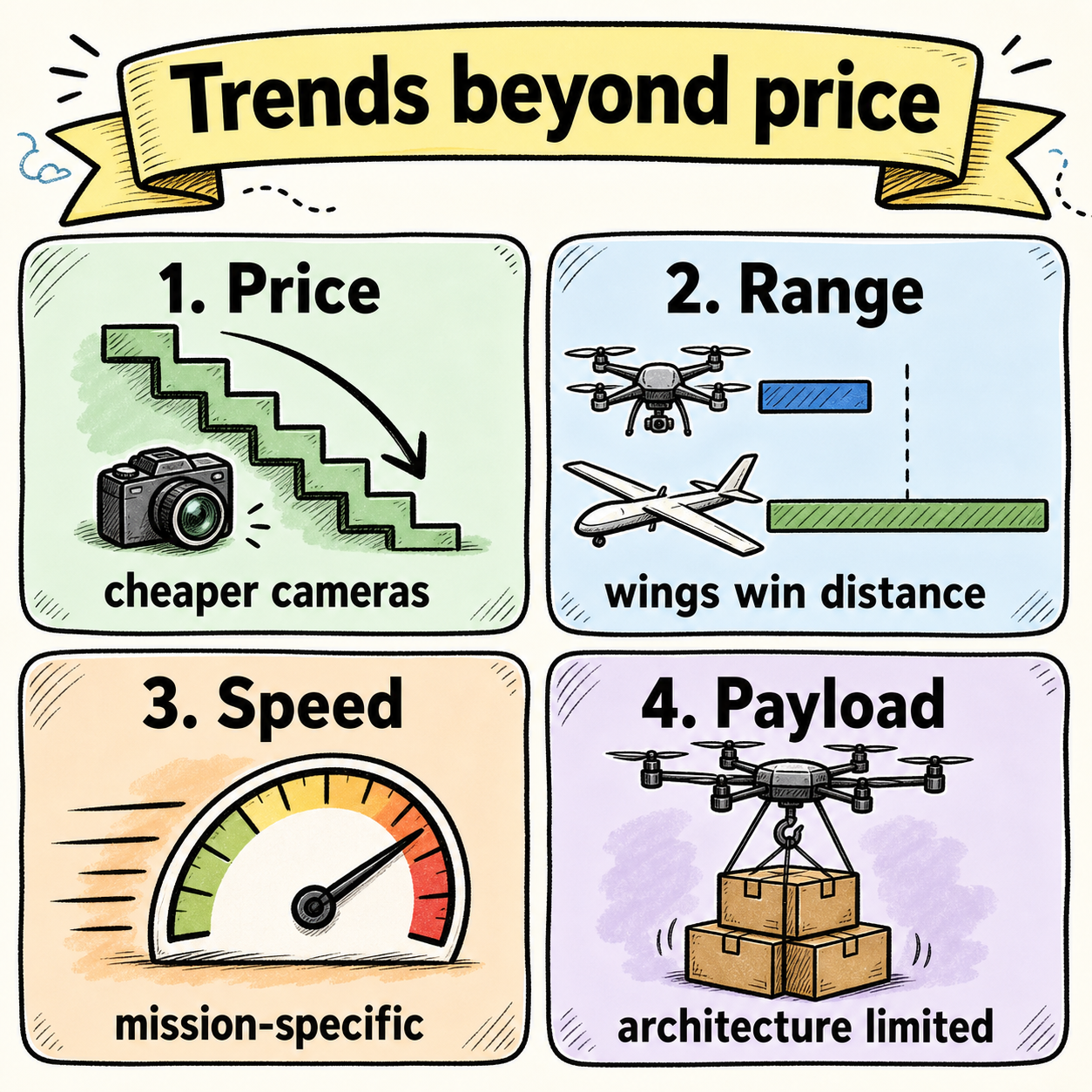
Price collapse (and its limits)
❓ How far have drone prices fallen, and is the whole market getting cheaper forever?
Trend classification: consumer hardware price-performance — logistic / paradigm-limited exponential in components, not a single endless S-curve for “all drones.”
Metric: Dollars per unit of usable aerial capability (stabilized 4K-class imaging, obstacle sensing, flight time, ease of use).
Period: roughly 2012–2026 for multirotor cameras.
Pattern: Early ready-to-fly camera quads cost on the order of $1,000+ for then-impressive but fragile systems; by the mid-2020s, capable beginner and travel drones sell from roughly $200–$800, strong prosumer kits around $800–$2,200, and enterprise airframes with RTK, multiple sensors, or heavy lift from low five figures into six figures. DJI US list snapshots in mid-2026 still span roughly hundreds of dollars (mini class) through ~$2k prosumer kits up into enterprise five-figure systems (e.g. high-end Matrice / delivery class SKUs in public price tables).
Mechanism: Shared consumer electronics stack — MEMS sensors, application processors, Li-ion/LiPo cells, brushless motors, global manufacturing scale (especially China), and software that turns unstable airframes into app products.
Bottlenecks: Airframe physics, batteries, radios, and regulation do not fall at Moore’s law rates. Passenger eVTOL and certified aircraft remain million-dollar-class programs. Security-driven bans or tariffs can raise prices in some markets even as global BOM falls.
Reach: Same component deflation feeds robots, AR headsets, and IoT — drones are one beneficiary.
Consumer market caveat: Unit growth is not pure hockey stick. U.S. hobby registration and analyst notes already flagged stagnation episodes around the late 2010s after the first novelty wave. Enterprise, agriculture, defense, and public safety can grow while living-room toys plateau.
Market size (order-of-magnitude only): Analyst houses disagree. Commercial drone market figures cited for the mid-2020s often land in the low-to-mid tens of billions USD with high-single-digit to low-double-digit CAGRs depending on inclusion rules; consumer is smaller. Treat any single TAM slide as a scenario, not a census.
Range and endurance
❓ Why do some drones cross countries while others die in twenty minutes?
| Class | Typical endurance / range order | Why |
|---|---|---|
| Consumer multirotor | ~20–45 min; few km practical under VLOS/rules | Hover power + small battery |
| FPV freestyle / racing | Often shorter; high power draw | Thrust-to-weight over efficiency |
| Enterprise multirotor | Similar minutes; better weather margins | Still rotor hover physics |
| Logistics multirotor (e.g. ~30 kg class) | Often ~15–25 min loaded | Payload trades directly with time |
| Fixed-wing small UAV | Hours; tens to hundreds of km | Wings carry weight |
| Hybrid VTOL long-endurance | Vendor claims up to many hours / 100–300+ km class on specific models | Vertical takeoff + wing cruise |
| MALE military (Predator/Reaper family) | Half-day+ on station with fuel engines | Hydrocarbon energy density |
| HALE / specialty | Day-scale or more (design-dependent) | Altitude, efficiency, sometimes solar |
| Passenger eVTOL design missions | Often tens of miles to ~150+ mi design range; short urban hops optimized | Battery + reserves + certification |
Trend classification: range for battery multirotors — slow / near-logistic without architecture change; range for the product category overall — stepwise via fixed-wing, hybrid VTOL, fuel, and better packs.
Hybrid VTOL cargo UAVs (examples in trade press: long-endurance CW-class platforms advertising multi-hour flight and 25–50 kg payload bands) show the architectural leap: stop hovering for the whole mission.
Speed
❓ How fast do drones go?
- Camera multirotors: often ~30–70+ km/h cruise envelopes; not the point of the product.
- FPV racing: much faster in short bursts; sport and military FPV attack craft exploit speed + agility.
- Military turboprop/jet UCAVs and targets: hundreds of km/h to jet speeds.
- Passenger eVTOL claims: cruise often marketed around ~150–200+ mph (≈240–320+ km/h) for leading tilt designs (e.g. Joby S4 public figures in that band), far above hover-drone norms but below airliners.
Trend classification: top speed — not the primary exponential story. Useful speed is mission-specific; autonomy and routing matter more than drag races for logistics.
Payload and heavy lift
❓ How much weight can drones carry, and what is the frontier?
- Consumer: camera and gimbal measured in grams to low hundreds of grams.
- Pro/enterprise multirotor: sensors, small drop packages — kilograms.
- Delivery / mid heavy multirotor: public examples like DJI FlyCart 30 class — on the order of ~30 kg payload with short endurance (~18 min class in third-party summaries).
- Industrial heavy multirotor: specialist platforms claiming 100–200+ kg, with flagship marketing examples up to ~500 lb (≈227 kg) class (e.g. Griff Aviation 300 cited in industry roundups) at high six-figure prices.
- Hybrid / fixed-wing cargo: tens of kg over long range, or larger experimental logistics.
- Passenger eVTOL: human payloads (multi-passenger) — a different certification universe.
- Military sling / converted platforms: can exceed commercial multirotor norms.
DARPA Lift Challenge (announced path into 2026 trials): seek aircraft ≤55 lb including fuel/power that lift ≥110 lb over a set course — a >2:1 and program goal toward ~4× payload-to-vehicle emphasis. That is an explicit admission that today’s ratio is the bottleneck.
Trend classification: payload — stepwise by architecture and power source; not a smooth Moore curve.
Autonomy and operations (the quiet trend)
❓ Besides the airframe, what capability curve reshapes value?
Waypoint missions, terrain follow, precision agriculture patterns, automated inspection orbits, docking, and partial obstacle avoidance moved from research to product features. The binding constraint for economic autonomy is often BVLOS approval, detect-and-avoid, and spectrum, not whether the autopilot can hold a square.
Trend classification: onboard autonomy features — rapid stepwise productization; regulatory operational envelope — slower, jurisdictional, logistic.
China concentration as a structural trend
❓ Who owns the commercial small-drone stack?
Multiple U.S. policy and industry analyses through 2025–2026 still describe DJI as holding a dominant share of consumer and a large share of commercial small UAS globally (figures such as ~70–90% in various segments appear in secondary reports — treat as approximate). That is a geopolitical and supply-chain trend, not just a brand story: alternatives exist but often lag on price-performance, and security restrictions can fragment the market.
Contrarian balance
❓ What looks like a trend but may be hype?
- “Everything will be delivered by drone next year” ignores energy cost per tonne-km, weather, noise, and doorstep complexity.
- Endless consumer growth ignored saturation and regulation.
- eVTOL timelines have repeatedly slipped; certification depth is real progress, passenger networks are not yet ubiquitous utilities as of mid-2026.
- Battery breakthrough headlines often quote cell Wh/kg, not certifiable packs with cycle life and thermal margins.
Round-2: delivery unit economics
❓ What does public evidence say a drone delivery costs?
Secondary 2024–2026 estimates still span roughly ~$5–$30 per delivery at current volumes (density and distance dependent), with optimistic paths below $5 and some customers reportedly willing to pay $20+ for speed niches. Treat single-point market-report claims of sub-$2 universality as forward-looking. Drones win sparse/time-critical/high-vertical-friction routes first; dense multi-stop grocery remains van territory. Deep dive: 10-follow-up-deep-dives.
Practical takeaway
Price of small sensing drones fell hard because they became electronics. Range, payload, and passenger transport improve when designers change architecture and energy carrier, not when they only shave grams on a quad frame. Read every trend with its metric, or marketing will average a Mini and a Reaper into nonsense.