Last updated: 2026-07-23
06 — Convergence with IoT, sensors, networks, and AI
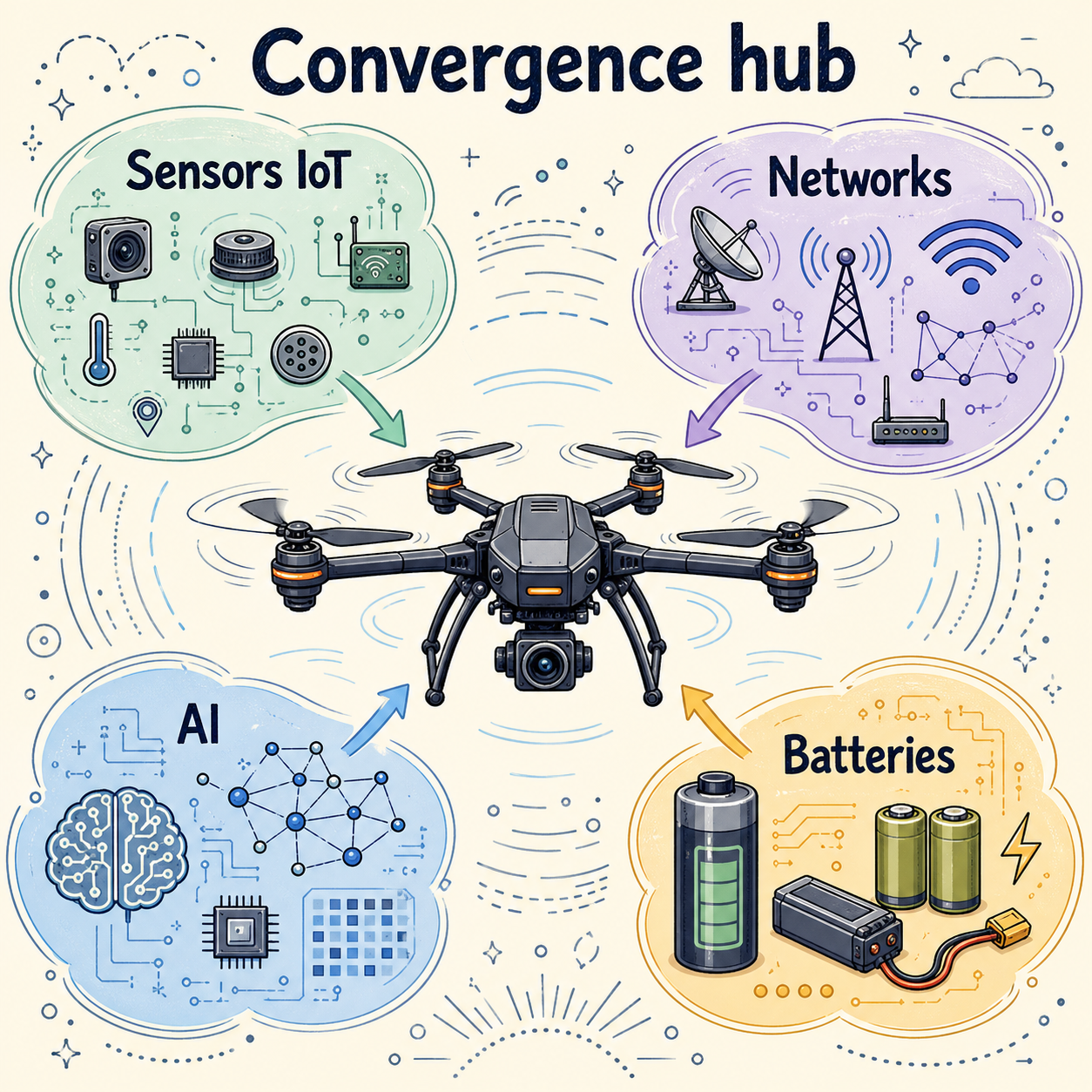
Drones sit on the atoms side of a bits–atoms pair
❓ Where do drones live in the EmTech map?
In the OOM framing, transportation moves mass through physical space; networks move information. A drone is primarily a Transportation / Robots / Drones object — an embodied machine. Its value, though, is usually information or logistics: it either senses the world into bits or delivers atoms more flexibly than roads allow.
That makes drones a natural convergence hub.
Sensors and IoT: the portal into bits
❓ How do sensors and IoT turn a flying battery into a product?
Without a payload, most civilian drones are expensive frisbees. The economic payload is often a sensor suite:
- RGB cameras and gimbals (media, inspection)
- Thermal imagers (search, electrical faults, fire)
- Multispectral / hyperspectral (agriculture, environment)
- LiDAR and photogrammetry stacks (mapping, digital twins)
- Gas sniffers, magnetometers, radios for specialized work
Internet of Things enters when drones become mobile nodes in a sensing fabric: automatic uploads to cloud GIS, farm management platforms, BIM models, or security systems; docking stations that recharge and wait for API tasking; swarming inspectors that tile a solar farm.
Convergence type: strong between cheap flight and cheap sensing — each multiplies the other. Better cameras justified better gimbals; better gimbals justified better craft; fleet software then justified many craft.
Weak convergence example: slapping a 5G badge on a brochure without integrating tasking, data pipelines, and maintenance.
Networks: the invisible airframe
❓ Why is connectivity as important as propellers?
A UAS is defined by its data link. Modes include:
- Short-range consumer radio / Wi-Fi-like links
- Proprietary long-range OcuSync-style systems
- Cellular (4G/5G) command and telemetry
- Satellite for beyond-line-of-sight military and some commercial
- Mesh among vehicles for relay and swarms
Networks determine range of control, latency, bandwidth for video, and jamming vulnerability. In peaceful inspection, LTE might be enough. In electronic warfare, a drone that needs a clean uplink dies first.
LEO satellite constellations and private 5G are enablers for BVLOS fleets; they are also new attack surfaces.
Convergence type: strong — uncrewed aviation without communications engineering is a fantasy. Counterpart insight: improving networks can raise drone usefulness as much as improving motors.
Artificial intelligence: from stability to missions
❓ What does AI actually do on and for drones?
Layer the stack:
- Flight stability and estimation — classical control + sensor fusion (the original “autopilot AI,” often not deep learning).
- Perception — detect obstacles, people, vehicles, defects; segment crops; track targets.
- Navigation — vision odometry, SLAM, GNSS-denied flight, precision landing on a charger.
- Planning — coverage paths, multi-stop delivery, deconfliction.
- Human interfaces — natural language tasking, one-operator-many-vehicle orchestration.
- Swarm policies — local rules that create global patterns (see chapter 07).
- Offboard analytics — models that turn hours of footage into structured reports.
Edge AI chips let more of this run onboard, reducing link needs and latency. Cloud AI still dominates heavy mapping reconstruction and fleet optimization.
Convergence type: strong and accelerating with foundation models and better onboard compute — but physical constraints remain. A perfect detector does not add watt-hours to the battery.
A utility pilot once flew every tower. Now a docked drone launches on a ticket, flies a learned orbit, flags a cracked insulator with a vision model, and files a work order before the coffee cools — when weather and airspace allow. The “drone” is the visible tip of an AI + IoT + network stack.
Robots and self-driving cousins
❓ How do drones relate to ground robots and autonomous cars?
Shared ingredients: sensors, autonomy software, safety cases, fleet management. Differences: drones move in 3D with less friction and less forgiveness (no shoulder to pull onto), face stricter aviation law, and burn energy to stay still. Self-driving cars and warehouse robots teach perception and fleet ops; drone teams teach radio and airspace. Cross-pollination is real (simulators, ML ops, teleoperation).
Weak vs strong convergence checklist
| Pairing | Pattern | Example |
|---|---|---|
| Drones × sensors/IoT | Strong | Inspection digital twins |
| Drones × AI perception | Strong | Obstacle avoidance, agriculture analytics |
| Drones × networks | Strong | BVLOS C2, mesh relay |
| Drones × batteries/energy | Strong | Every electric mission |
| Drones × 3D printing | Weak-to-moderate | Custom frames, rapid spares — helpful not defining |
| Drones × crypto | Mostly weak | Occasional tokenized ideas; not core physics |
| Drones × VR | Moderate | FPV goggles, remote presence |
Practical takeaway
Treat modern drones as flying robots on a network, carrying sensors, sharpened by AI, powered by batteries. Progress speeches that mention only airframes miss the product. Progress speeches that mention only AI miss gravity.