Last updated: 2026-07-23
07 — Drone swarms
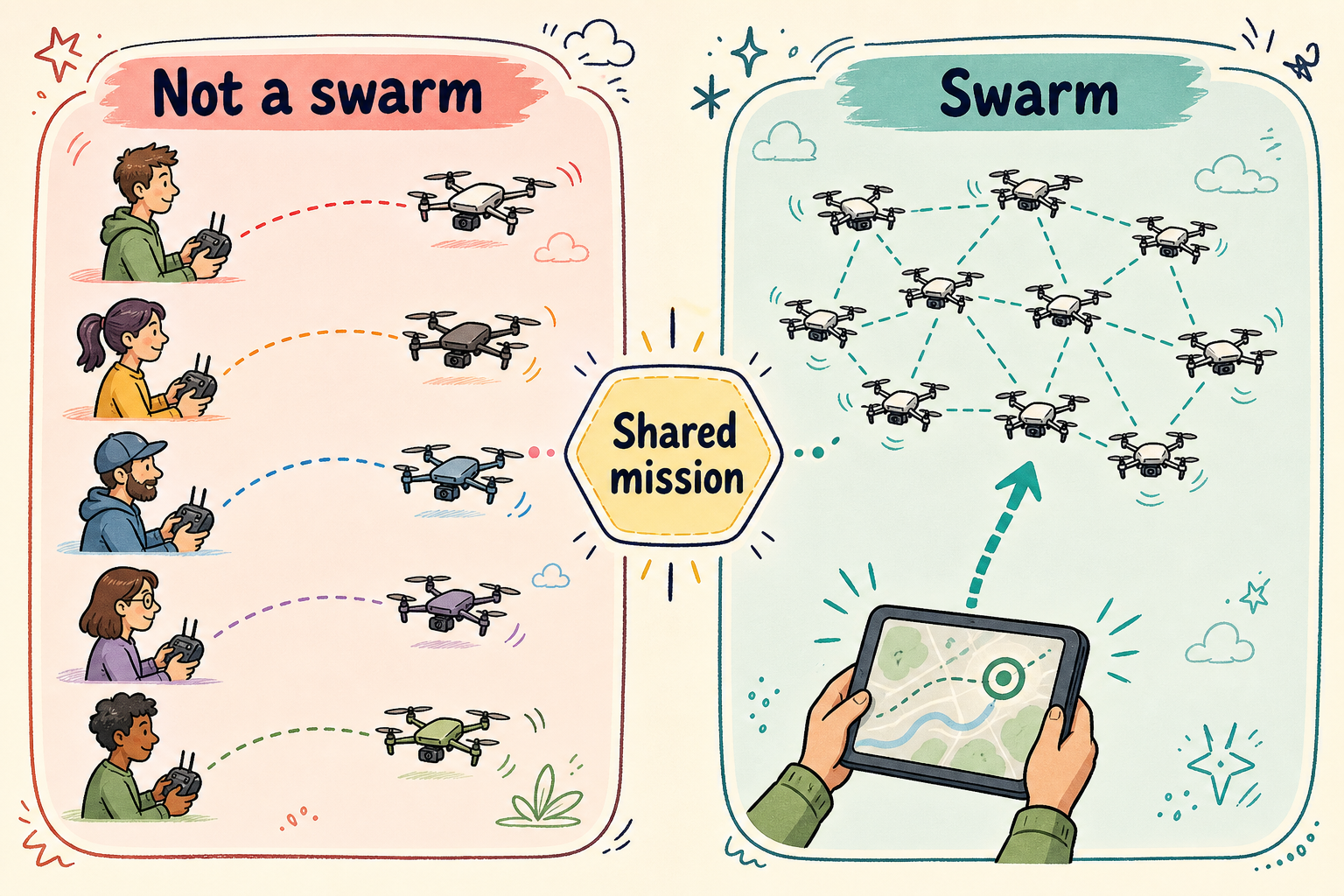
What a swarm is (and is not)
❓ When is a group of drones a swarm rather than just many drones?
A drone swarm is a set of air vehicles that achieve a mission through coordinated multi-agent behavior — sharing state, dividing tasks, reacting to local sensing, and producing a group capability that a single platform lacks. Coordination may be centralized, hierarchical, or largely decentralized with local rules.
Not automatically a swarm:
- Fifty drones at a light show on pre-scripted trajectories from a show computer (impressive choreography; limited online tactical adaptation).
- Fifty FPV pilots each flying one attack quad (mass, not swarm intelligence).
- A wave of independent one-way munitions aimed at the same region (saturation attack; coordination may be only in planning).
Closer to swarm:
- Vehicles that elect leaders, re-task when members die, cooperatively search a volume, or form dynamic communication relays.
- One operator assigning a intent (“map this block / suppress that ridge”) while vehicles allocate sub-tasks.
The distinction matters because budgets and headlines love the word swarm, while engineers need to know whether the hard problem is airframes or multi-agent control under bandwidth and jamming limits.
Why swarms are attractive
❓ What problem does swarming solve?
- Coverage — many sensors tile space faster.
- Attritability — losing one node need not end the mission.
- Complexity attack — defenders face many axes of approach.
- Specialization — scouts, relays, effectors as roles.
- Human span of control — if software works, one team directs many vehicles.
Biology metaphors (bees, starlings) inspire algorithms but do not ship certified code. Real systems mix classical consensus, auction-based task allocation, graph networking, and machine learning.
Research and military programs
❓ What has been demonstrated at program scale?
DARPA OFFSET (OFFensive Swarm-Enabled Tactics) envisioned infantry employing on the order of 250 small air and ground robots in urban settings, with an ecosystem for generating and testing swarm tactics. Field experiments through the early 2020s exercised growing numbers of real and simulated agents, human-swarm interfaces, and launch/recovery gadgets (including carrier concepts for many small UAS). OFFSET is a landmark existence proof for the research agenda, not a single SKU you can order as “the OFFSET drone.”
In January 2026, reporting on a Pentagon/DIU Orchestrator Prize Challenge (funding on the order of $100 million class) underscored the next bottleneck: vehicle-agnostic command of mixed fleets — different makers, different domains — under human authority. Buying many robots is easier than giving a commander a coherent orchestrator.
Ukraine-related analysis from 2025 onward emphasizes movement from pure one-operator-one-drone tactics toward greater automation and swarm-like tooling, while acknowledging that much combat power still comes from mass production of simple systems and skilled pilots rather than science-fiction fully autonomous clouds.
Civilian cousins include agricultural multi-drone spraying coordination, stadium light shows, and research labs forming shapes or search patterns.
Light shows: entertainment mass that is not a tactical swarm
❓ Did drone shows replace fireworks — and does that make them “swarms”?
Partly yes on entertainment; usually no on multi-agent tactics. Cities and festivals increasingly book LED multirotor light shows instead of (or beside) classical fireworks: programmable shapes, less smoke and fallout, reusable airframes, and branding that updates in software. Public stills now look like night skies full of moving constellations over parliaments, waterfronts, and stadiums.
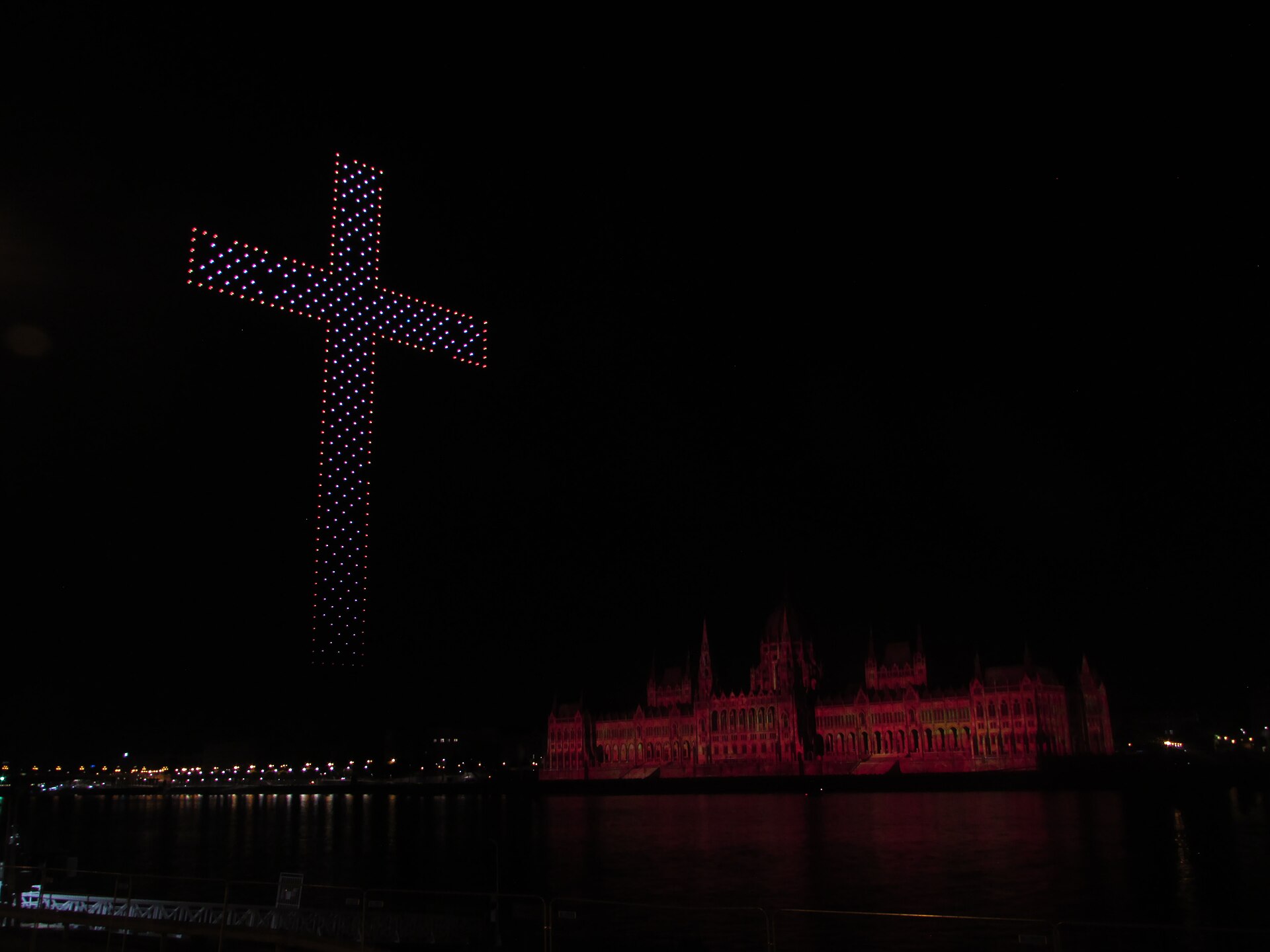
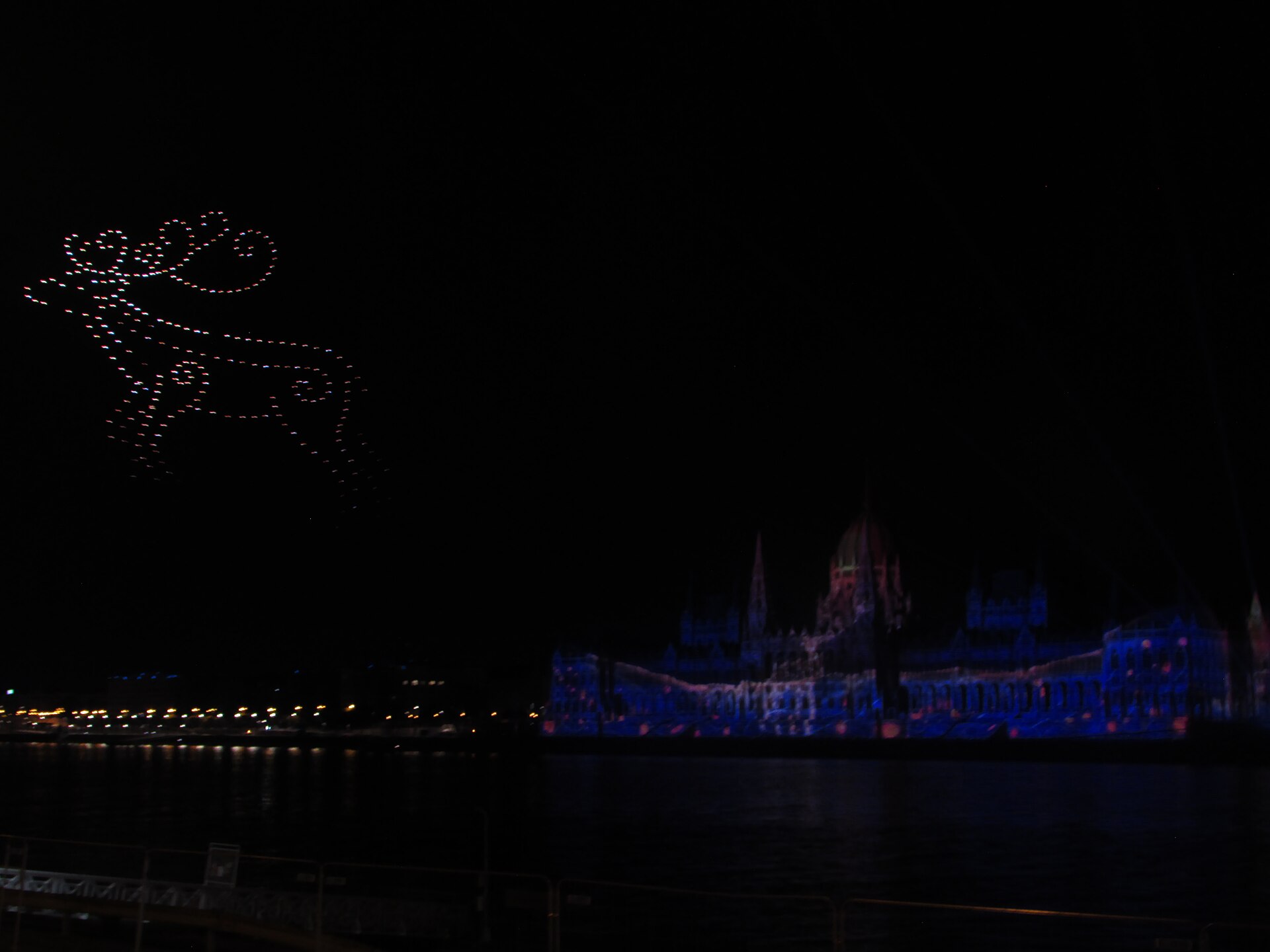
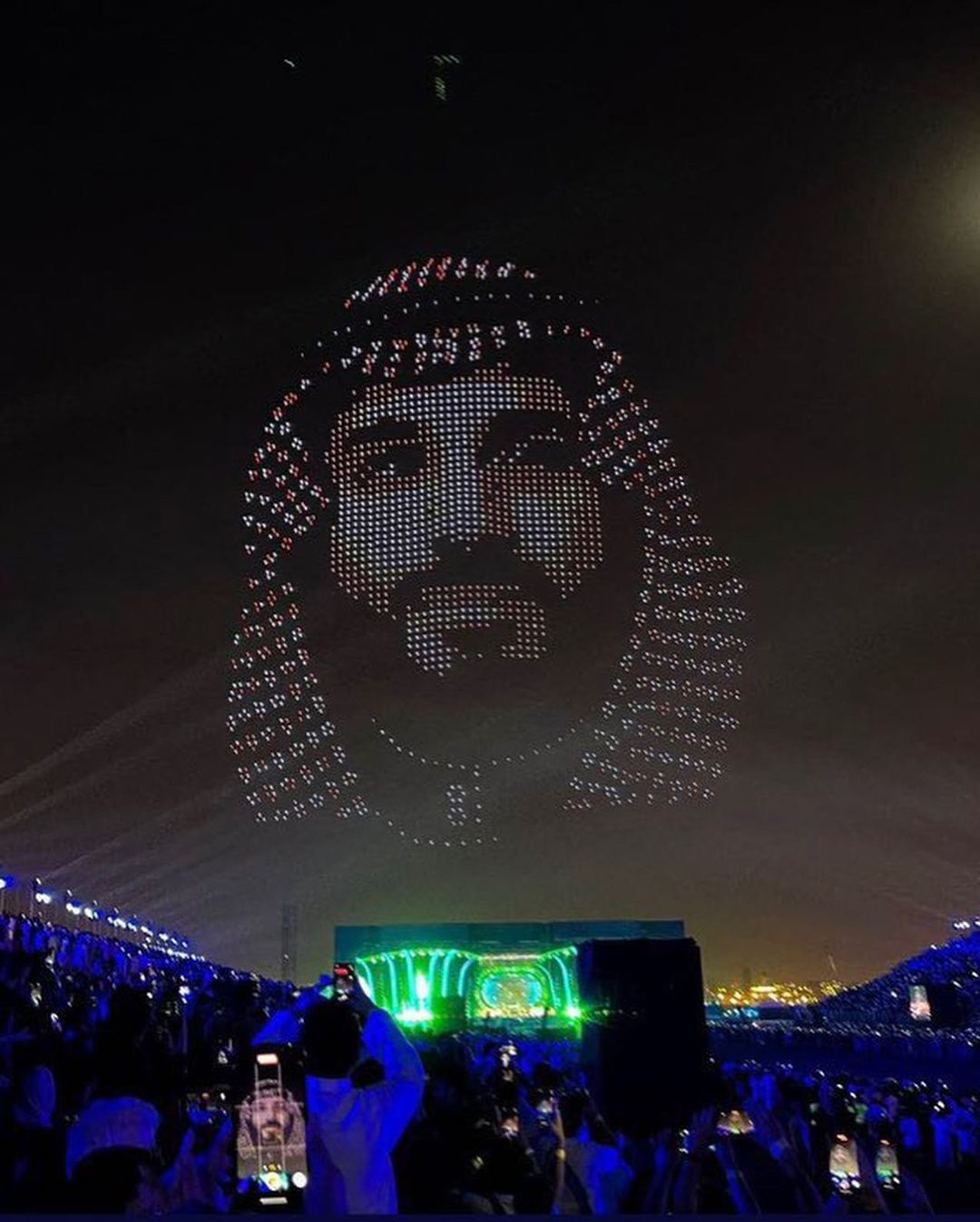
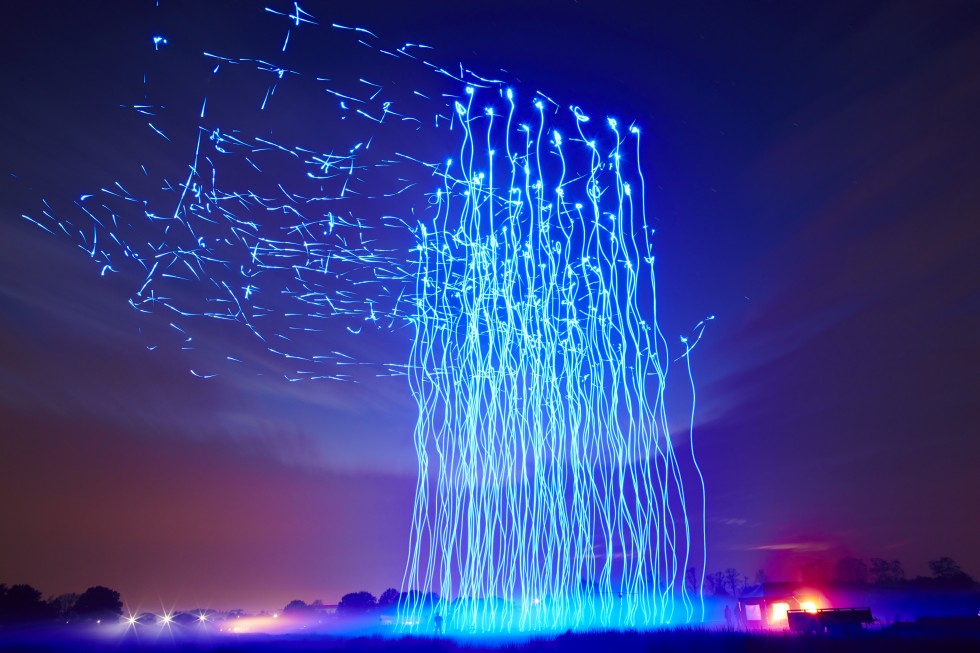

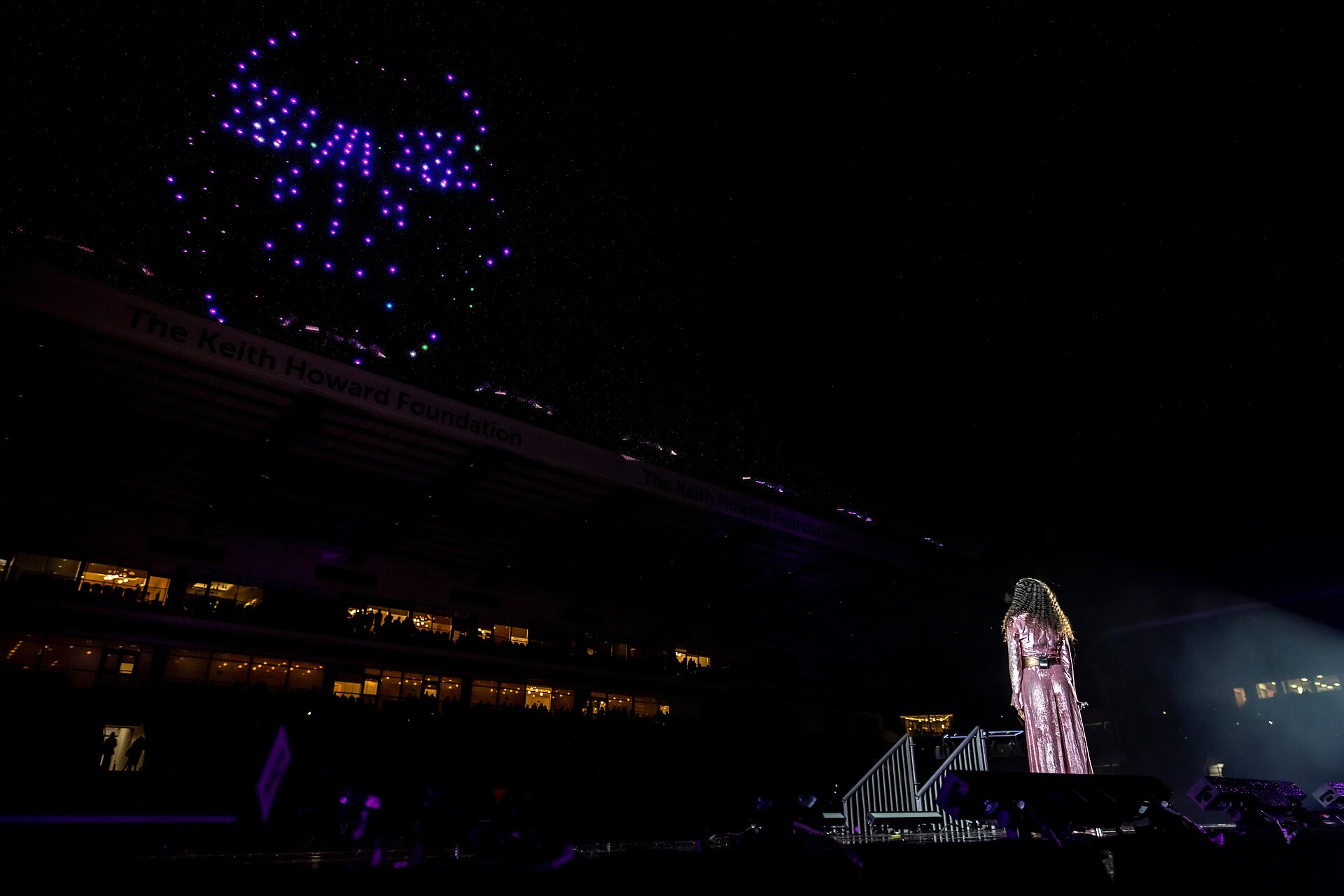
What “best” optimizes here: time-sync, show-computer trajectories, RF channel plans, launch/recovery logistics, and safety case over crowds — not adaptive task allocation under jamming.
Gunpowder rhyme (entertainment → force). Gunpowder emerged in China and lived a double life: fireworks and festival spectacle on one path, military rockets, bombs, and guns on the other. The chemistry did not pick a morality; institutions and markets did. Drone mass rhymes. The same generation of cheap multirotors that replaced New Year’s gunpowder in the entertainment sky also underwrites racing culture and, with different payloads and C2, wartime FPV and saturation attacks. Light-show “swarms” train public tolerance and industrial logistics for many small aircraft in one volume; they should not be confused with OFFSET-style adaptive swarms — but they are not a separate species of machine either.

Technical stack of a swarm
❓ What subsystems must work together?
- Relative navigation — GNSS, vision, UWB, or tactical radios to know neighbor geometry.
- Communications graph — who can talk to whom; multi-hop mesh; graceful degradation when jammed.
- Task allocation — who searches which cell; who attacks; who recharges.
- Collision deconfliction — especially in dense takeoff.
- Human-swarm interface — maps, playbooks, kill-switches, rules of engagement.
- Logistics — batteries, launchers, spare airframes; swarm ops are industrial.
AI appears in perception, local planning, and sometimes learned policies — but reliable autonomy in clutter and EW remains harder than demo videos.
Governance and the counter-swarm problem
❓ What breaks when scale defeats classical control?
Law and ethics struggle when lethal force involves semi-autonomous groups. Even for non-lethal use, liability for a hundred-agent failure is ugly. Defenders face cheap offense: detection clutter, ammunition cost per hard kill, and urban RF chaos. Policy work on counter-UAS authorities (especially in domestic airspace) lags technology in several jurisdictions — a strategic imbalance often noted in 2025 hearings and analyses.
Round-2 field notes: fiber FPV and cost exchange
❓ What changed the swarm/mass picture after 2024?
Fiber-optic FPV (C2 over a physical fiber spool) became a major answer to RF jamming: no radio link to jam, at the cost of cable logistics and snag risk. Open analyses describe mutual Russia–Ukraine adoption, ranges to tens of km class on long fiber, and sectors where fiber is a large share of FPV employment. That is EW-driven architecture, not a battery milestone.
Cost exchange: One-way attack drones in the ~$20k–$50k class versus missile interceptors often at hundreds of thousands to millions per shot create attacker-favorable ratios. Sustainable C-UAS trends toward cheap interceptor drones, guns, directed energy, and EW, layered — not Patriot-vs-FPV forever. See chapter 10.
❓ Operational test for “swarm” vs “mass”?
If losing N vehicles does not force a human to rejoystick each survivor, and agents reallocate tasks, the swarm claim is stronger. Industrial mass can still decide wars without that property.
Trend classification
Metric: number of cooperating agents per operator / per mission and robustness under attrition.
Period: 2010s research → 2020s field experiments and wartime mass.
Pattern: stepwise and domain-split — light-show counts are huge but scripted; tactical autonomous cooperation grows unevenly; pure independent mass is already industrial.
Mechanism: cheaper airframes + better radios/compute + algorithmic multi-agent tools + wartime selection pressure.
Bottlenecks: EW, identification friend/foe, airspace safety, human accountability, battery logistics.
Reach: same orchestration problem appears in robot warehouses and agentic software fleets — “swarm” is becoming an operations research word as much as an aviation word.
Contrarian note
Many “swarm” capability claims are rebranded multi-UAV waypoints. Ask: do agents re-plan under loss and surprise without a human rejoysticking each unit? If not, you have a formation or a salvo, not a swarm.
Practical takeaway
Swarms are real as a research program and partial operational practice. The strategic story of the mid-2020s is often mass + autonomy assists + desperate EW, with true large-scale adaptive swarms as the direction of travel. The new scarce resource is not only drones — it is orchestration under fire and under law.