Last updated: 2026-07-23
10 — The flying car that isn’t one thing
For a century, popular culture promised a car that would lift out of traffic and sail above the mediocrity of surface streets. Inventors kept answering with prototypes. Timelines kept answering with delays.
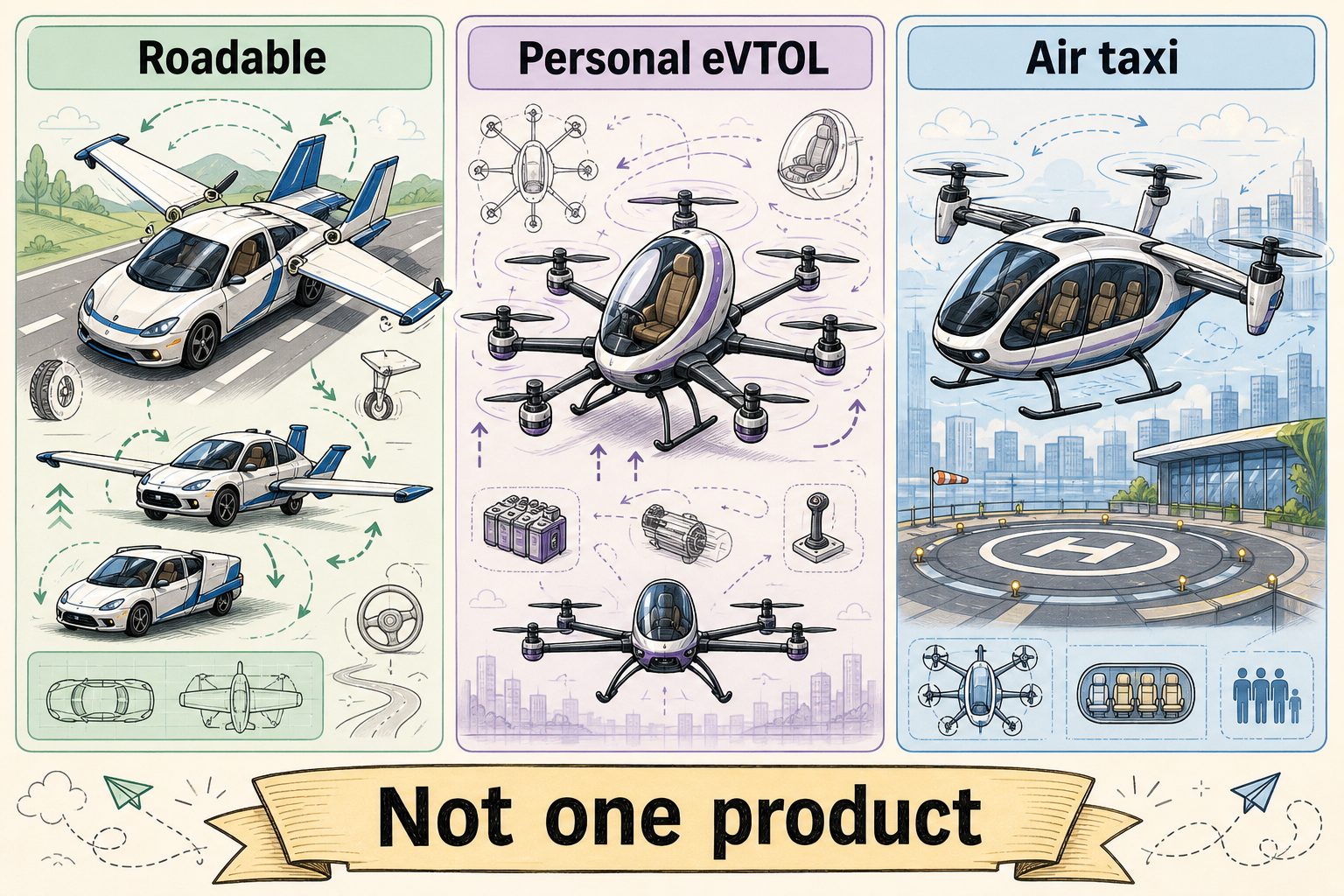
The phrase “flying car” still collapses three different products into one daydream.
Roadable aircraft drive on public roads and fly—folding wings, dual legal personalities. Terrafugia’s Transition, a light-sport roadable airplane story that began in the 2000s, became a mascot for the pattern: real engineering, repeated near-term sales forecasts, capital stress, ownership changes, and the stubborn fact that you still need somewhere legal and safe to take off. A driveway photo does not erase the preflight.
Personal eVTOLs, sometimes called personal aerial vehicles, are small electric VTOL craft you might own or rent. They may never hold a license plate. Opener’s BlackFly lives in this neighborhood: all-electric personal flight, ultralight-adjacent mass narratives, short endurance on the order of ~20 minutes in public writeups, prices in the high five to low six figures in secondary coverage, and “no license” claims that are jurisdiction-specific and easy to overread.
Air-taxi eVTOLs are commercial passenger networks—Joby, Archer, and peers. They are flying taxis, not garage pets. Investors prefer them because fleet utilization spreads pilot, maintenance, and certification cost across many tickets. A private dual-mode vehicle that flies twice a month is a luxury boat with rotors.
Alef Aeronautics illustrates marketing gravity. In 2023 the FAA issued a special airworthiness certificate in the experimental family for Alef’s program aircraft—limited purposes such as research, development, and exhibition. That is a real step. It is not a production type certificate, not airline-like passenger approval, and not proof of concurrent mass road legality. Special airworthiness is a lane. It is not the highway.
ASKA’s A5 markets drive-and-fly hybrid VTOL with SUV-sized road mode and ambitious flight range claims up to about 250 miles with hybrid assist and speeds near 150 mph class in company materials. The hybrid generator is the tell: pure batteries dislike car mass times useful range.
Shared DNA with drones is real—motors, distributed propulsion, flight computers, sensors, battery limits. The differences are harsher: people onboard, residual risk targets, road regimes, unit prices, and ops models.
What would have to be true for dual-mode personal flight to matter beyond niches? Pack energy and efficient cruise for useful stage length. Autonomy good enough that average drivers are not amateur pilots. Noise and community acceptance. Clear dual-certification playbooks—or honest abandonment of road mode. Insurance and maintenance as boring as brake shops. Airspace that can absorb the traffic without daily near-miss headlines.
Until several of those move together, expect demos and thin preorder books. The serious money still chases networked aerial rides and uncrewed machines that never needed cup holders.
A skeptical line older than any startup remains useful: the optimal stack may be good ground EVs, rail, and occasional premium airlift—not millions of private rotorcraft over playgrounds. Weather, wires, and kinetic energy do not care about crowdfunding videos.
Reserve “flying car” for dual-mode claims. Say personal eVTOL or air taxi when that is what you mean. Precision is not pedantry here. Precision is how you avoid buying a slogan.