Last updated: 2026-07-23
01 — The day the eye grew teeth
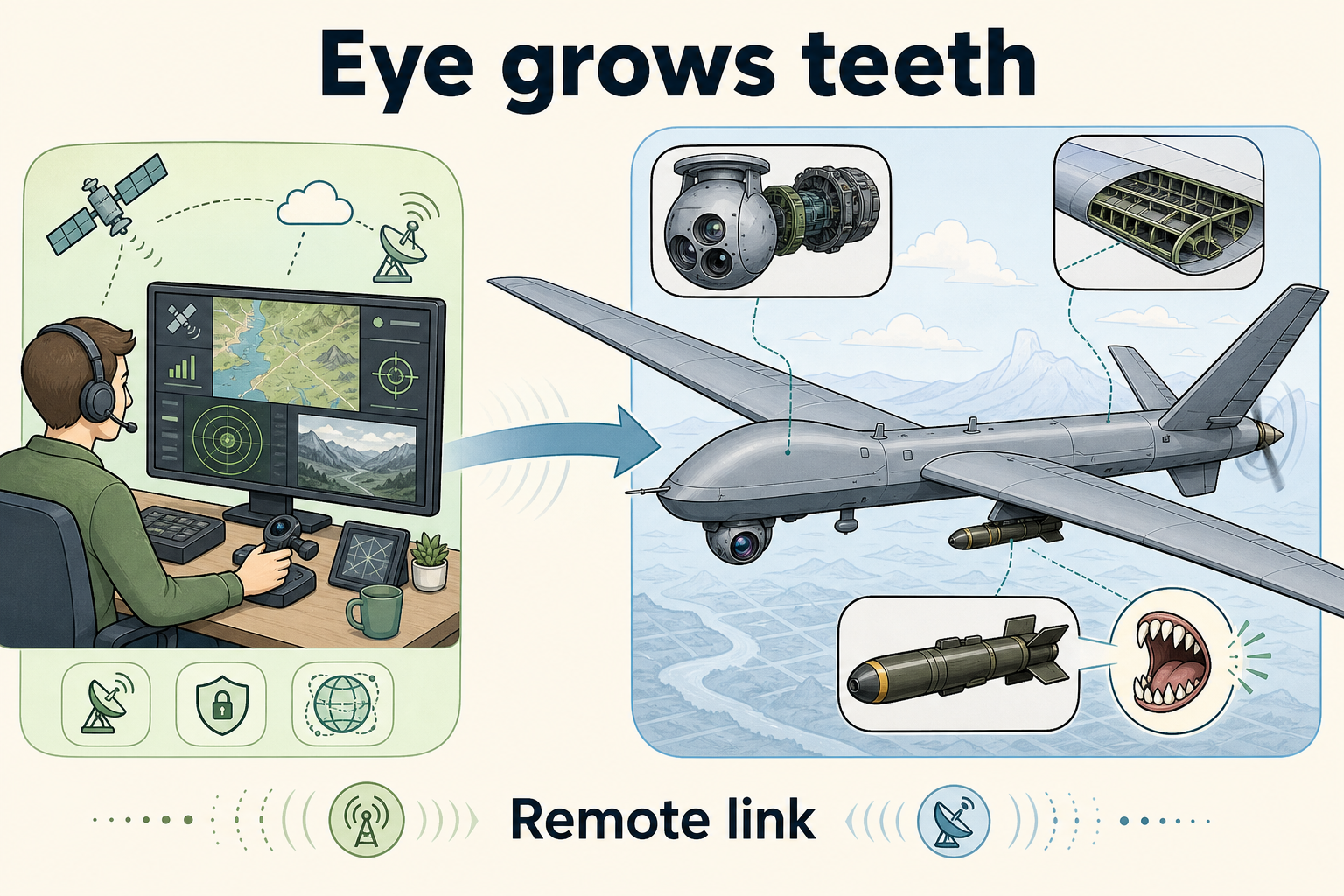
On February 16, 2001, at Nellis Air Force Base in Nevada, an Air Force captain named Curt Hawes did something no pilot had done before. He was not sitting in a cockpit over the desert. He was linked to a long-winged, propeller-driven aircraft that looked more like a model airplane than a warplane—the MQ-1 Predator—and from that remote link he launched a Hellfire missile that found its target on a test range.
The Predator had already been an eye. Now it had teeth.
That moment matters less as gadget trivia than as a hinge in how humans project force and attention. For decades, uncrewed aircraft had been targets, decoys, or cameras. Arming a remotely piloted aircraft collapsed the distance between seeing and striking. Later combat use would raise harder questions about law, distance, and responsibility. The technical fact is simpler: once you can hold a stable orbit for hours with a sensor ball and a data link, attaching a weapon is an engineering choice and a policy choice, not a science-fiction leap.
The same century that put Hellfires on Predators also put folding camera multirotors in backpacks. That is the puzzle this book is about. How did “no pilot onboard” become both a strategic weapon and a consumer appliance? Why is a quadcopter not simply a small electric helicopter? Why did prices fall for the gadgets that take wedding videos while city-wide delivery fleets and air taxis still grind through rules, batteries, and noise? And why does every decade rediscover the flying car only to discover it is three different machines wearing one slogan?
An unmanned aerial vehicle, or UAV, is a powered aircraft without a human pilot onboard. It may be flown by a person on the ground or by software, recovered or expended, carrying a camera, a package, or a warhead. A drone, in everyday speech, is whatever the public points at when they mean that class of machine. The word is casual, elastic, and stubborn. Engineers and regulators often prefer UAV for the vehicle and UAS—unmanned aircraft system—for the whole kit: aircraft, ground control, links, and support.
Hold those distinctions lightly for now. The Predator story is the emotional door. The definitions are the map. The mechanism is why the map suddenly filled with flying things.
What comes next is not a museum tour of gadgets. It is a single argument: drones scaled when control became electronics; they stall where energy, law, links, and neighbors still bite.
The sky did not get a new element. We got a new way to steer mass through it without strapping a person to the mass.