Last updated: 2026-07-23
08 — Mass is not a swarm
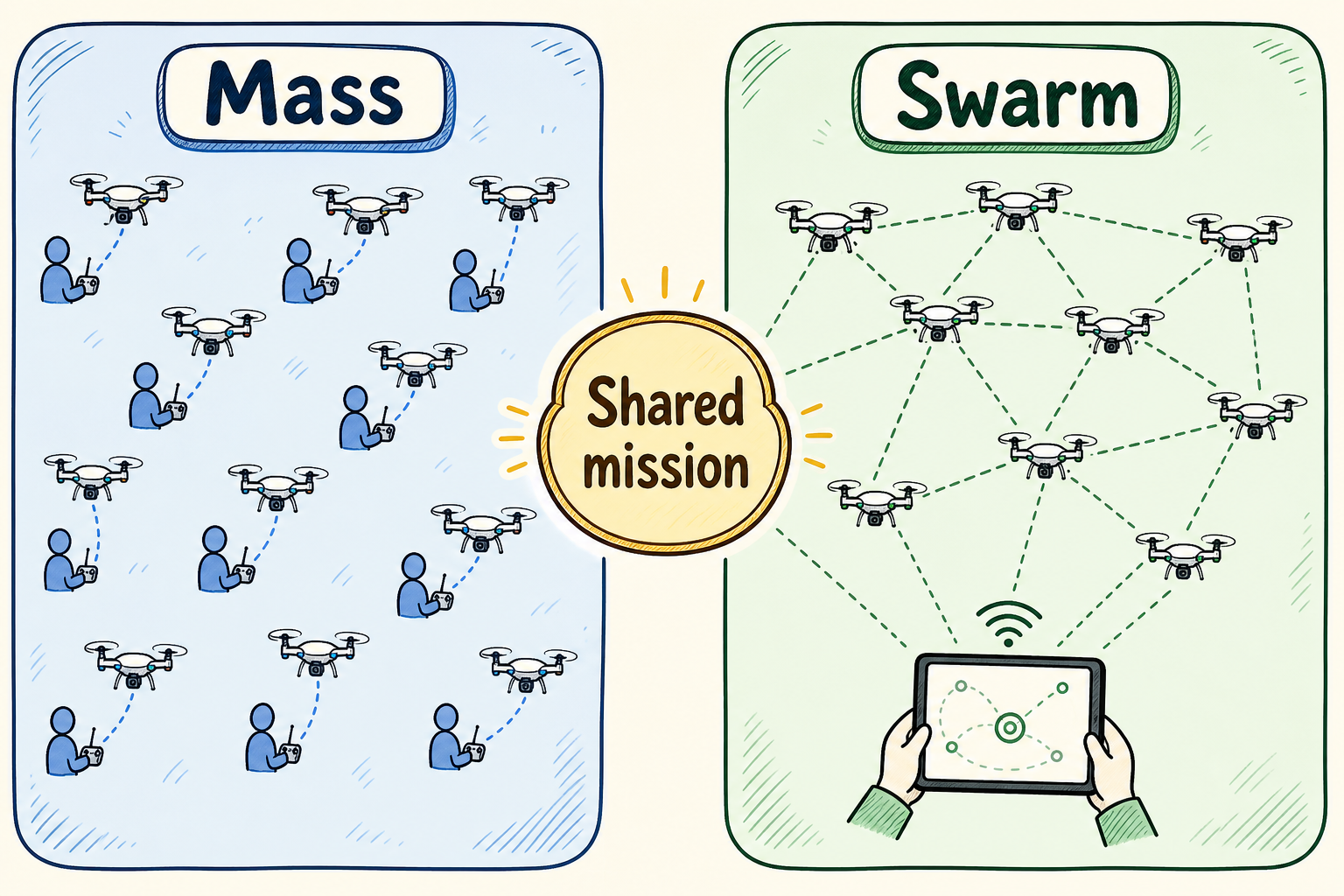
A stadium light show lifts a thousand quadcopters into a glowing logo. The crowd says “swarm.” The aircraft are following a script. Lose power on fifty of them and the logo gains freckles; the others do not hold a council and redesign the show.
That is choreography. It is impressive. It is not the same thing as multi-agent autonomy.
A drone swarm, in the useful sense, is a set of air vehicles that pursue a shared mission through local coordination—task allocation, relative navigation, degraded communications—so that the group keeps working when individuals fail or the plan meets surprise. The operator may set intent at the level of “clear this block” rather than joysticking each airframe.
DARPA’s OFFSET program—OFFensive Swarm-Enabled Tactics—spent years pushing toward urban experiments with large numbers of air and ground robots, playbooks, and human-swarm interfaces. Field experiments climbed into the low hundreds of physical agents with simulated companions. The residue is less a single product than a toolbox and a lesson: orchestration is hard. In 2026, U.S. defense innovation efforts were still writing checks toward vehicle-agnostic orchestrators—software to task mixed fleets from mixed vendors—because buying drones by the pallet is easier than commanding them as a mind.
War taught a blunter lesson. Ukraine’s sky filled with mass: FPV attackers, reconnaissance quads, one-way cruise drones. Production targets climbed into the millions per year in open analyses. Much of that mass is not a swarm. It is industry plus courage plus radios—until the radios die.
Then came fiber. Fiber-optic FPV trails a physical filament so the control link cannot be jammed like a radio. Ranges stretch into the tens of kilometers on long spools in reported systems. Snags and logistics are the tax. In some sectors, open reporting described fiber as a large fraction of FPV employment. Electronic warfare did not end drones. It forced a materials answer.
Here is a field test you can keep in a pocket:
| If this happens… | Mass / many pilots / salvo | Stronger swarm claim |
|---|---|---|
| You lose N vehicles | Mission wilts or humans retask each unit | Survivors reallocate tasks |
| Communications degrade | Fleet blinds | Local autonomy or non-RF links continue |
| Operator ratio | Near one human per airframe | One intent, many effectors |
Cost exchange completes the bleak arithmetic. One-way attack drones often discussed in the $20,000–$50,000 band can force defenders to spend missile interceptors at hundreds of thousands to millions of dollars per shot. Ratios favor the attacker until defense shifts to cheap interceptor drones, guns, directed energy, and electronic warfare in layers. The cheap offense does not make defense impossible. It makes expensive-only defense a road to bankruptcy.
Governance lags the propellers. Domestic counter-drone authorities in several countries remain fragmented; shooting at a flying object near an airport is a legal maze even when the technology exists. Lethal autonomy in groups stresses law and ethics harder than a single remote pilot with a clear chain of command.
Call mass what it is. Reserve “swarm” for coordination under loss. The strategic scarce resource is increasingly orchestration under fire and under law—not another unboxable quadcopter.
From abstractions of many to portraits of a few: what “state of the art” looks like when the category is really a street of different shops.