Last updated: 2026-07-23
07 — Sensors, networks, minds
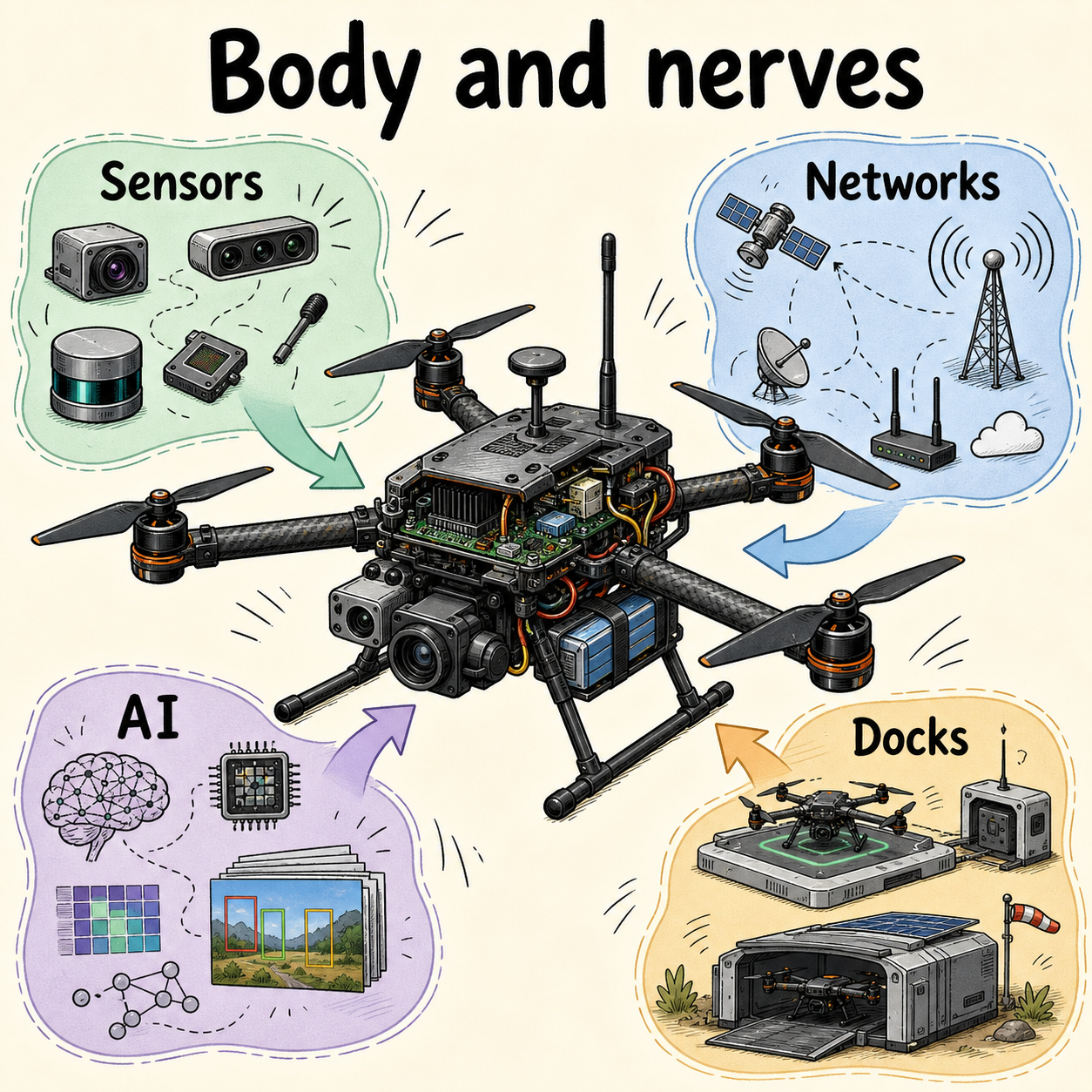
A drone without a payload is a loud paperweight. Most of the civilian value is not the flight. It is what the flight carries: cameras, thermal imagers, LiDAR—light-based ranging that builds 3D maps—multispectral sensors for crops, gas sniffers, loudspeakers, defibrillators, blood.
That is why drones sit in the emerging-technology map next to the Internet of Things. The IoT is the idea of everyday objects as networked sensors and actuators. A docked inspection drone is a flying IoT node that returns to charge. A precision-ag hexacopter is a tractor that learned to levitate for a few liters of spray. The convergence is strong: cheaper flight multiplies mobile sensing; better sensing justifies fleets and docks.
Networks are the nervous system. Early military UAVs leaned on line-of-sight radios, then satellite links that let a pilot in one hemisphere fly a mission in another. Consumer craft talk to phones and proprietary radios. Delivery networks need reliable command links and traffic services. Swarms need graphs of who can hear whom when the channel degrades. LEO satellite constellations—low Earth orbit internet in the sky—offer new backhaul options with their own latency, cost, and jamming stories.
Artificial intelligence enters as perception, planning, and interface. Onboard models track subjects, spot rust on a turbine blade, navigate when GPS lies or dies. Offboard models turn a day’s flights into a report a human can sign. Foundation-model hype should be separated from shipped features: many “AI drones” still mean competent computer vision and solid state estimation, not science-fiction judgment. The hard cases remain weather, clutter, adversarial electronic warfare, and the last meters of responsibility when something goes wrong.
There is a clean strategic filter hiding here.
If your decision only needs information, prefer moving bits: sense, compress, transmit. If your decision needs matter in a new place—blood, a spare part, a warhead—you must move atoms, and you will pay hover’s tax, weather’s veto, and the regulator’s patience.
Remote inspection often beats delivery on pure economics. Delivery wins when time is extreme, roads are lies, or the payload’s value density is absurd—medical logistics before pizza, again and again.
Moats follow the same split. Commodity airframes are weak moats. Integrated camera-drone experience can be strong. Enterprise payloads and workflows lock in. Dock and fleet software become recurring revenue. Certified passenger eVTOL, if achieved, is a regulatory fortress. Military mass production plus EW-resilient command is national-industrial power, not a startup feature list.
The flying robot is the body. Sensors are the reason. Networks are the nerves. Software is increasingly the skill. The next chapter asks what happens when the bodies come in dozens and hundreds—and when people start calling that a swarm whether or not the word fits.