Last updated: 2026-07-23
06 — The limiter stack
Every few months a battery headline arrives like a weather front. A laboratory cell hits 450 or 550 watt-hours per kilogram at the cell level—Wh/kg, a measure of how much energy you store per unit mass—and social media declares the air-taxi age open by lunch.
Pack the cell into a certifiable battery with cooling, structure, wiring, and cycle life under climb-and-hover abuse, and the number shrinks. Put the pack into a vehicle that must hold reserves for go-arounds and weather, and the mission shrinks again. The headline was not a lie. It was a different object.
Batteries matter. Gravimetric energy density is a hard gate on pure-electric hover and on short eVTOL hops. They are not the only gate.
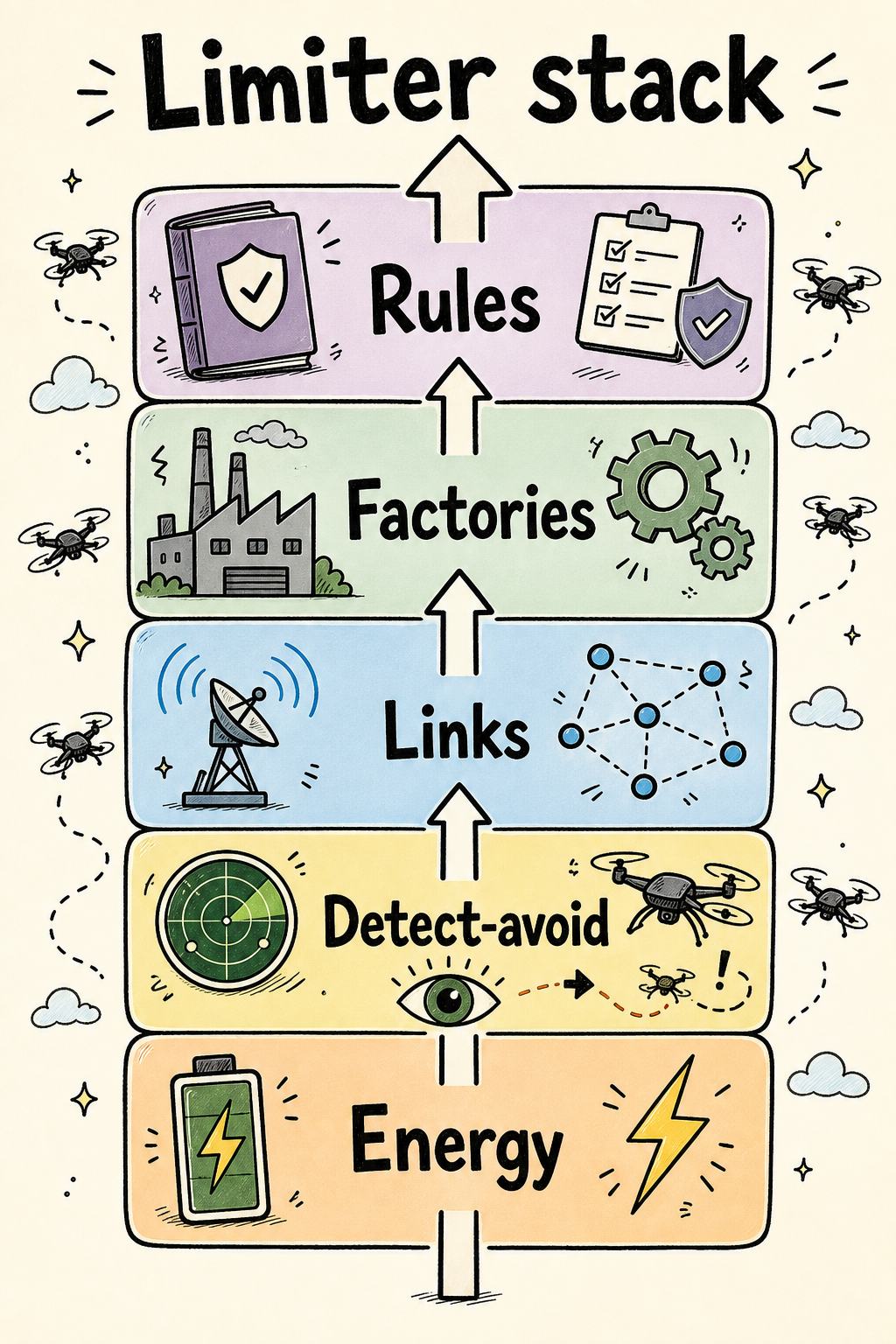
Think of a stack of limiters, all of which must clear for a fleet to exist:
Energy and architecture. Short, quiet, frequent missions favor batteries and multirotors. Long endurance and thin logistics favor hybrid-electric systems and wings. Hydrogen fuel-cell UAVs show multi-hour loiter in demos when ground hydrogen logistics are acceptable; they are not backyard appliances. Passenger eVTOLs need pack energy and utilization and noise that neighbors will tolerate.
Autonomy and detect-and-avoid. A drone that cannot sense and yield to other traffic is a trespasser with propellers. “Good enough” detect-and-avoid is a performance claim about range, weather, and non-cooperative targets—not a checkbox in a pitch deck.
Links. Command and control must survive distance, urban multipath, and, in war, jamming. Satellite links made Predators global. Mesh radios make swarms gossip. Fiber spools make FPV unjammable at a price in mass and snag risk.
Factories and supply chains. Ukraine’s lesson is industrial: millions of simple airframes beat a few exquisite ones when the exchange rate of attrition favors the cheap. Civilian markets learned a cousin lesson from DJI’s scale.
Rules. In the United States, the FAA’s Part 108 effort is the attempt to normalize many BVLOS operations through performance-based rules rather than endless one-off waivers. A notice of proposed rulemaking landed in that arc (docket FAA-2025-1908), with comment activity into early 2026. As of mid-2026 reporting, the rule was still in the rulemaking tunnel—not a finished “open sky” permit. Executive orders can compress calendars; they do not delete implementation lag.
A milestone is real when energy, control, link, airframe, and law are jointly true for a mission. Double the battery tomorrow and freeze detect-and-avoid and airspace rules, and city delivery fleets still stall.
The stack view is not pessimism. It is a map of what to fund. Cells without docks and rules are museum pieces. Rules without aircraft are PDFs. Aircraft without neighbors’ consent are lawsuits with lift.
Next: the other half of the stack—the bits that ride on the atoms.