Last updated: 2026-07-23
05 — What got cheap—and what did not
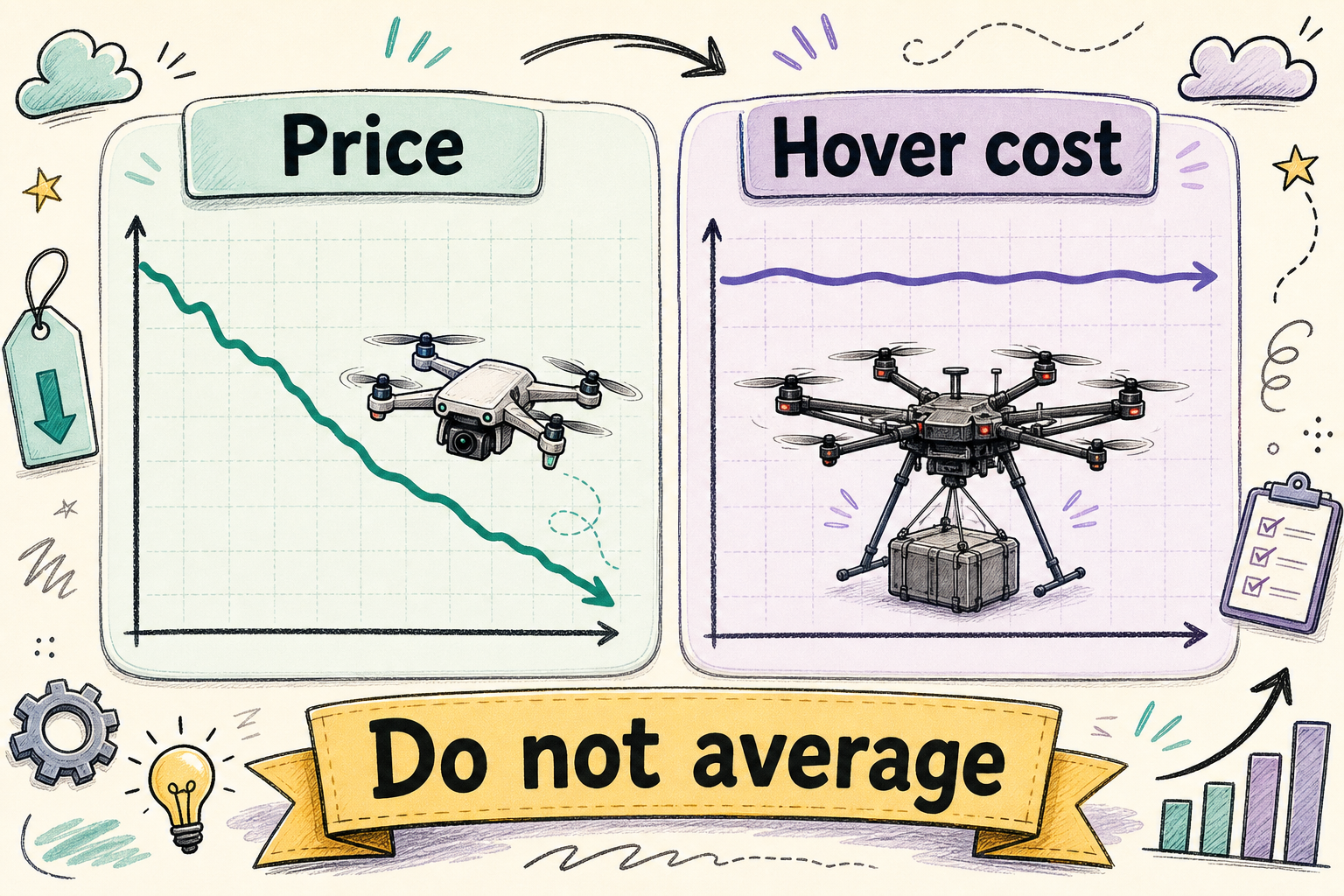
Walk a 2013 electronics aisle in memory: a ready-to-fly camera quadcopter that could take a stable photo might cost as much as a used car payment stacked wrong, or at least a painful luxury. Walk a 2026 storefront: capable Mini-class craft live near a few hundred dollars; flagship creators’ kits climb toward a couple thousand; toys sink under fifty. Capability per dollar on small sensing multirotors fell on the order of ten times across that arc in many comparisons—not because gravity got kinder, but because the vehicle became a cousin of the smartphone.
Sensors, motors, compute, and batteries rode electronics learning curves. Gimbals that once belonged on film sets shrank into plastic shells. Obstacle-sensing suites migrated from research demos into menus. Apps ate training manuals.
What did not get cheap on the same curve is anything that still fights mass × time in the air.
Range and endurance split hard by airframe. A pure multirotor often thinks in tens of minutes and a few kilometers of practical mission radius under real wind and reserves. A fixed-wing survey UAV thinks in hours and tens to hundreds of kilometers. A hybrid VTOL cargo craft—up like a multicopter, then cruise on wings—advertises the compromise that logistics actually wants: vertical access without surrendering the entire flight to hover’s fuel bill. Vendor claims for some hybrid classes reach multi-hour endurance and 100–200+ km mission radii with tens of kilograms of payload. Always read the asterisks: still air, specific payloads, perfect links.
Speed is another dishonest average. A camera drone cruises like a cautious cyclist in a hurry. Racing FPV screams. A military jet UCAV lives in another regime entirely. Passenger eVTOL marketing often circles roughly 100–200+ mph cruise classes depending on design—fast compared with traffic, modest compared with airliners.
Payload is where fantasies go to be weighed. Delivery multicopters in the FlyCart conversation carry on the order of 30 kg for short hops with flight times that collapse when loaded—public summaries in the ballpark of ~18 minutes class endurance for that example. Industrial oddities and helicopter-like UAVs push toward hundreds of kilograms. DARPA’s Lift Challenge language aims at shattering ratios—payloads several times vehicle weight in constrained demos—not at stocking every warehouse with flying forklifts next Tuesday.
Markets tell a split story. Analyst tallies of “commercial drones” wander from the low tens of billions upward depending on what they count; treat them as bands, not gospel. Consumer markets cooled from the mid-2010s froth even as enterprise inspection, agriculture, and defense demand kept industrial lines busy. DJI still dominates large slices of the global small-drone installed base in mid-2020s analyses (segment shares often quoted in the 70–90% neighborhood—approximate, political, contested). That concentration is a trend with teeth: performance, price, repair ecosystems, and national security arguments tangled into one supply chain.
Autonomy features productized fast—waypoints, orbits, tracking, docking. The economic envelope of autonomy did not. Beyond visual line of sight, or BVLOS—flying where the remote pilot cannot unaided see the aircraft—remains a legal and technical boss fight. Detect-and-avoid, spectrum, and traffic management decide whether a clever autopilot is a product or a demo.
Price fell where electronics lived. Performance stuck where physics and permission live.
If you remember only one chart from this chapter, remember two lines that refuse to be averaged: dollars per stable aerial photo, crashing downward; ton-kilometers per kilowatt-hour in pure hover, still a miser.