Last updated: 2026-07-23
04 — From balloons to fiber
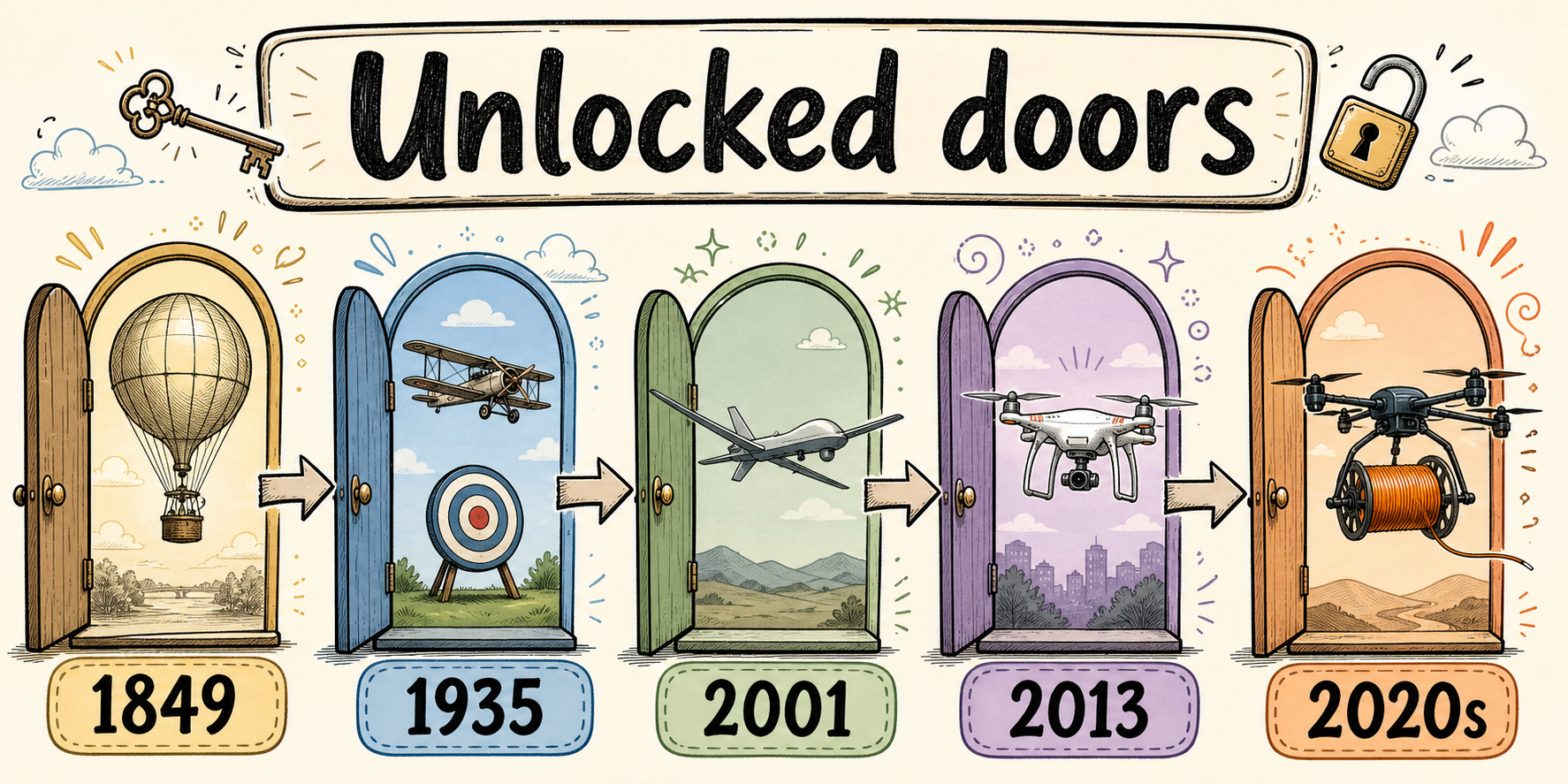
In July 1849, Austrian forces attacking Venice sent unmanned balloons carrying explosives over the city. Guidance was wishful. Wind was the autopilot. Still, the idea was already adult: put harm or eyes in the air without risking a crew.
The twentieth century turned the wish into radio.
In the First World War, Britain and the United States experimented with aerial targets and “aerial torpedoes”—the Kettering Bug among them—radio-guided or preset attempts to send explosives without a pilot. Between the wars and into the Second, radio-controlled target aircraft multiplied. Britain’s Queen Bee helped popularize the word drone in military slang: a worker aircraft that existed to be hunted in training. In the United States, actor-turned-manufacturer Reginald Denny’s Radioplane company mass-produced target drones; the OQ-2 and its kin rolled out of factories by the thousands. Marilyn Monroe, before that name, worked on Radioplane assembly—an almost too-perfect piece of Americana stuck to the supply chain of uncrewed flight.
Vietnam put reconnaissance drones into large-scale operational use. Israeli Scout UAVs in the early 1980s showed what real-time tactical video could do to a battlefield’s nervous system. Then came the long-endurance American line that the public learned as Predator and Reaper: satellite links, remote split operations, sensors that stared for hours. The February 2001 Hellfire shot at Nellis was the moment the staring eye became a fist; combat use followed in the wars of the 2000s.
Civil aviation agencies moved slower than wars. The FAA’s early commercial authorizations and the mid-2010s surge of exemptions and Part 107 rules opened a lane for film crews, surveyors, and utilities. In parallel, something quieter and more revolutionary happened in Shenzhen and on Christmas lists worldwide.
Frank Wang (Wang Tao), a student who had obsessed over model helicopters, founded DJI in 2006 out of work that began in a Hong Kong University of Science and Technology dormitory mindset: make stable flight controllable for people who were not expert pilots. The Phantom line, arriving in the early 2010s, was not the first multirotor. It was among the first that felt like a product—gimbal, app, batteries you could swap, a price that hurt less than a film helicopter day. MEMS sensors, brushless motors, and lithium packs had crossed a threshold. The military had needed decades and budgets. The consumer stack needed a bill of materials that looked like consumer electronics.
Then war returned as a factory problem. In Ukraine and elsewhere in the 2020s, first-person-view racing technology, cheap airframes, and munitions fused into attritable attack craft by the hundreds of thousands and then millions in annual production ambitions. Electronic warfare answered with jammers; engineers answered jammers with fiber-optic FPV—a drone that trails a hair-thin fiber so its control link cannot be radio-jammed. The cable snags, the spool adds mass, the logistics hurt. The radio silence is worth it where the spectrum is a battlefield.
History here is a tech-tree, not a trophy shelf. Each door opens a hallway with a new lock. Balloons lacked guidance. Radio guidance lacked endurance and sensors. Endurance sensors lacked legal civil airspace. Cheap multirotors lacked range. Range solutions lack quiet neighbors and finished rules. Fiber links lack elegance.
The next chapter is what the price charts and the payload charts actually say when you stop averaging a toy and a Reaper into one dishonest number.