Last updated: 2026-07-23
03 — Not a tiny electric helicopter
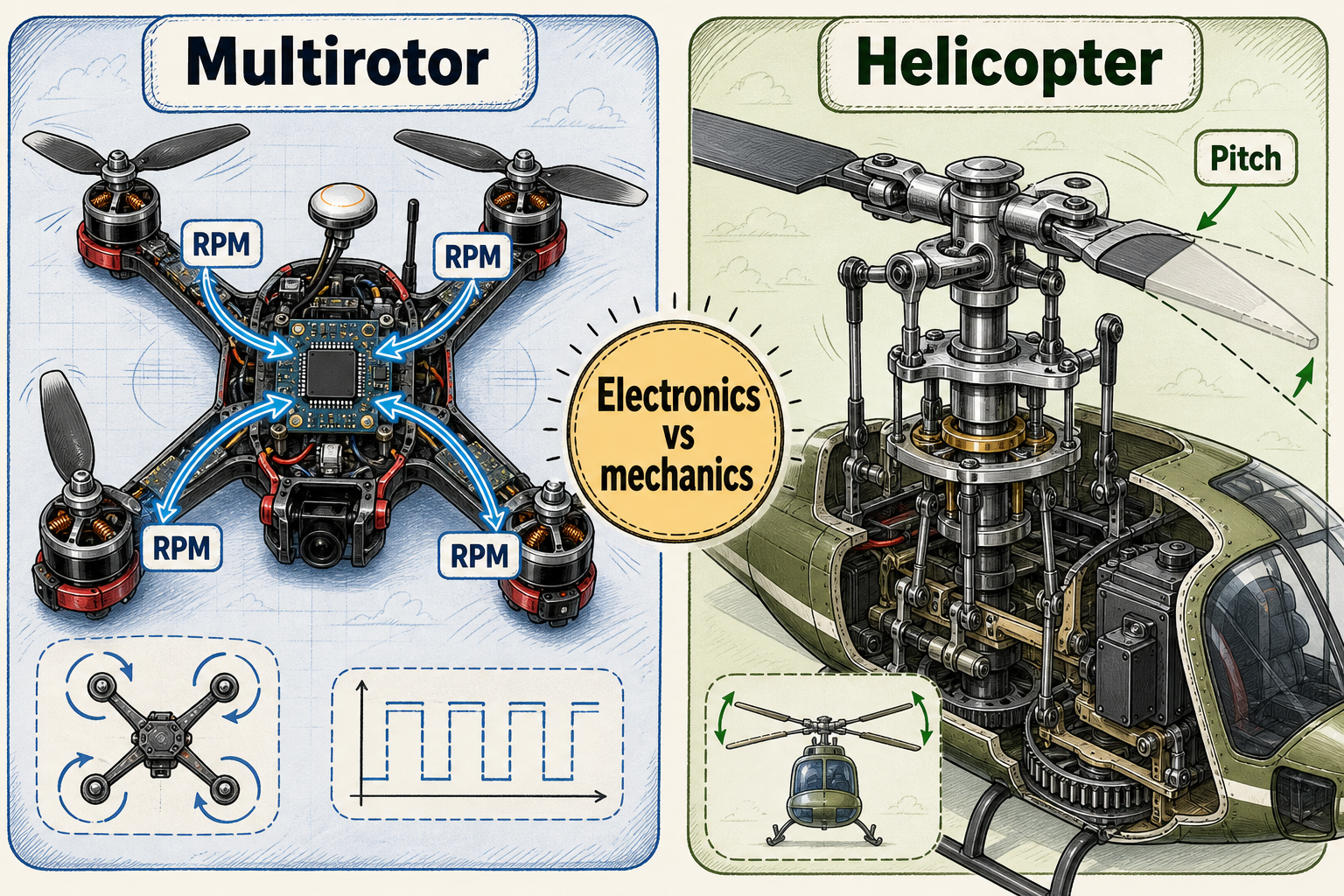
Open a toy-store multirotor and a training helicopter in your mind’s eye at the same time.
The helicopter’s main rotor is a mechanical essay. Pitch links, swashplate, collective and cyclic inputs—the blades change angle as they spin so the disc of the rotor can lift, tilt, and translate. A tail rotor or other anti-torque system fights the fuselage’s urge to spin the other way. Centuries of craft knowledge live in that head. It is beautiful. It is heavy. It is expensive to build and to maintain.
The multirotor looks almost dumb by comparison. Four (or six, or eight) propellers, fixed pitch, each on its own electric motor. No swashplate ballet. To roll, yaw, or climb, the flight computer simply spins some motors faster and others slower, thousands of corrections per second, reading a tiny IMU—an inertial measurement unit, a chip that senses acceleration and rotation—and closing the loop before the human eye notices a wobble.
That swap is the heart of the consumer drone revolution.
Fixed pitch means the blade angle does not change in flight; thrust changes with RPM, revolutions per minute. Variable pitch, the helicopter’s tool, changes blade angle so a large rotor can be authoritative without constant wild speed swings. Helicopters win efficiency and authority at scale partly because a large, slow disc moves air more kindly than many small, frantic discs. Multirotors win manufacturability and agility at small scale because brushless motors, cheap sensors, and fast microcontrollers turned stability into a software problem.
In 2007, researchers including Gabriel Hoffmann and colleagues at Stanford described quadrotor dynamics and control in a form the new industry would live inside: differential thrust as the control surface, electronics instead of linkages. The paper is not a founding myth so much as a receipt. The physics were ready when the bill of materials got cheap.
People still ask why we do not simply scale quadcopters into airliners. Hover is hungry. Holding still in the air means continuously paying the full cost of weight. Wings let you trade forward speed for lift and stretch range. A single large rotor can be kinder than a storm of small ones when the vehicle grows toward human mass. That is why heavy lift and long endurance keep drifting back toward hybrid VTOL—vertical takeoff, then wing-borne cruise—or toward helicopter-like designs, and why passenger eVTOLs spend so much engineering on transition modes: lift plus cruise, tilt rotors, or careful compromises.
A multirotor is an electric aircraft that outsourced mechanical complexity to bandwidth.
It is not a helicopter that forgot its heritage. It is a different bargain with the air.
That bargain set up a history that runs from Austrian bomb balloons to fiber-optic attack drones—and it explains why the history is not a smooth climb but a series of unlocked doors.