Last updated: 2026-07-23
02 — Three labels, one sky
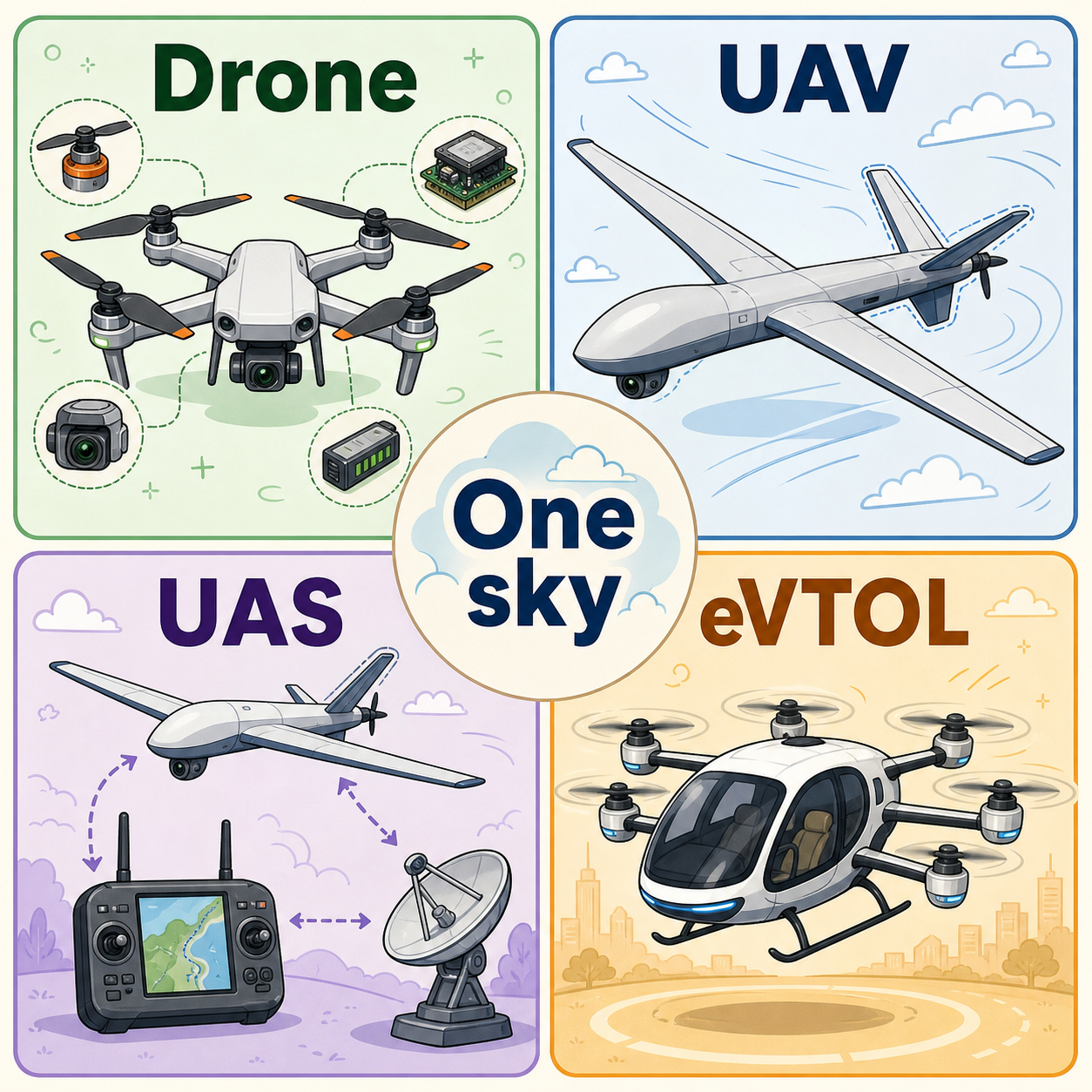
In a Shenzhen store window, a white quadcopter no heavier than a water bottle sits beside a brochure promising cinematic video. In a Nevada hangar, a turboprop with the wingspan of a small airliner waits for a satellite pass. In a California test field, a multi-seat electric craft with tilting propellers runs another certification flight. Shoppers call all three “drones,” or sometimes “flying cars,” and then wonder why the rules and prices make no sense.
The labels are doing different jobs.
A drone, in plain speech, is the umbrella. It can mean a toy, a survey tool, a racing craft, a one-way attack munition, or a military hunter. The word is useful in conversation and slippery in contracts.
A UAV—unmanned aerial vehicle—is the aircraft itself: the thing that leaves the ground without a pilot in the seat. Military and aerospace writing prefers this term because it points at a vehicle class, not a vibe.
A UAS—unmanned aircraft system—adds everything required to make the vehicle useful: the ground control station, the command-and-control link, the launch and recovery gear, the human procedures. Think of the difference between a car and a car-plus-keys-plus-roads-plus-driver. The UAS is the package. Regulators care about packages because accidents happen at the seams between radio, pilot, and airframe.
An eVTOL is something else again—or rather, two things at once. Literally, the letters mean electric vertical take-off and landing: electric propulsion plus the ability to rise and settle without a runway. Many small camera multirotors are eVTOLs in that engineering sense. In markets and newspapers, though, “eVTOL” usually means a full-size, often passenger-carrying, certification-heavy air-mobility machine—an air taxi aspirant, not a pocket Phantom.
So can a UAV be an eVTOL? Yes. Can an eVTOL be crewed? Yes. Can a “drone” be either? In speech, yes; in law, you must look up the weight class and the manning.
Weight classes are not trivia. Under many rules, craft under about 250 grams face lighter burdens. In the United States, much commercial small UAS work lives under Part 107, with a familiar under 55 pounds band and a thicket of waivers for what the eye cannot see. Heavier systems slide toward manned-aviation-like regimes. Passenger eVTOLs chase residual risk closer to transport aircraft than to hobby kits. Mixing those ladders is how people get surprised by fines, grounded fleets, or vaporware timelines.
One more edge: the loitering munition. It looks like a drone, flies like a drone, and ends like a missile. Export control and the law of armed conflict do not always care what marketers call it. When the vehicle is designed to expend itself into a target, the word “aircraft” starts to share a border with “munition.”
The practical habit is simple. Ask four questions of any flying object in the news: Is there a person onboard? What does it weigh? Is the hard problem the vehicle or the whole system? Is the safety target “don’t hit the picnic” or “airline-like residual risk with passengers inside”?
Answer those, and the slogan dissolves into a machine you can actually think about.
Next comes the mechanism that made the small ones explode in number: why a quadcopter is not a helicopter that swallowed a battery.