Last updated: 2026-07-23
11 — Why fleets lag demos
In Rwanda in 2016, a different flying story began—one that had nothing to do with cup holders. The government partnered with Zipline, a California company, to hurl blood and medical supplies by autonomous drone toward remote clinics. Mountains and roads had been delaying transfusions. The drones did not abolish gravity. They attacked time where time was lethal. Analyses later reported sharp cuts in delivery times and in expired blood products. Hubs scaled toward hundreds of possible flights per day. The lesson traveled farther than the airframes: medical corridors and sparse geography pay for aviation logistics before suburbs order sandwiches from the sky.
That contrast is the chapter’s engine. Demos prove vehicles. Fleets require systems.
BVLOS rulemaking in the United States shows the pattern. Part 108’s proposed framework aims to replace waiver-by-waiver entrepreneurship with performance-based normalization for many low-altitude missions—delivery, inspection, agriculture, public safety—complete with new roles, security expectations, and traffic concepts. Proposed is not final. Final is not implemented. Capital that models nationwide autonomous density before effective dates is doing scenario planning, not accounting.
Delivery unit economics remain a fog of secondary estimates: often about $5 to $30 per delivery at current volumes depending on density and distance, with optimistic narratives toward under $5 and customer willingness above $20 in speed niches. Sparse last meters, bad roads, extreme time value, and high vertical friction favor drones. Dense multi-stop grocery favors vans. Docked networks that cut pilot labor matter as much as airframe price.
Noise is not a footnote on passenger eVTOL. Regulators in Europe and elsewhere have been drafting VTOL-specific noise methods and limits; community perception studies treat close-in repetition as the wound that one demo flight cannot reveal. A perfect type certificate at a hated vertiport is a stranded asset with rotors.
Joby’s conforming TIA flights prove certification can grind metal forward. They do not prove ticket prices, utilization, or neighbor consent.
Energy decision rules tidy the battery argument without dismissing it:
- Short, quiet, frequent → batteries and multirotors
- Long endurance, thin charging → hybrids and wings
- Long loiter with hydrogen logistics → fuel cells in niches
- Passenger eVTOL → packs plus noise plus utilization
Cost-exchange defense is the military twin of civilian unit economics. If the shot costs more than the threat by factors of tens to thousands, inventories lie even when radars work. Layered cheap effectors are strategy, not thrift theater.
Alef’s experimental certificate is the flying-car twin of the same discipline: read the form number, not the headline.
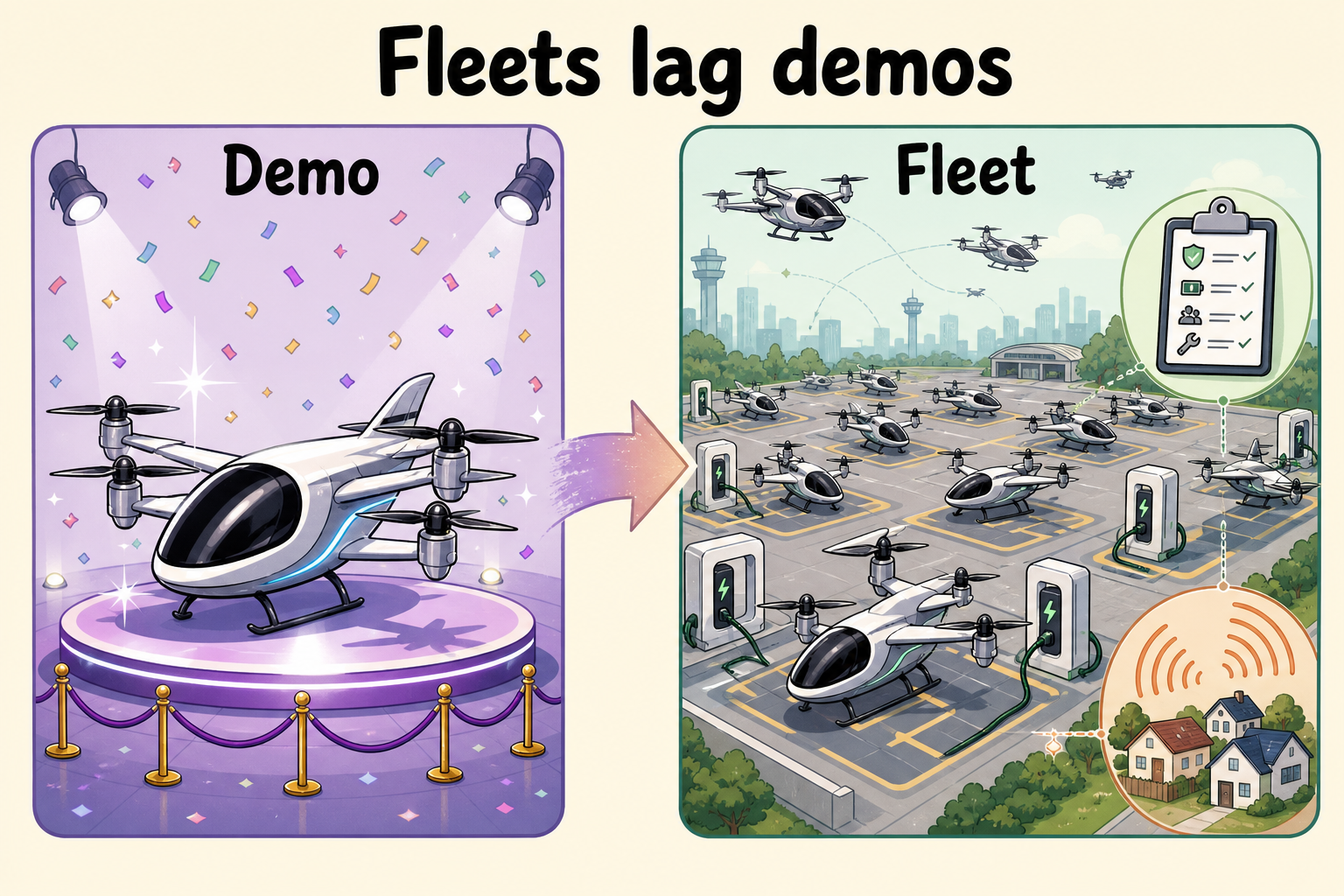
Fleets lag demos because a demo clears a stage. A fleet clears a stack—energy architecture, detect-and-avoid, finished rules, noise-compatible siting, and sustainable cost exchange on both the commercial and defense sides.
There is one more layer under “finished rules”: traffic geometry. Roads jam because non-parallel paths on a plane must meet. The sky can separate those meetings by height—but only with digital air traffic services and disciplined landing pads. That story is next.
The machines that forgot the pilot still live in a world that remembers neighbors, budgets, and law.