Last updated: 2026-09-02
Dollar rails, not a casino
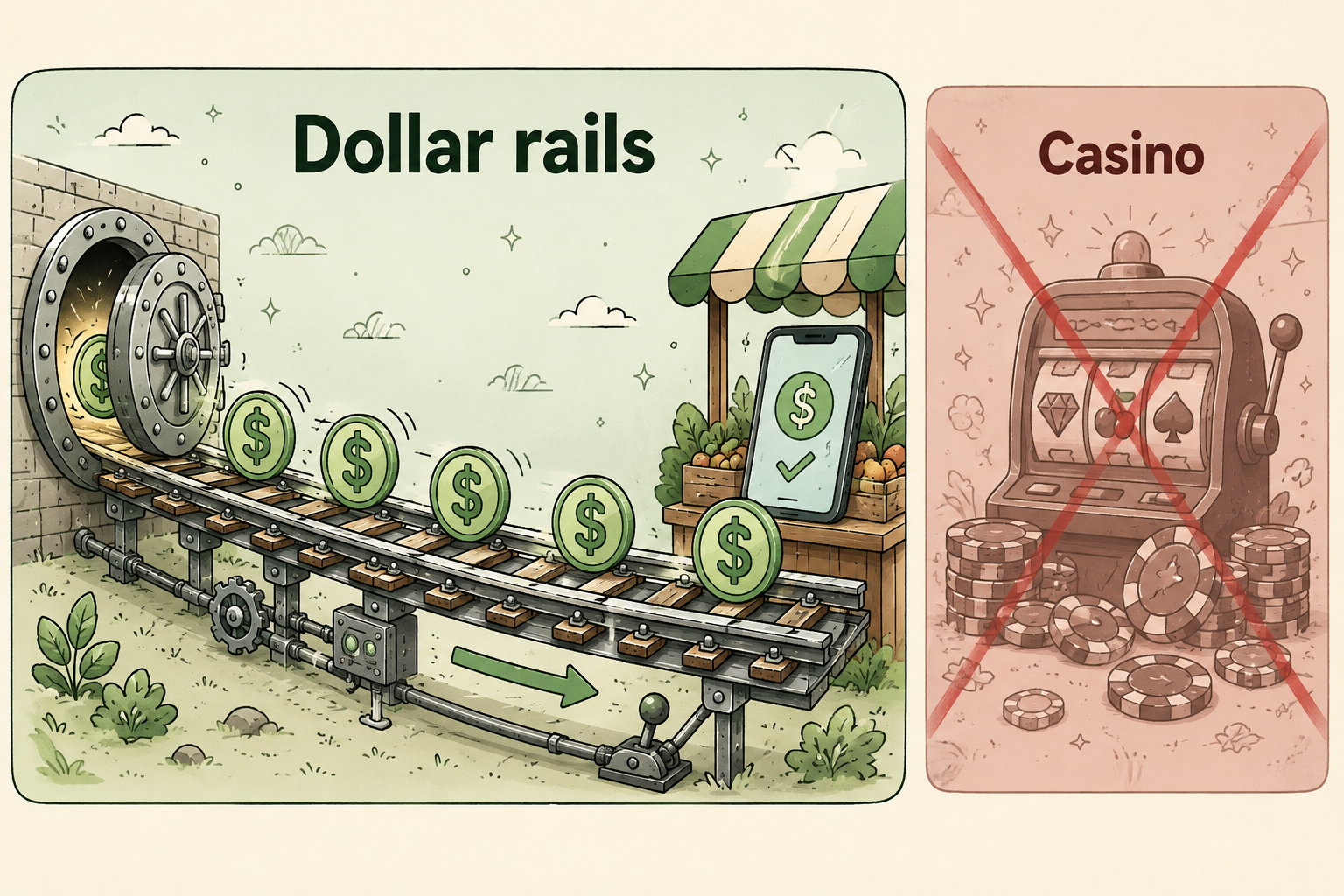
“Crypto” is a tray name, like “electronics.” It holds casinos, collectible tokens, private ledgers, and dollar payments. Inventing from the tray name is how you get a slot machine for a fish stall.
The product that fits a same-day stall is cheap public-ledger dollar rails. A public ledger is a shared record anyone can check, not a private spreadsheet inside one company. A dollar rail here means a token that is supposed to stay worth one dollar because an issuer holds matching dollars or treasuries, not because a crowd is betting. Cheap means a transfer can cost a fraction of a cent, so a stall sale is not eaten by the fee.
The dollars already exist in a bank. An on-ramp is the door from that bank into the token. An off-ramp is the door back to cash or a card the wholesaler already trusts. Without those doors, a token in a phone is a souvenir.
A live instance of this product category in 2026 is an Ethereum layer 2: a chain that posts its work to Ethereum so Ethereum can still act as a court if the operator cheats. Base is one such instance, incubated by Coinbase. Naming that instance is not the invention. The invention is a local use of the category — a payout, a family send, a small share, a tiny software payment — that a stall can actually run.
If your design needs a new casino, a new national currency, or a promise that no one can ever freeze a dollar, you have left the product. Stay on the rail. Invent the local use.