Last updated: 2026-08-20
Seeing and sparse carrying came first
A blood bag can beat a washed-out road. A grocery tote usually cannot. The difference is not slogans. It is payload, distance, weather, and what happens if the flight aborts.
Cheap stable camera ships already unlocked inspection and mapping: roofs, lines, fields, search. Medical and sparse logistics — blood, vaccines, defibrillators on thin routes — win before dense multi-stop grocery. Public cost bands in the mid-2020s still sit roughly in the five-to-thirty-dollars-per-delivery conversation; treat any “under two dollars everywhere” slide as a forecast, not a census.
Beyond visual line of sight (BVLOS) — flying when the operator cannot see the aircraft — is the operational unlock for real corridors. In the United States, comprehensive BVLOS rulemaking was still proposed, not finished, in mid-2026. Waivers exist. A city-scale pizza fleet is not a utility.
Autonomy features productized fast: orbits, docks, obstacle sense. The economic envelope is still the rule book, detect-and-avoid, and weather.
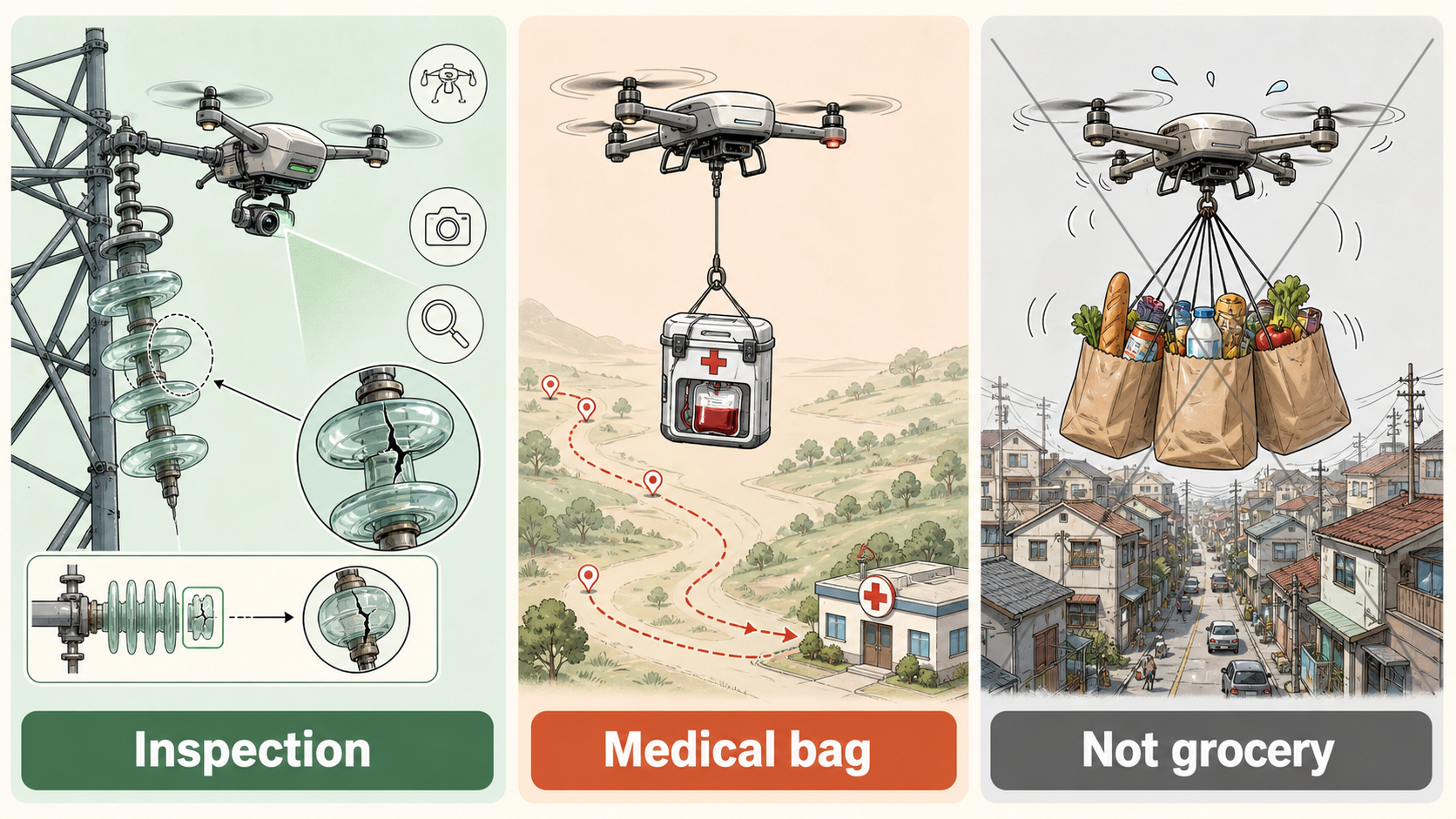
Invent inside the unlocked use cases. The next page is how to choose see versus carry.
The tempting mistake is to average a hospital corridor and a holiday catalog into “drones will deliver everything.” Sparse, time-critical, high-friction routes come first. Doorstep grocery stays a van problem.
That is what lets you choose whether the job is information or a box.