Last updated: 2026-08-20
The sky is a volume, not a road
A city traffic engineer stares at two delivery routes that cross on a map over a park. On a road, that is a merge. In the air, one flight can sit at eighty meters outbound and the other at one hundred twenty inbound. Same park. No meeting.
On a map, two car paths are lines in a plane. Unless they are parallel, they must meet. Cities force those meetings onto shared pavement. That is dimension, not a moral failure of drivers.
Aircraft paths are curves in three-dimensional space. Two tracks can cross on the map and miss in height — if separation rules hold. 3D does not delete conflicts; it relocates them. They return as the same volume at the same time, as takeoff and landing funnels at pads, as corridors for noise and predictability, and as weather ceilings that squash usable height.
Voice air-traffic control cannot vector every small craft. UAS traffic management (UTM) is the digital answer: share flight intent and constraints by software, not by a controller on the radio. Pads and vertiports still recreate choke points.
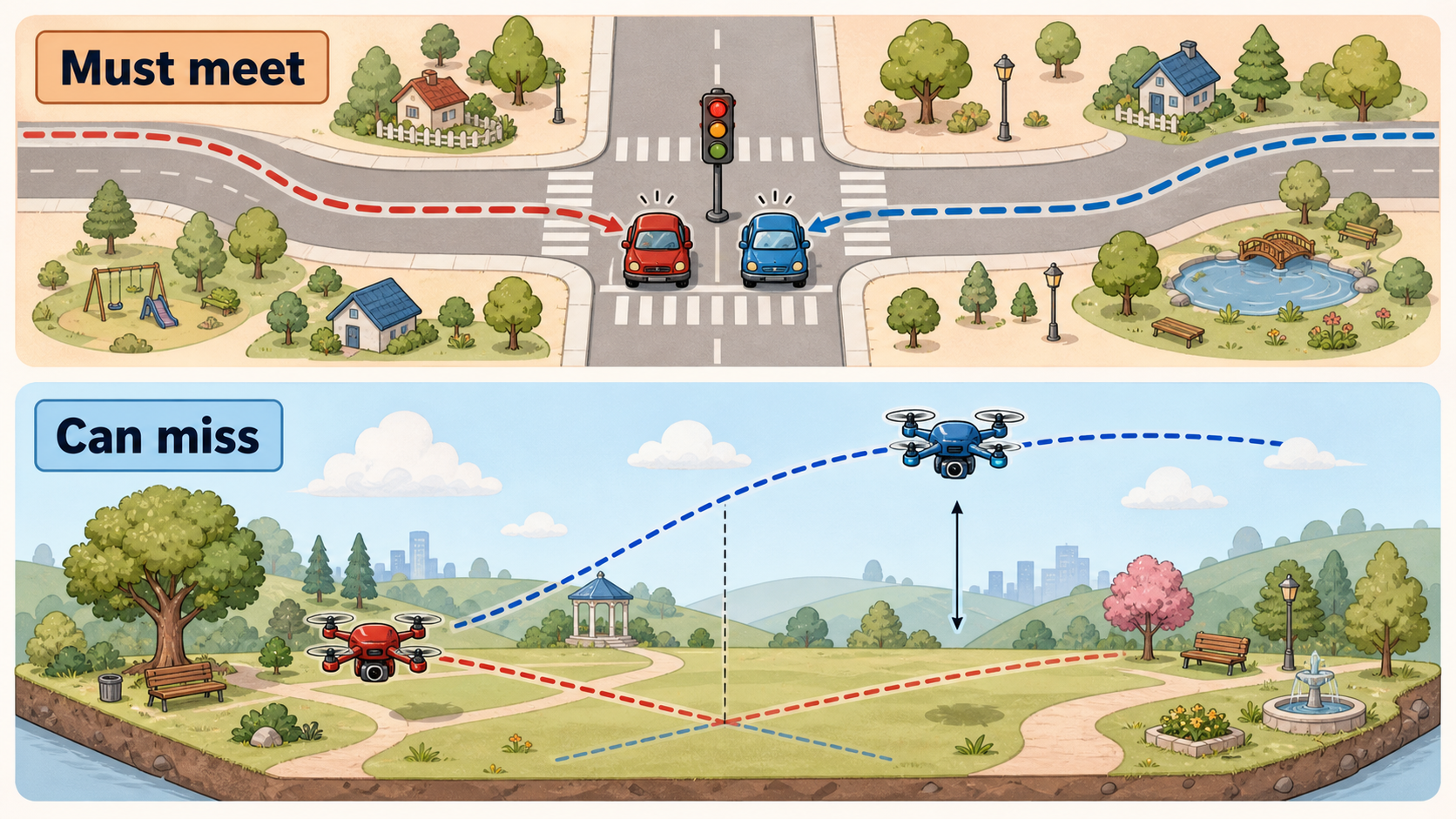
The extra degree of freedom is real en route. It is not a slogan that abolishes management.
The tempting mistake is to treat “just fly over the jam” as the whole design. The jam moves to the pad.
That is what lets you pick use cases that fit the extra dimension without pretending the sky is empty.