Last updated: 2026-08-20
Flying car is three products
A family loads luggage into a dual-mode vehicle for a driveway photo. The unglamorous middle of the trip is still: drive to a suitable field, preflight, weather, airspace — then maybe fly. The driveway was never the hard part.
Flying car is a popular phrase, not one engineering class. Under it sit at least three machines. A roadable aircraft drives on public roads and flies. A personal flyer is a small electric vertical-takeoff craft you might own — often not street-legal as a car. An air taxi is a commercial passenger craft on routes; it is a flying bus, not a car you park at home.
Dual mode doubles the problem: crash cages and license plates and airworthiness, weight, and pilot rules. Cars want mass for a crash. Aircraft want every kilogram to earn its keep. Special experimental certificates are not consumer type certificates. Mid-2026 still looks like prototypes and preorders, not an appliance next to the washing machine.
Serious money and certification depth went to networked air taxis and uncrewed drones that never needed cup holders. A personal flyer that flies twice a month is a luxury boat with rotors.
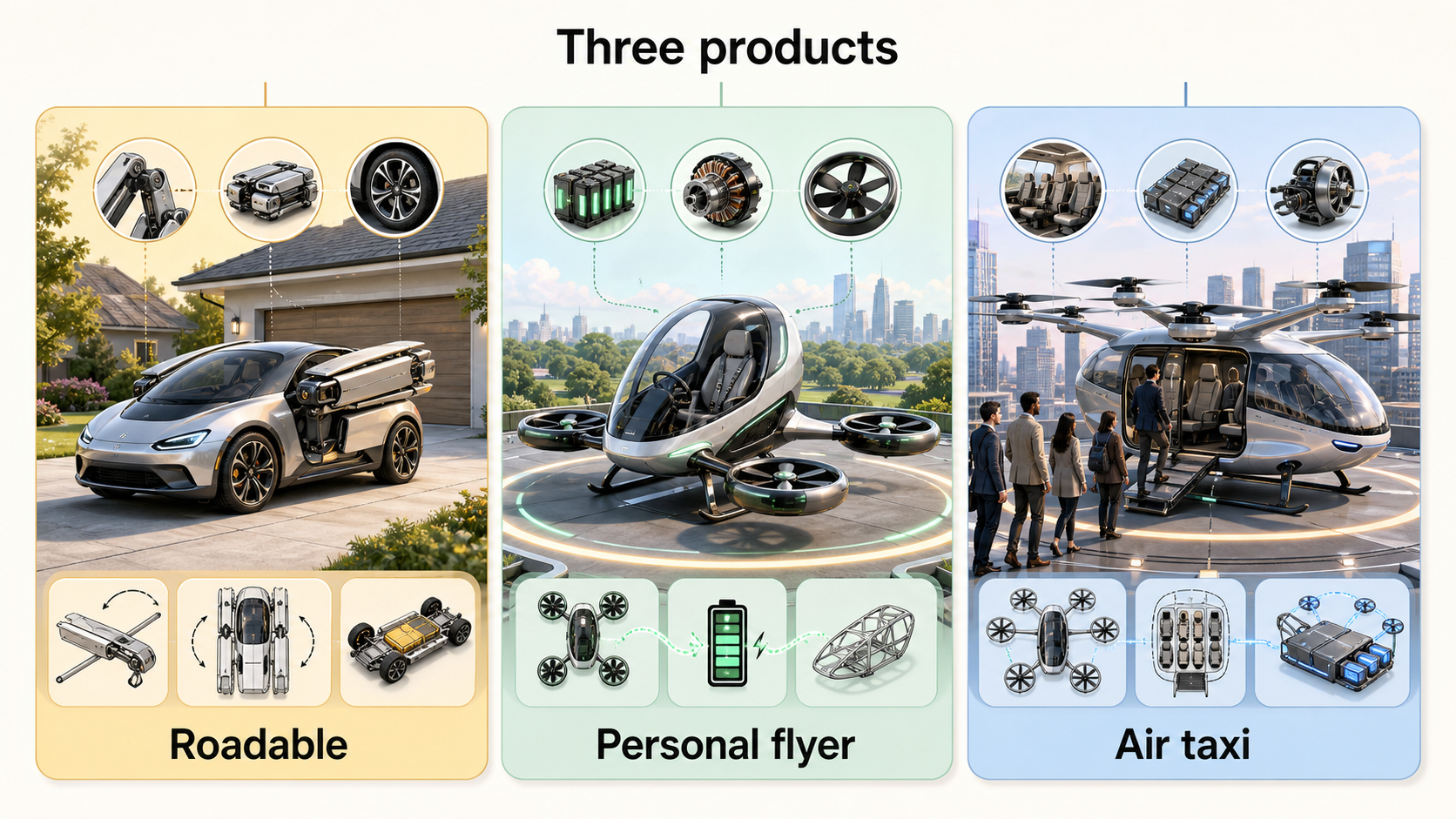
Reserve “flying car” for true road-plus-air claims. Use personal flyer or air taxi when that is what you mean.
The tempting mistake is to treat cheap camera drones as proof that suburbs will sound like airports. Shared motors are not a shared product.
That is what lets you refuse the driveway fantasy before you invent a local job.