Last updated: 2026-08-20
Fly a camera, or fly a box
A cracked insulator can travel as a photo. A unit of blood cannot. One flight moves bits. The other moves atoms. Mixing them up designs the wrong machine.
Without a payload, most civilian drones are expensive frisbees. The economic payload is often a sensor: a camera, a thermal imager, a mapping stack. That is the bits job — see the world, upload, let a person or a model decide. The atoms job is logistics: a small parcel, a sample, a bag of blood. Hovering to carry mass is expensive. Wings help. Weather, abort plans, and who meets the box at the pad matter more than they do for a photo.
Networks are the invisible airframe for both. A sensing flight can live with a short radio. A corridor beyond visual line of sight needs a link that survives the ridge. Improving the network can raise usefulness as much as improving the motor.
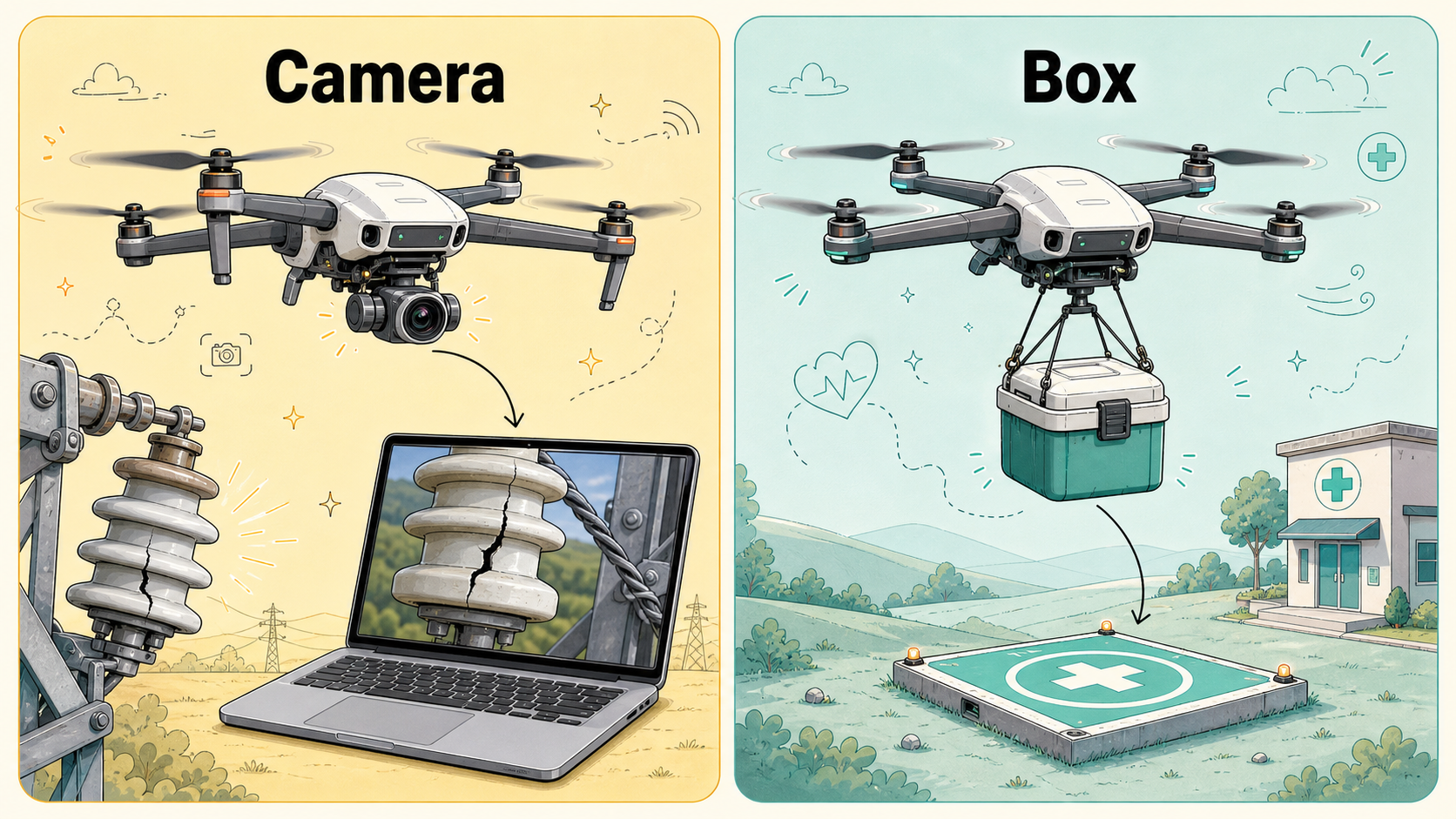
Say which job you are doing. Then the limits on the last page become a checklist instead of a fog.
The tempting mistake is to treat every drone as a flying van. Many of the best 2026 jobs never pick up a box. They pick up a picture.
That is what lets you name a local pilot that is honest about see versus carry.