Research · Resets · stocks
Debt cycle
Last updated: 2026-07-30
Mechanism
❓ Why do debt cycles end in resets across civilizations?
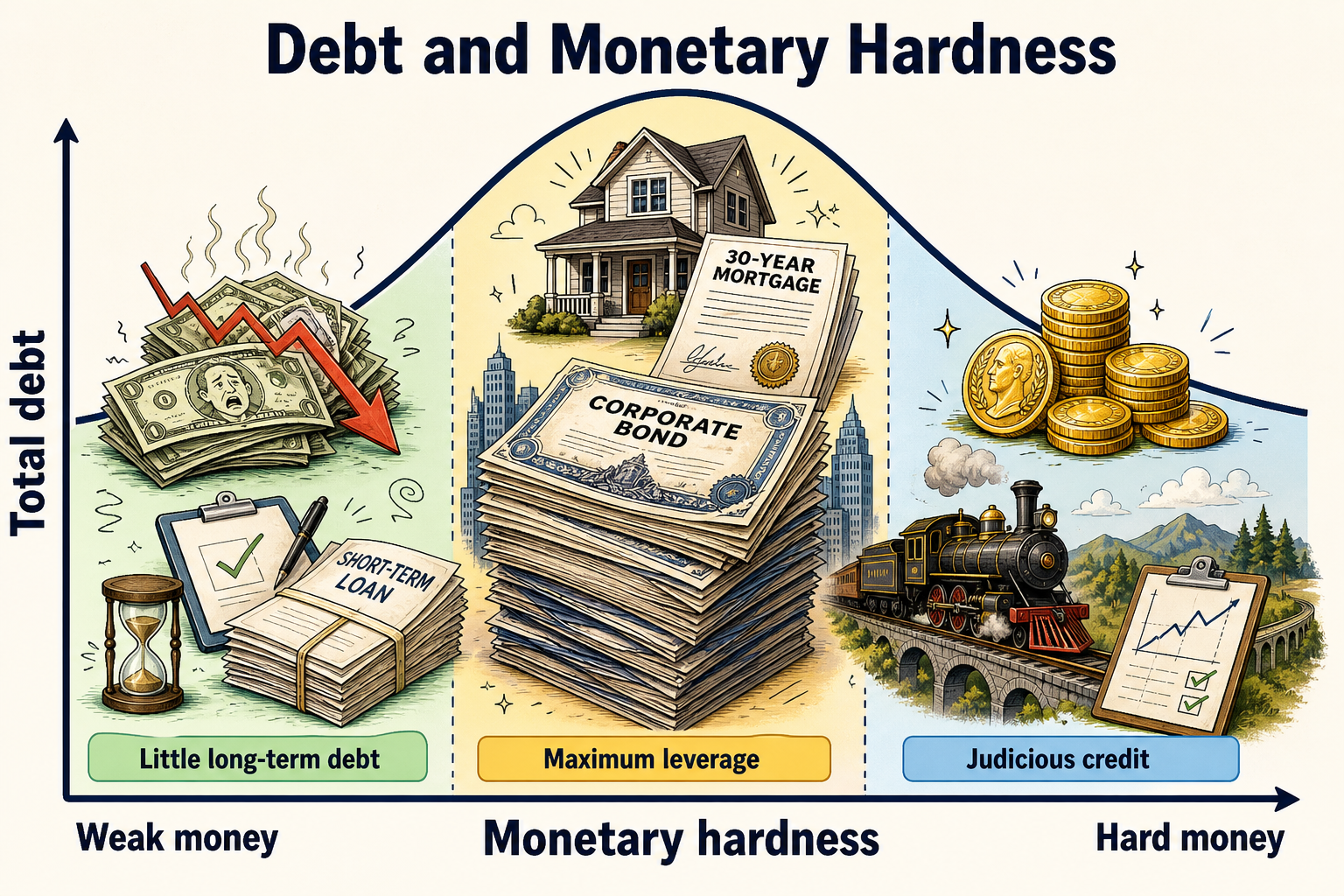
Debt is a promise of future money. Compounding claims can outrun the economy’s ability to service them in real terms. Wealth and credit claims concentrate; losers face debt peonage (historical) or medical/student/consumer traps (modern). When legitimacy fails, resets arrive via default, inflation, restructuring, or revolution (Chapter 19).
2008 as surface event
❓ Was 2008 only bad mortgages?
Bad underwriting and ratings were the spark. Fuel was multi-decade claim buildup: Alden cites end-2007 US total debt ~$52.7T on a monetary base ~$837B—order-of-magnitude more claims than base. Zero rates and emergency base doubling followed when private credit seized.
Global debt now (2024–2026)
❓ Did the world delever after COVID?
No full reset. IMF Global Debt Monitor (2025): global debt stabilized near ~235% of GDP (public+private), still above pre-COVID ~230%, after a 2020 peak near 258%. IIF commentary in late 2025 reported still-rising nominal global debt stocks (figures vary by methodology—use as directional). UNCTAD (2025): global public debt ~$102T in 2024; developing-country public debt growing faster since 2010. IMF Fiscal Monitor path: global public debt rising toward ~100% of GDP later this decade under baseline projections—driven heavily by US and China.
Trend classification: debt/GDP is a slow stock with cyclical pulses, not a pure exponential LOAR; political willingness to inflate or restructure is the regime variable.
Fiscal dominance
❓ Are central banks independent enough to stop entropy?
When sovereign debt service and rollover needs dominate, monetary policy becomes constrained (fiscal dominance). “Independence” is legal form; crisis coordination is recurring practice. Alden treats CB independence partly as myth under stress—consistent with post-2008 and post-2020 joint actions.
Dalio parallel
❓ How does this relate to Dalio’s long-term debt cycle?
Overlapping: debt peaks, internal conflict, monetary debasement, external order stress. Differences: Alden’s money-as-tech / speed-gap spine and stronger emphasis on open digital bearer assets as a novel exit technology.