Research · Telecom vs metal
The speed gap
Last updated: 2026-07-30
Mechanism
❓ What is the speed gap, exactly?
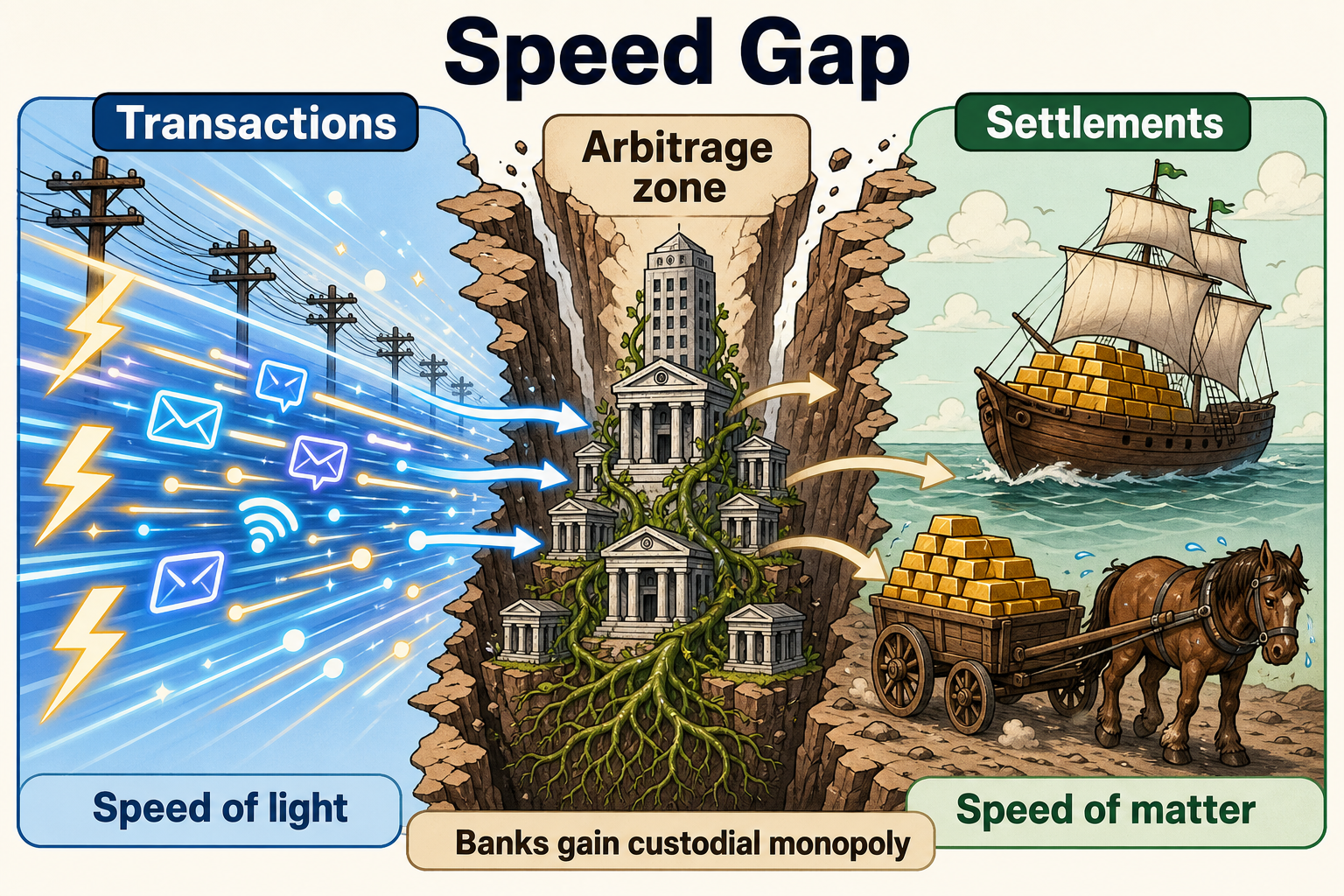
For most of history, messages about trade and bearer money moved at human/animal/ship speed. Banking netted obligations but could not beat travel. The telegraph (working systems from the 1830s; durable transatlantic cables by the 1860s) and later the telephone made ledger updates move near light speed across oceans. Gold and silver still required physical transport and verification.
Alden’s Chapter 8 states the consequence: people and institutions shifted to interconnected bank accounts; metal became a slow vault asset; currency units became political between creditors and debtors. W. Stanley Jevons, writing in the 1870s, already described world clearing concentrated through hubs while metallic reserves thinned relative to claims.
Soft money beat hard money on speed. That is the path-dependent break.
Why moral gold stories are incomplete
❓ Was leaving gold only moral failure?
Alden argues no. Maintaining gold MoE after telecom required ever-heavier abstraction (paper claims, centralization). Abstraction invited over-issue. War finance shattered convertibility repeatedly (Chapter 9). 1971 completed a long process more than it invented a new sin.
Do FedNow, PIX, UPI close the gap?
❓ Instant retail payments seem to erase the problem—do they?
They erase payment latency inside trusted banking networks. They do not create a globally portable, non-liability, hard-supply bearer asset. They make the state/bank ledger nicer. That is valuable and orthogonal to “who can freeze, inflate, or sanction the unit.”
Stablecoins add 24/7 transfer of dollar claims on public chains; redemption still sits with issuers and banks. Speed of claims ≠ scarce settlement.
Refutability
❓ What would kill the speed-gap thesis?
Evidence that scarce bearer assets settled at global electronic speed for ordinary commerce throughout the telegraph era without claim intermediaries—or that pure claim systems show no systematic debasement advantage for issuers—would break it. Neither holds in the historical record Alden uses.
External note
Payment-system modernization is real (FedNow operational; PIX-scale systems in Brazil; UPI in India). Treat them as claim-rail upgrades, not refutations of monetary hardness problems.