A long-form essay
Who Holds the Stamp?
Why claim ledgers run the world — and what freezes, debt entropy, and open rails change.
Last updated: 2026-07-30
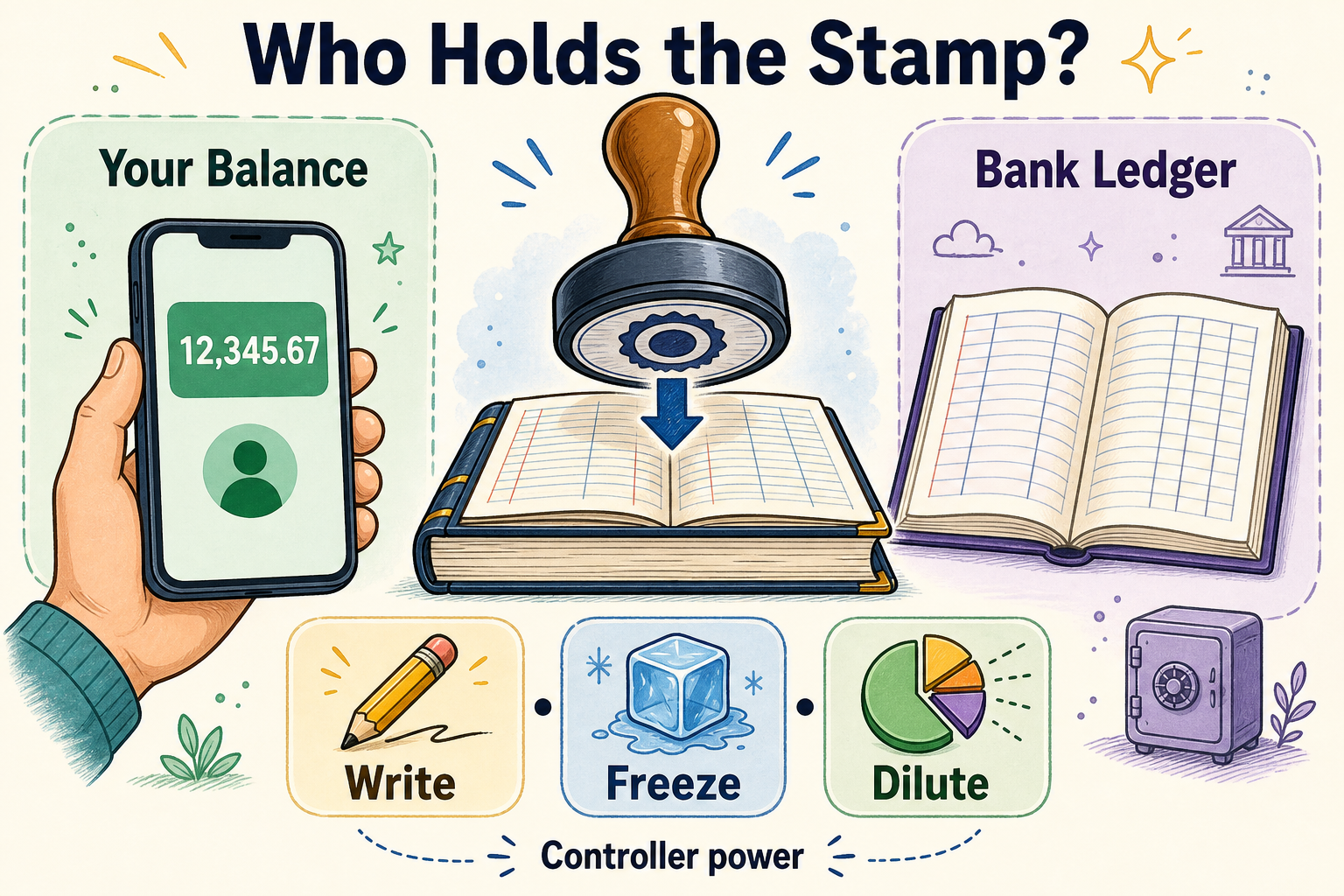
Money is a ledger. Whoever can write it, freeze it, or dilute it holds a kind of power older than any app. The global financial system is not merely having a rough decade. It is built so that fast commerce runs on claim ledgers controlled by banks and states, while scarce settlement—the thing that used to discipline those claims—cannot keep up. Savers on the wrong side of that design lose purchasing power. People on the periphery lose whole currencies. People near cheap credit and crisis liquidity win.
This essay is the story of how that design came to be, what it does to ordinary lives, and what the next forks look like.
I. The woman who robbed her own bank
In September 2022, in Beirut, a twenty-eight-year-old interior decorator named Sali Hafiz walked into a bank with what turned out to be a toy gun. She was not after strangers’ money. Lebanon’s banks had locked depositors out of their own savings through a grinding financial collapse. Hafiz’s sister, Zeina, had cancer. The family needed funds that existed as numbers on a bank screen and refused to become cash. So Hafiz forced the issue. She became a folk figure overnight—Lebanon’s “Wonder Woman”—and a fugitive. Reuters later found her on the run, insisting she was not a criminal. She had only wanted what the ledger said was already hers.
That scene is the whole argument in one room. A bank deposit is not a gold coin in a drawer. It is a liability of the bank—a promise. When the promise breaks, the law and the guns point at the customer who tries to collect, not only at the ledger-keeper who failed.
The same year, far from Beirut, American tech firms learned a faster version of the same lesson. Silicon Valley Bank did not die from a cartoon villain. It died from duration risk and a digital run. Clients had parked huge uninsured deposits; the bank had parked those funds in long bonds that fell when rates rose. On March 8, 2023, SVB announced a securities sale and a capital raise. By March 9, withdrawals hit about forty-two billion dollars. On March 10, regulators closed the bank—one of the largest U.S. failures since 2008. Depositors were later made whole by extraordinary official action. The lesson for the system was not that runs are over. It was that claim money still runs, only faster, and that backstops still choose who gets the parachute.
Two cities. One mechanism. Your “money in the bank” is permissioned speech in value form.
II. Money is a ledger
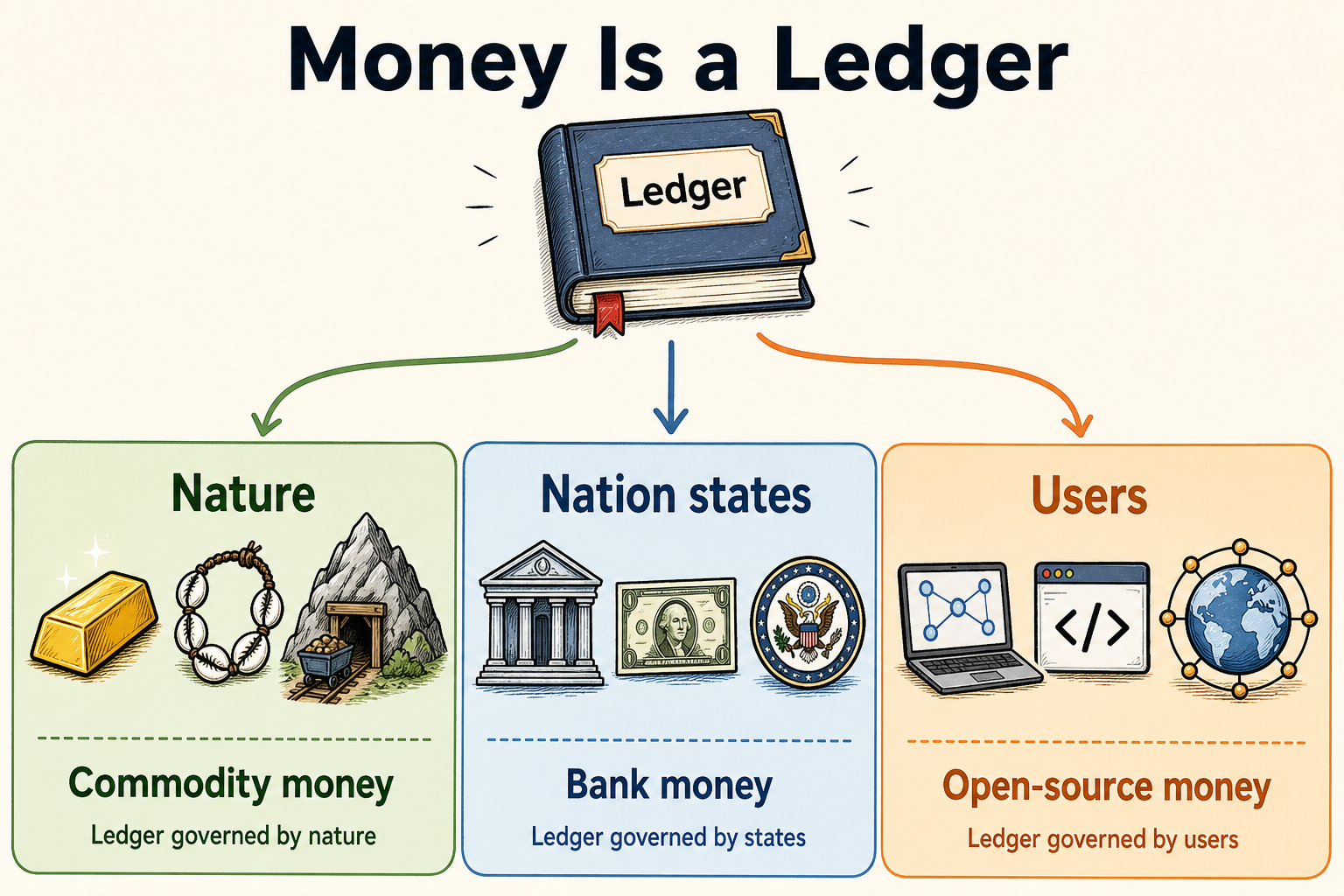
Strip the romance. A ledger is a record of who may transfer value to whom. Clay tablets did it. Shells and gold did it when nature made them hard to fake. Bank books do it now. Central banks keep the master pages for national systems.
Two old schools fight about origins. One says money emerges as a scarce good that strangers accept. The other says money is debt and obligation on a social or state record. Both describe real history. Both miss the shared core if they fight alone. The core is the ledger. The fight is who writes it.
Nature-controlled ledgers resist printing by decree and move slowly. State- and bank-controlled ledgers move quickly and can be diluted, frozen, or bailed out. User-controlled open networks—when they work—try to put scarcity and rules outside any single issuer. A balance on an exchange is still a bank-like claim with better branding. A token with a mint button is a club ledger. Controller identity is not a slogan. It is the variable that predicts freezes, hyperinflations, and bailouts.
“Money is a shared delusion” is a bad explanation. Belief helps adoption. Soft monies still die when someone can expand supply cheaply and skim the difference. Scarcity is not decoration. It is the cost of forgery.
III. Banks made commerce faster—then owned the rails
Banking’s original genius was not printing. It was netting. Merchants could clear many trades without shipping metal for each one. Hawala networks, bills of exchange, and double-entry bookkeeping turned trust and paper into speed. Transactions (daily trade) separated from settlements (final transfer of the scarce thing).
Fractional reserve banking pushed further. A bank holds only a fraction of demand claims as immediately available base assets and lends the rest. Credit expands. Runs become logical: more promises than instantly deliverable base. Free banking tried market discipline. Central banking socialized the backstop and standardized the unit—and put politics at the base of the money.
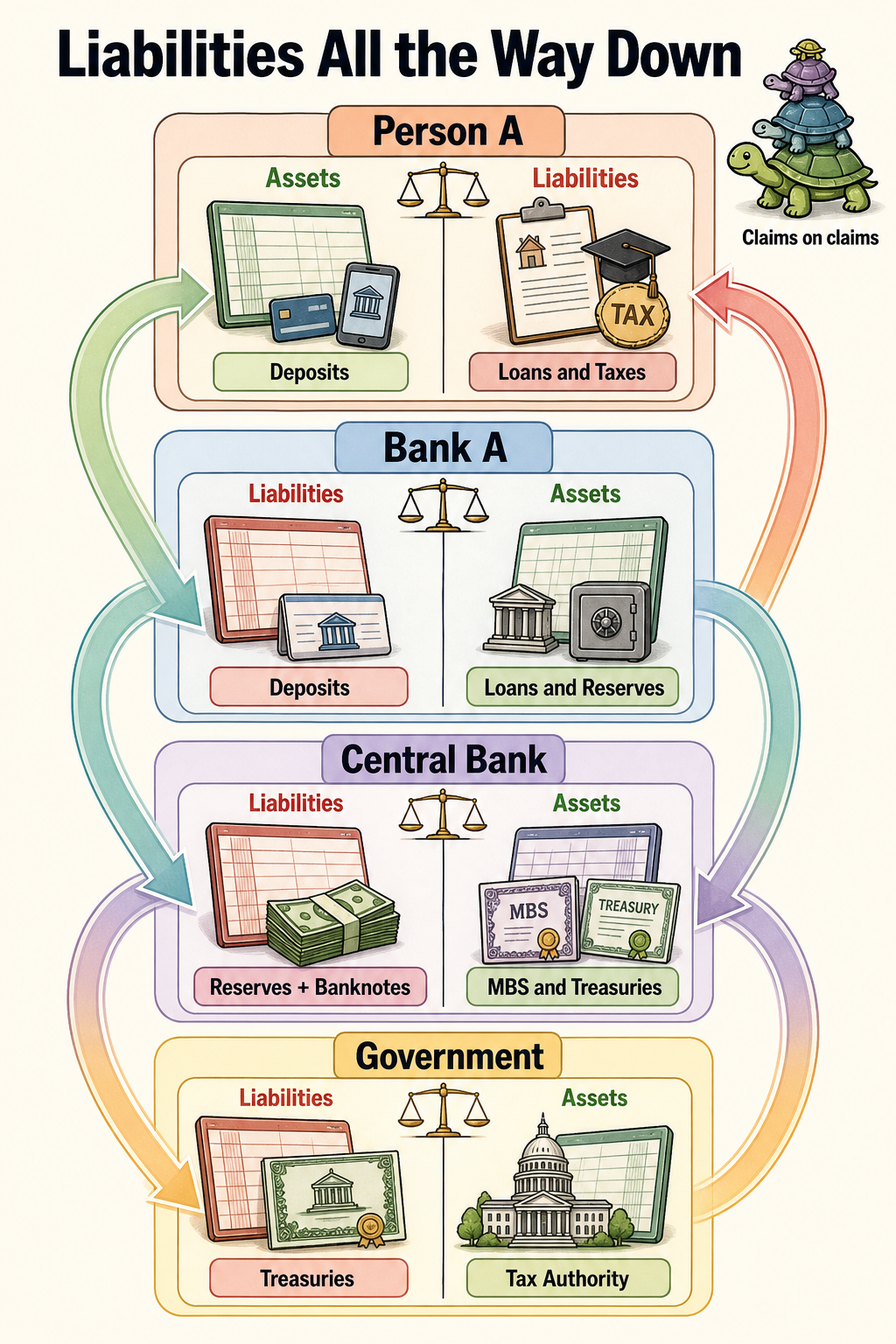
Your deposit is the bank’s liability. The bank’s reserve is a claim on the central bank. In pure fiat, the base is a central-bank liability backed by policy credibility and government paper, not a redeemable metal bar. Liabilities all the way down. That is why a stamp on a bank works, and a stamp on a coin in your pocket does not.
IV. The speed gap
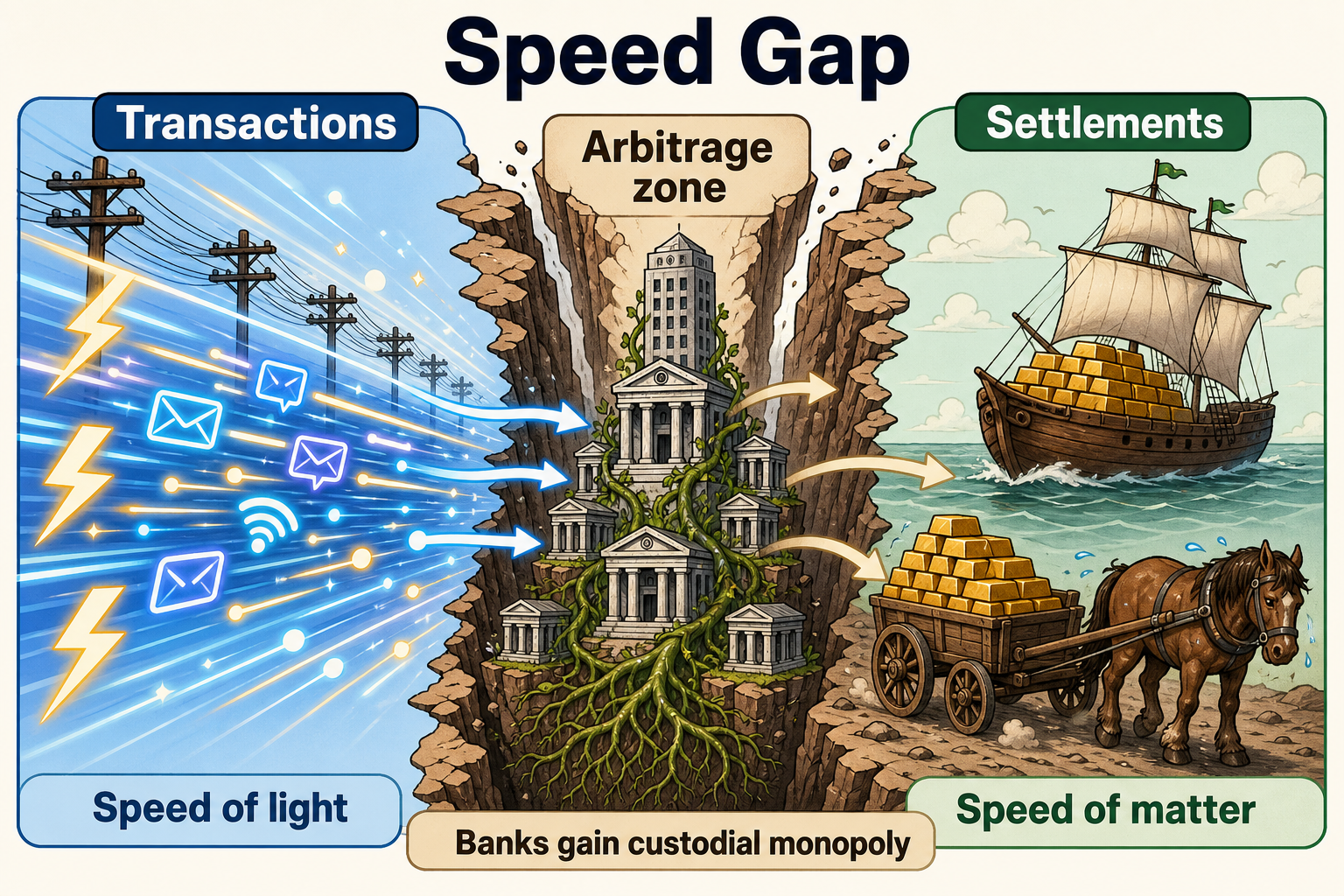
For most of history, messages about trade and bearer money moved at the same pace: foot, horse, ship. Then the telegraph arrived. Working systems in the 1830s; durable transatlantic cables by 1866, when the Great Eastern helped put a lasting line into service between Ireland and Newfoundland. Messages crossed oceans in minutes. Gold still crossed in holds.
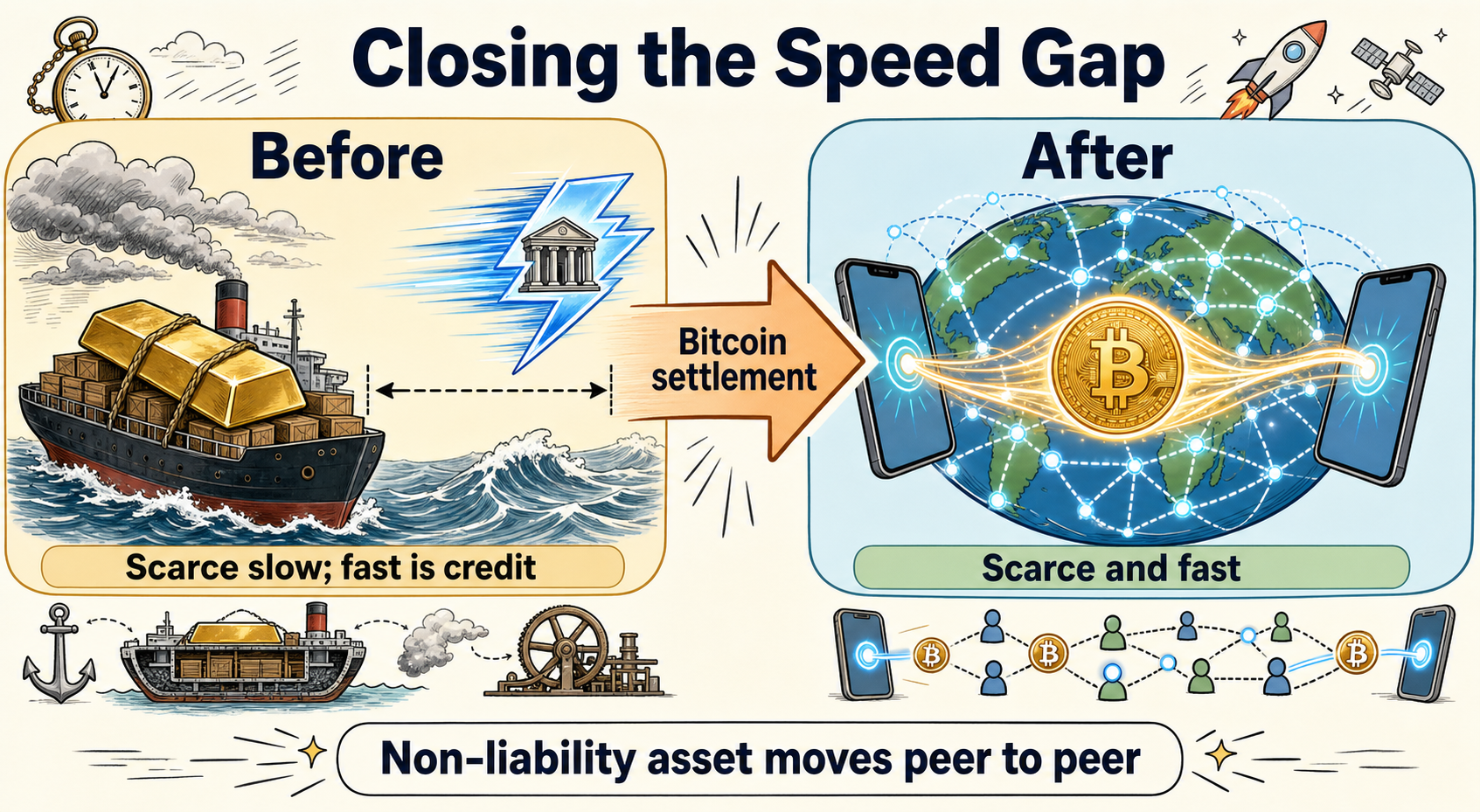
That mismatch is the speed gap: transactions at light speed, scarce settlement at matter speed. Soft claim money beat hard metal money on the attribute commerce cared about most—speed. W. Stanley Jevons, writing in the 1870s, already saw world clearing concentrating through hubs while metallic reserves thinned relative to claims. Banks and states took full control of the fast path. Gold retreated into vaults and jewelry and political debate.
Modern instant payment systems—FedNow-class rails, PIX, UPI—make the bank ledger nicer. They do not restore a scarce bearer asset you can settle globally without asking an intermediary. They close payment latency. They do not close the monetary problem.
Stablecoins move dollar-like balances twenty-four hours a day on public networks. Redemption still sits with issuers and banks. Fast claims are not the same as scarce settlement.
V. War, Bretton Woods, and the gold window
War finance teaches states the same lesson every century. Taxes are slow. Printing and suspending convertibility are fast. Honesty dies under emergency and often stays dead.
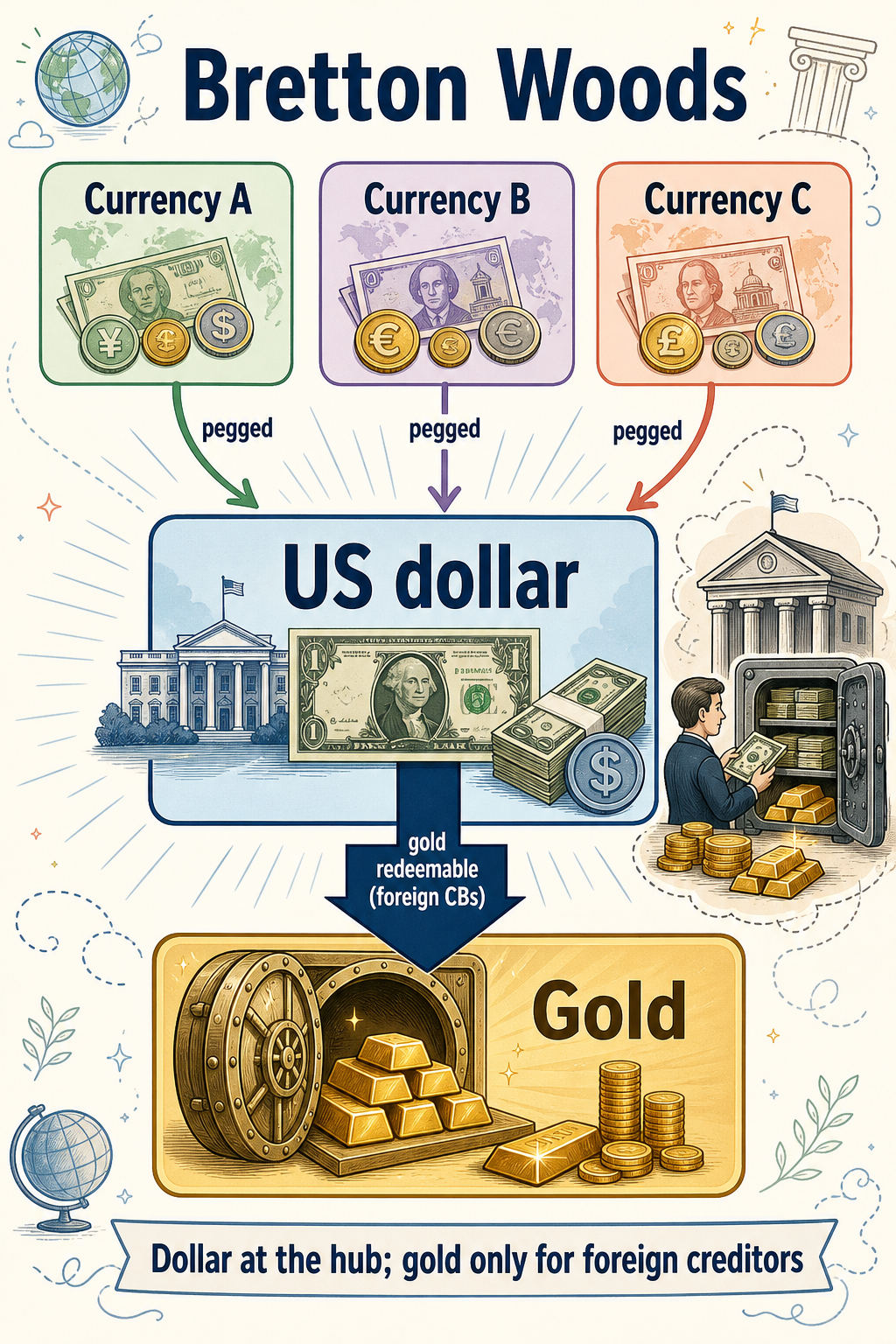
After the Second World War, Bretton Woods tried a hybrid: other currencies pegged to the dollar; the dollar tied to gold for official holders. It exported dollar liquidity and imported the Triffin tension—the world needed dollars, and dollars eventually outran gold confidence. On August 13–15, 1971, at Camp David, Richard Nixon and a small group of advisers including John Connally, Arthur Burns, and Paul Volcker decided the break. On the evening of August 15, Nixon told the nation the United States would suspend dollar convertibility into gold. Foreign governments could no longer swap dollars for metal at the window. The international system slid into pure claim money at the center.
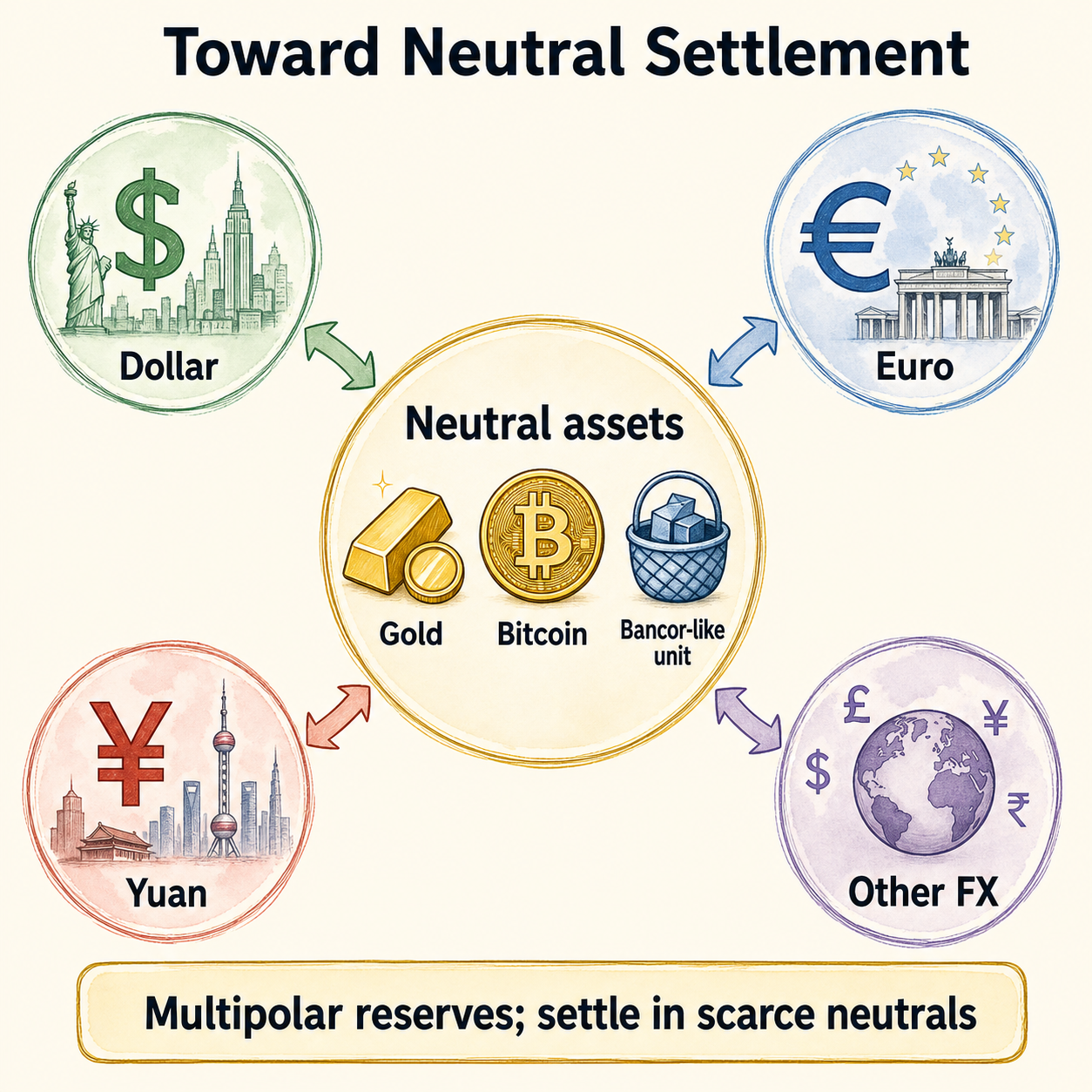
Oil invoicing, deep U.S. capital markets, and network effects kept dollar demand alive—the petrodollar pattern. The crown is heavy: the reserve issuer supplies the world’s safe asset and absorbs political blowback when that asset is weaponized. After 2022 sanctions on Russian reserves, commentators predicted a dollar dump. Official reserve data through 2024–2025 still show the dollar near roughly fifty-eight percent of disclosed foreign-exchange reserves—drifting, not collapsing. Alternatives remain shallow. Chaos still shows up first on the periphery: serial devaluations, capital controls, black-market dollars in envelopes.
Egypt halves a currency and a hundred million people renegotiate life. Argentina and Türkiye print triple-digit inflation into G20 membership. The core calls it emerging-market volatility. The mechanism is hierarchy.
VI. How pure fiat creates and destroys
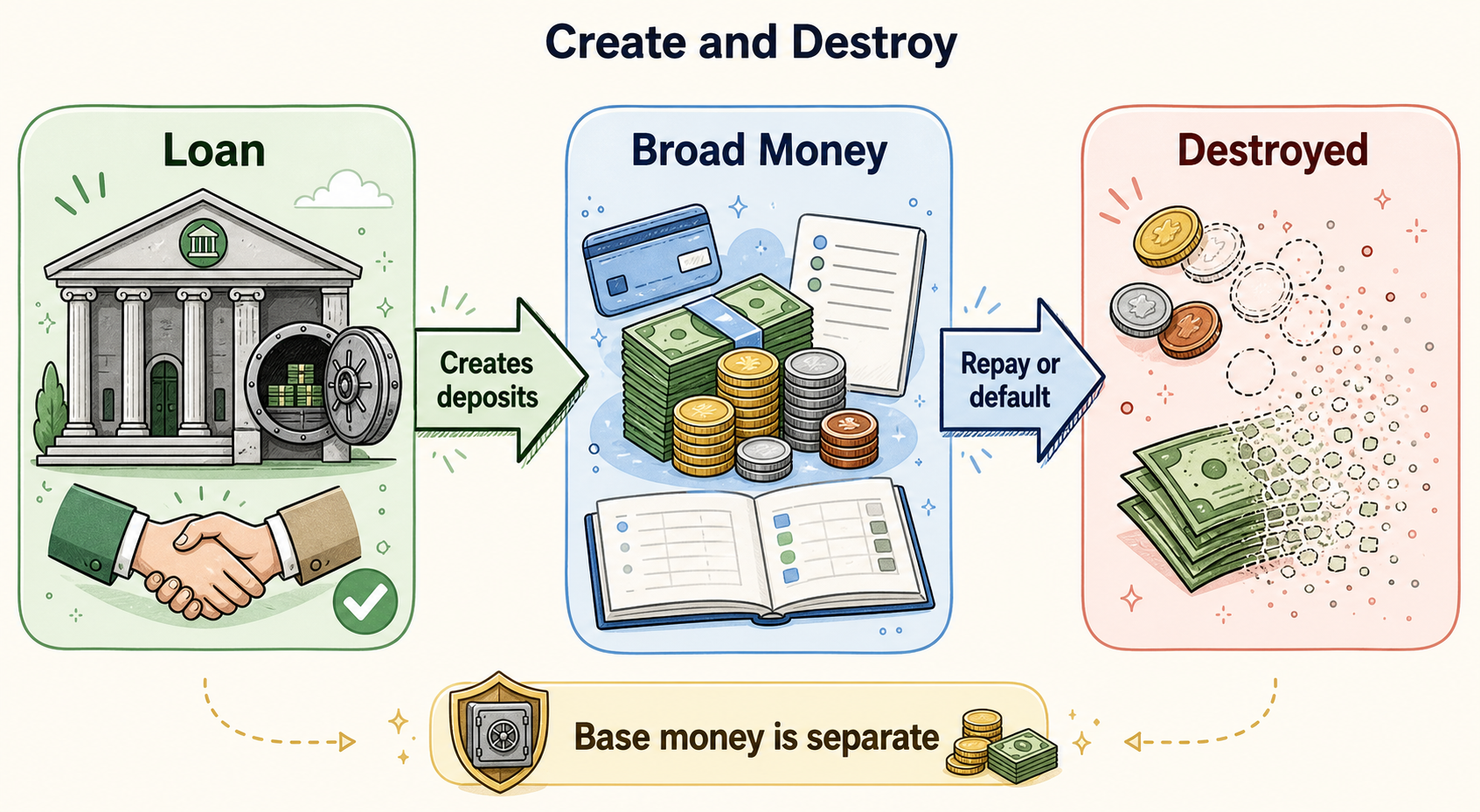
Base money is currency in circulation plus bank reserves at the central bank—a direct central-bank liability. Broad money is mostly the public’s bank deposits and close substitutes. In a simplified picture, loans create deposits; repayment and default destroy them. The central bank expands base money when it buys assets or lends into the system and can shrink it when it runs balance-sheet runoff.
Across a century, U.S. base and broad measures grew by orders of magnitude. Gold above ground grows on the order of one to two percent a year. Many national broad monies grew far faster for decades. The residual claimant of dilution is the saver paid in the unit.
Not every expansion hits consumer prices the same way. After 2008, large-scale asset purchases mostly swelled bank reserves. In 2020, base expansion paired with huge fiscal transfers into household and firm accounts. By 2021–22, consumer inflation hit multi-decade highs in advanced economies. Who holds the new deposits matters. Transmission is not a single dial labeled “print.”
By late 2025 the Federal Reserve had cut a swollen pandemic balance sheet from roughly 8.9 trillion dollars toward about 6.5 trillion and ended quantitative tightening, aiming to keep bank reserves “ample.” Global debt, public plus private, still sat near about 235 percent of world GDP in 2024 IMF monitoring—above pre-COVID levels. Public debt alone reached on the order of a hundred trillion dollars worldwide. Stocks of claims do not vanish because an app got faster.
This is entropy in the institutional sense: claim systems tend toward more promises, then reset through inflation, default, restructuring, or bailout politics. Elasticity can save a week. It does not erase the cycle.
VII. Financialization and the credit ladder
When the unit of account is a bad store of value, people bid scarce real things as substitute money. Gold carrying a monetary premium is mostly a curiosity for industry. Housing carrying a monetary premium prices nurses out of cities. Empty investment flats are not a vibe. They are monetary premium parked in concrete.
There is a rough bell curve. In collapse currencies, nobody offers honest thirty-year fixed debt. Under hard money, borrowers leverage carefully. In the soft middle—devaluing but not yet dead—debt culture thrives. Short the melting unit. Long the scarce asset. Stay levered enough to ride dilution, not so levered you die first in a recession—unless you are large enough that death is optional.
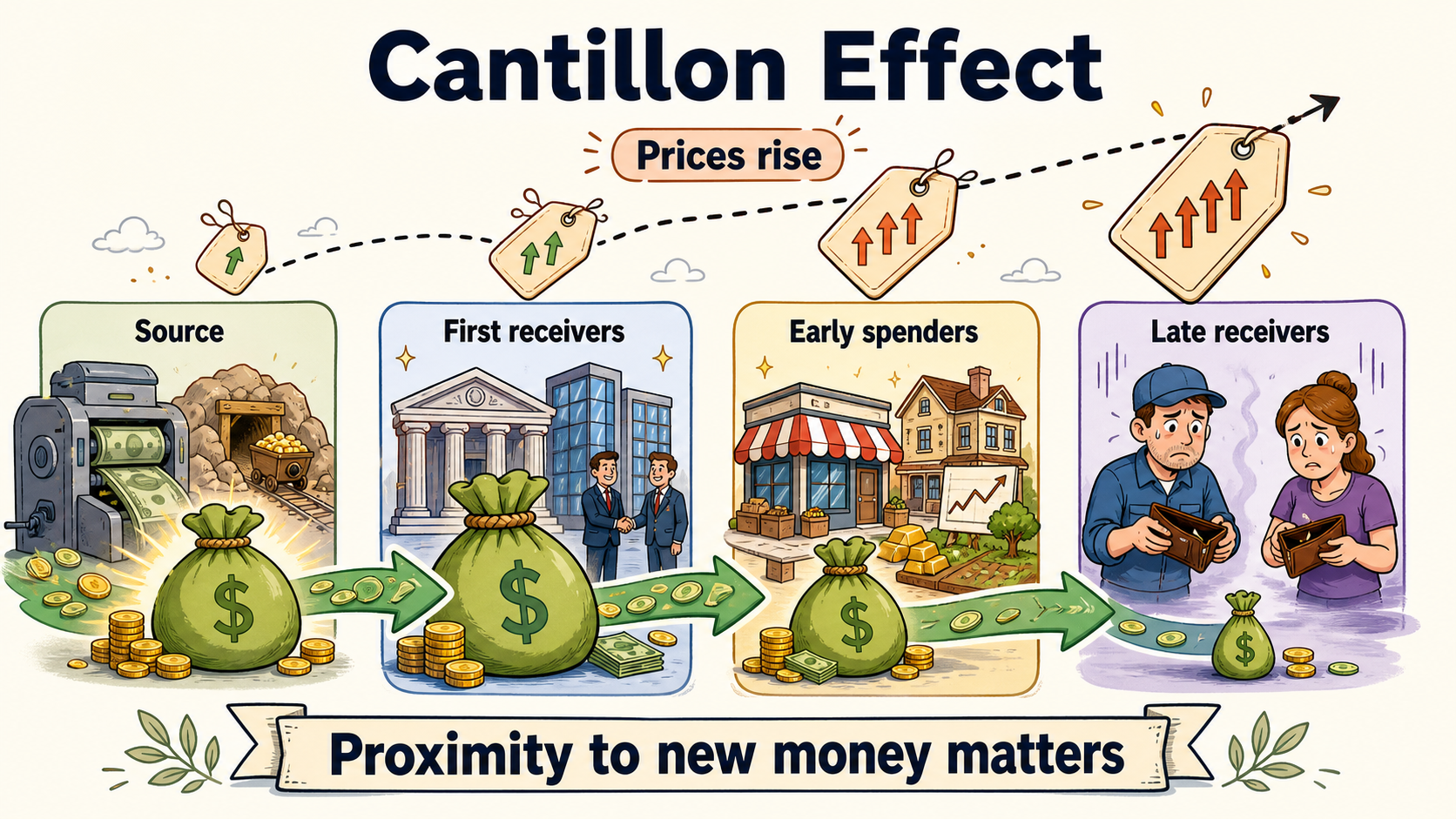
Cantillon effects name the uneven arrival of new money and cheap credit. First receivers spend before prices fully adjust. In modern form, the ladder matters more than the printing press photograph. At the top sits the sovereign that always finds a bid, including from its central bank. Next, global banks and megafirms with collateral and bond markets. In the middle, households and small firms with cyclical access. At the bottom, payday rates and overdraft fees.
Crisis reveals preference. In 2008, large banks received emergency support while many homeowners did not. In 2020, proximity to programs and balance-sheet strength again sorted winners. Progressive tax rhetoric can coexist with regressive monetary channels. Some central-bank research finds modest inequality effects from ordinary rate moves compared with education and technology. That critique has force for fine-tuning. It is weaker against the political economy of who gets the permanent cheap leverage and the emergency parachute.
VIII. The long debt cycle, without mysticism
Debt is a promise of future money. Promises compound. Real economies and political patience do not compound forever at the same rate. When claims concentrate and legitimacy fails, resets arrive. Ancient harvest failures produced debt bondage and periodic jubilees. Modern versions look like medical debt, student debt that outlives a career, or sovereigns that inflate away the real burden.
2008 was not only bad mortgages. It was a spark on a multi-decade pile of claims. When private credit seized, official balance sheets and guarantees expanded. The pattern repeated in new clothes in 2020. The surface story changes. The substrate—claim growth until stress—rhymes.
IX. Candidate exits, and how they break again
One technological ambition is to close the speed gap: a scarce asset that settles over networks without a central mint. Open proof-of-work networks try to make history expensive to rewrite with real-world energy cost, so “what happened” is not pure vote among coin holders. Layers on top try to move small payments without putting every coffee on a global mainframe. Success is not guaranteed. Capture through custodians and funds can recreate gold certificates: convenient claims that rarely test the vault. Fee markets after issuance subsidies remain an open empirical question. States can harass on-ramps. Users can lose keys.
Proof-of-stake systems can power applications. For neutral base money meant to serve adversaries, circular validation—coins choose the ledger that defines coins—worries people who want history external to ownership.
Stablecoins export dollar claims onto open rails. Under local inflation they are a lifeline. They are still dollars. Issuers can freeze. Banks can cut. Laws such as the European Union’s MiCA regime and the U.S. GENIUS Act of 2025 pull payment stablecoins into formal supervision. The state is not confused about who owns the claim layer.
Central bank digital currencies can improve wholesale plumbing. Retail designs can also finish what cash’s decline began: programmable, freezeable public money with perfect audit trails. Voluntary adoption has often been weak where private alternatives exist. Dual tracks are possible—compliance rails beside exit rails—if exit stays legal and usable.
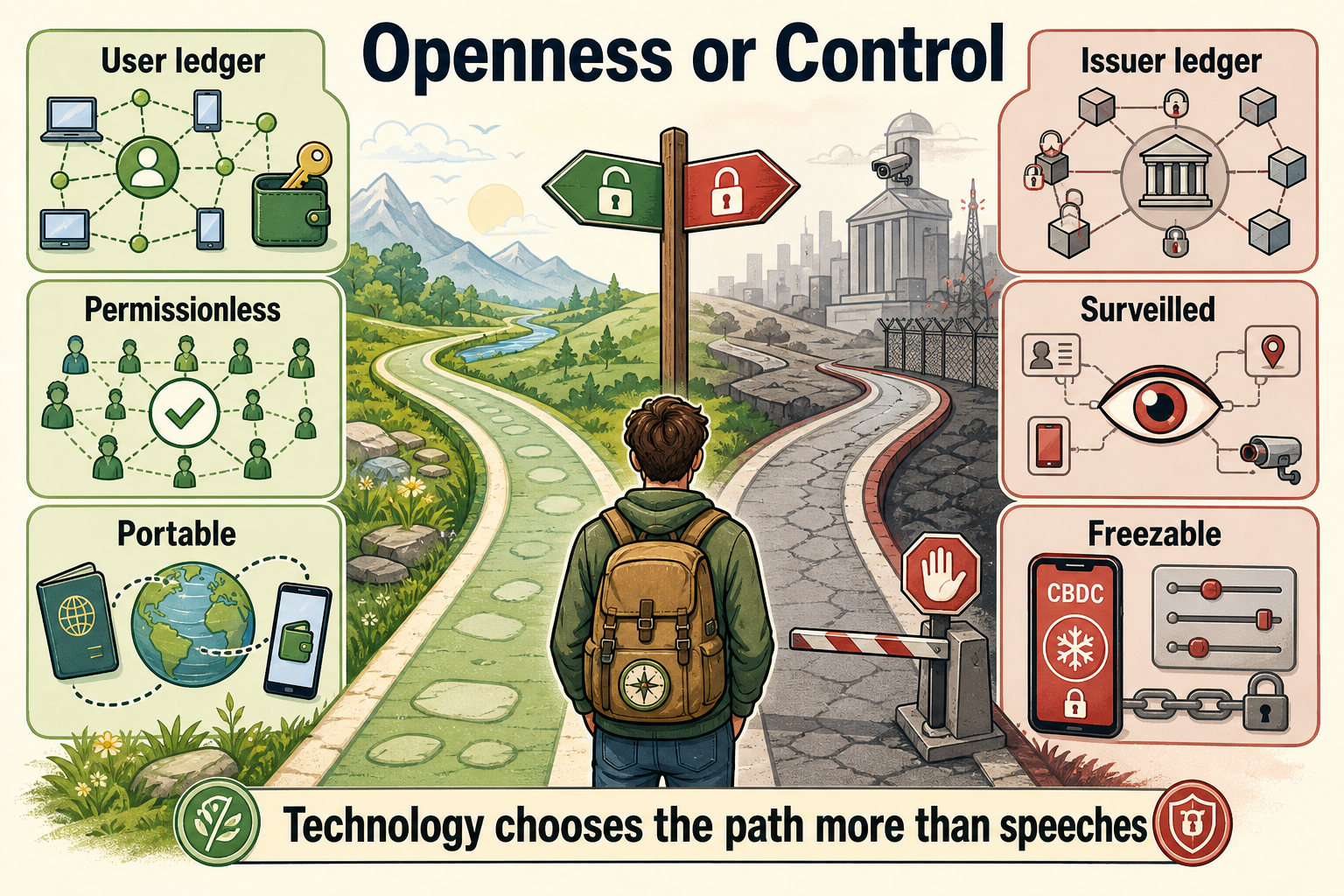
Every exit can re-break the system. Stables recreate hierarchy. CBDCs recreate the stamp. Custodial crypto recreates deposits. Leveraged DeFi recreates casinos. The question is never “is it digital?” The question is who holds the stamp.
X. Freezes as civil infrastructure
In February 2022, Canada invoked the Emergencies Act during the Freedom Convoy protests. Financial institutions were ordered to cease services to designated persons. Accounts froze. Crowdfunding froze. Courts later fought over legality and rights. The mechanical fact remains: deposit rails are policy surfaces.
Nigerian activists have described bank freezes during protests and the turn to open-network donations. Russian opposition networks under pressure have used similar tools when banks became instruments. Cashless pushes and total digital payment coverage shrink the private residual that cash once left by default. Cryptography raises the cost of remote seizure. It does not abolish law. It changes the price of control.
Human rights lists that include property, movement, and expression collide with money systems that can silence value with an API call. That collision is not a footnote. It is the Beirut toy gun in slower motion.
XI. What a careful mind does differently
Stop asking whether “the market” is broken this quarter. Ask five questions of any monetary claim.
Who can write or freeze this ledger?
What is the scarcity rule for the unit?
Is this base money, a bank claim, or a leveraged bet?
What is my exit under stress?
Who stands nearest to new credit when crisis hits?
Instant apps are not answers. Hardness, controller identity, and exit cost are answers. The woman in Beirut already knew. The system trained her the hard way.
The stamp reaches the bank.
It does not automatically reach the key.
References
Research base: Research package · Research references
Story and fact anchors used in this essay:
- Reuters / Al Jazeera coverage of Sali Hafiz (Hafez), Beirut, Sept 2022
- Silicon Valley Bank run and failure, March 8–10, 2023 (FDIC/Wikipedia/academic summaries)
- Transatlantic telegraph cable service, July 1866 (Heart’s Content)
- Federal Reserve History / State Department milestones on Aug 15, 1971 gold window suspension
- IMF Global Debt Monitor 2025; UNCTAD World of Debt 2025
- Fed FEDS Note on international role of the dollar (2025); IMF COFER
- CRS on Fed balance sheet / QT end 2025
- Canada Emergencies Act measures, Feb 2022
- GENIUS Act, Public Law 119-27 (July 18, 2025)
Enrichment stories (additional): see the research appendix for the full dossier.
Framing credit
The mechanism spine of this essay — money as ledger, the speed gap, fiat entropy, Cantillon ladders, and the openness-versus-control fork — is indebted to Lyn Alden’s Broken Money (2023). See the research appendix Sources for full bibliographic credit and chapter mapping.
Full dossier
Thirteen research sections, sources, and the master question ledger behind this essay.