Research · Credit ladder
Cantillon
Last updated: 2026-07-30
Definition
❓ What is the Cantillon effect here?
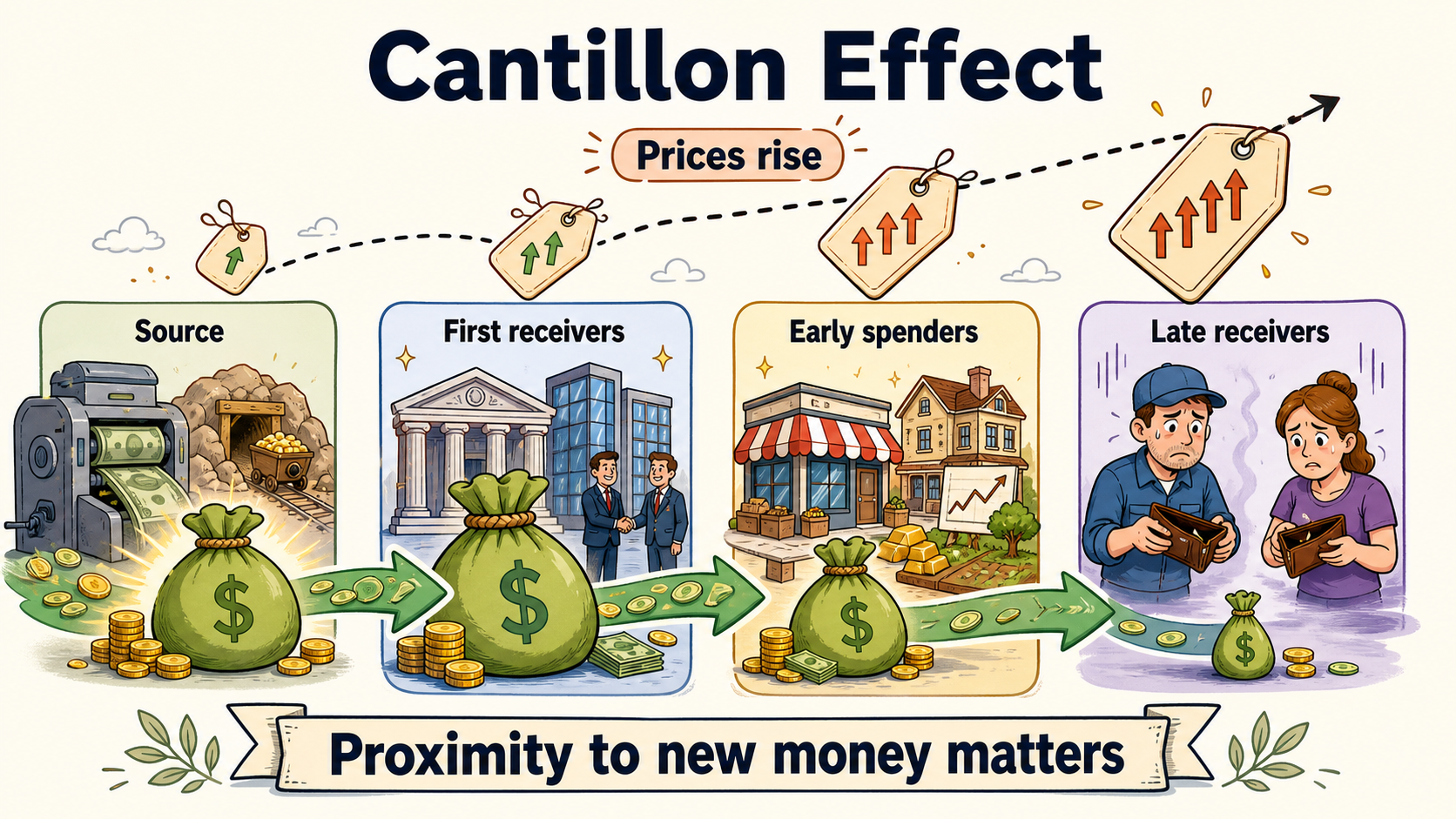
Cantillon effect: new money and cheap credit do not arrive uniformly; first receivers spend into markets before prices fully adjust, gaining real command over resources. In modern form, the key channel is unequal access to low-rate, long-duration credit and crisis liquidity—not only literal helicopter drops.
Credit ladder
❓ Who stands where on the ladder?
Top: sovereign that can always find a bid (including central bank).
Next: global banks and large corporates with capital-markets access and collateral.
Middle: households/SMEs with cyclical mortgage and loan access.
Bottom: payday/credit-card rates, overdraft fees, no collateral.
Risk pricing explains some spread. Soft-money regimes amplify the wealth gap because shorting the unit with cheap long debt is a primary accumulation technology (Chapter 18).
Bailouts as revealed preference
❓ What do 2008 and COVID show?
Selective liquidity and capital support to large intermediaries during fire sales lets connected balance sheets buy assets while households and smaller firms face tighter credit. PPP fraud and uneven COVID support are messy fiscal cousins of the same proximity problem. Optics of progressive taxes can coexist with regressive monetary channels.
Empirical debate (contrarian integrated)
❓ Do serious economists say Cantillon is overstated?
Yes. Central bank research (e.g. Cleveland Fed commentary tradition) often finds modest distributional effects of conventional policy relative to education, technology, and globalization; channels conflict (employment gains vs asset prices). Academic work also finds expansionary shocks can raise wealth inequality via portfolios even when income effects are ambiguous.
Weighing: Alden’s claim is strongest as political economy of crisis backstops + structural cheap leverage, weaker as a claim that every basis-point move is a primary inequality driver. Both can be true at different magnitudes.
Neutralization without hard money?
Harder: broader access to index assets, housing supply, competition policy, and limiting emergency privileges. Those are partial. They do not erase seigniorage asymmetry at the sovereign/CB apex.