Research · Who writes it
Money as ledger
Last updated: 2026-07-30
Definition
❓ What is money if we start from ledgers rather than from coins or from state decrees alone?
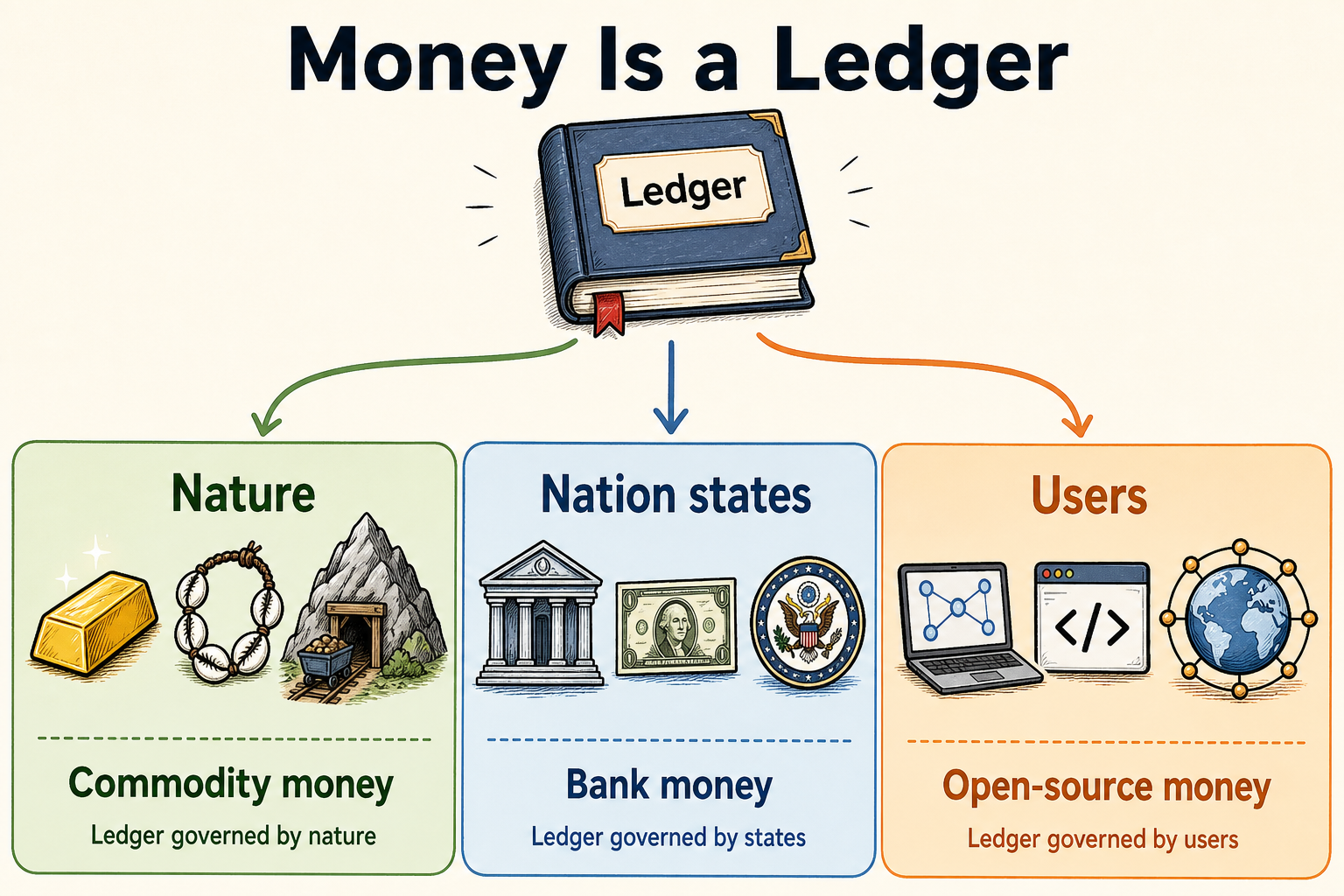
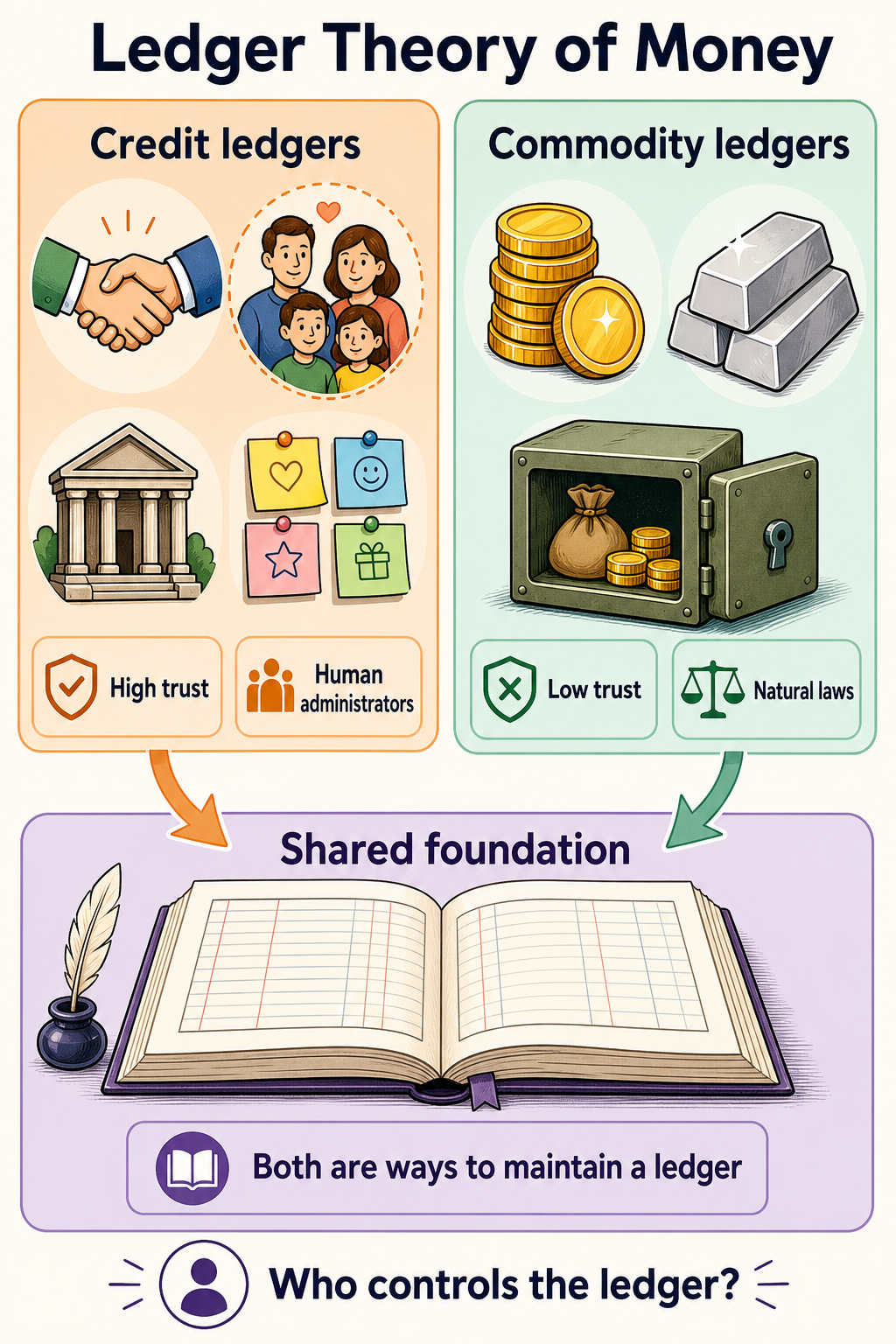
A ledger is a record of who may transfer value to whom. Money is whatever society uses as the dominant ledger entry for pricing, saving, and settling. That entry can be a physical object nature makes hard to forge (commodity money) or a book entry maintained by humans (credit/fiat money). Alden’s unified theory (Chapter 4) says both schools are partial: commodity theory (Menger tradition) explains emergence among strangers; credit theory (Knapp, Mitchell-Innes, much modern chartalism/MMT) explains tax-driven and social obligation ledgers. The shared substrate is the ledger. The fight is who writes it.
Three controllers
❓ Who can control a monetary ledger?
| Controller | Example | Strength | Weakness |
|---|---|---|---|
| Nature | Gold, historically scarce shells | Hard to print by decree | Slow to move/verify at planetary scale |
| States & banks | Fiat deposits, CB reserves | Fast, legible to law/tax | Dilution, freeze, political capture |
| Users (open rules) | Self-custodied bitcoin-like systems | Rules not unilaterally rewritten | UX, volatility, political hostility, immature scale |
Crypto-branded balances on exchanges sit in the middle column. Tokens with mint keys sit in club-ledger space. User control requires keys + enforceable consensus + exit.
Why “shared delusion” fails
❓ Is money just collective belief?
Belief matters for adoption, but soft monies die when someone can expand supply cheaply and extract seigniorage until users flee. Stock-to-flow (inventory relative to new production) is Alden’s durability filter: gold’s high ratio resists debasement; beads and tobacco failed when technology or abuse collapsed scarcity. A good explanation must include cost of forgery and expansion, not only coordination.
Legal tender and tax demand
❓ Why do people still use bad fiat?
Taxes, legal tender rules, and network effects force interaction with the official ledger even when it is a bad savings vehicle. That is chartalist insight inside the unified frame—not a full refutation of scarcity’s role in cross-border and store-of-value choice.
Good explanation note
Controller identity is hard to vary: if you delete “who writes the ledger,” freezes, hyperinflations, and gold’s historical MoE role become disconnected anecdotes.