Research · Structural diagnosis
What broken means
Last updated: 2026-07-30
The diagnosis is structural, not seasonal
❓ When Alden says the financial system is broken, what exact failure is she naming?
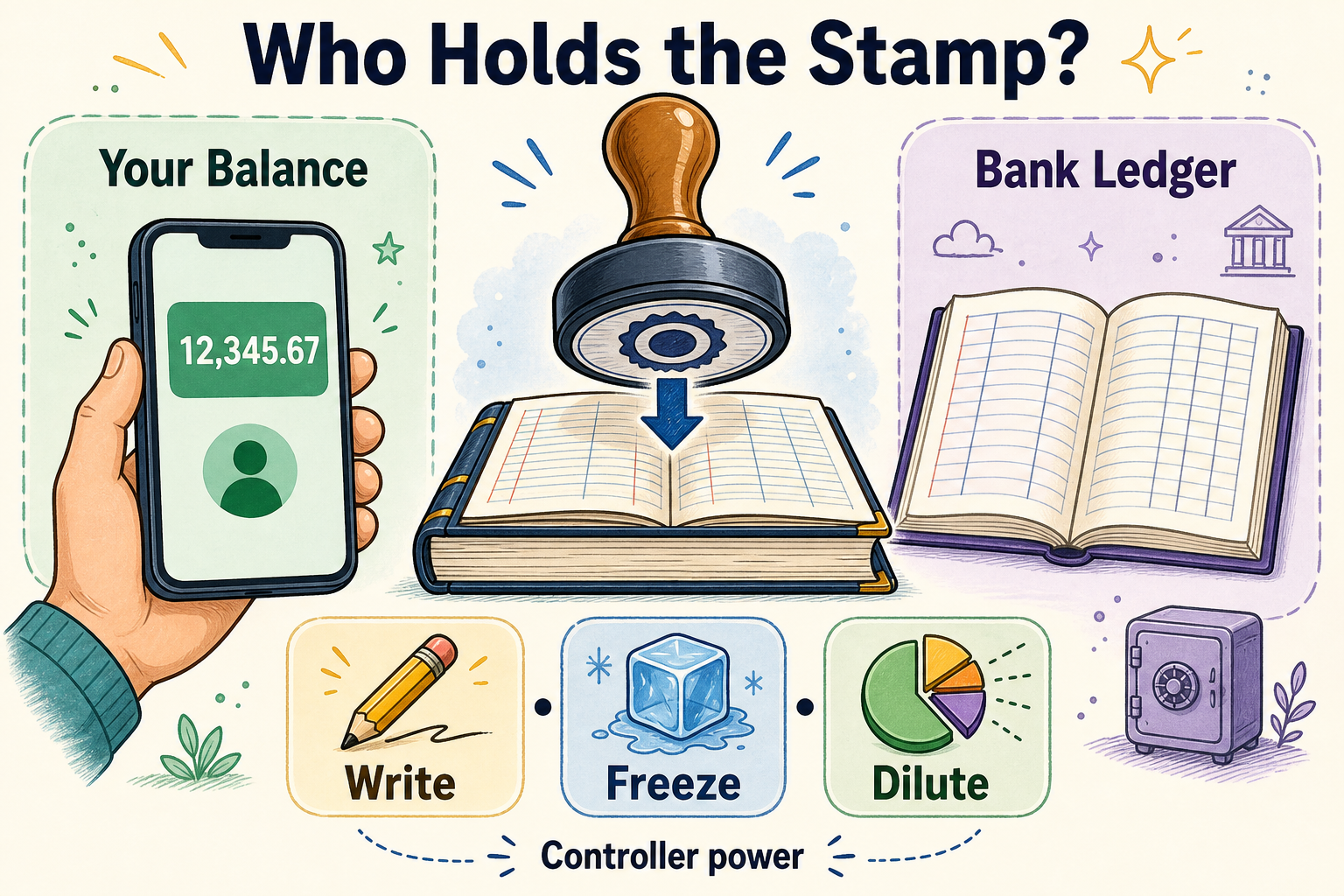
She is not mainly complaining that this quarter’s markets are ugly. She is naming a foundational mismatch: modern money is mostly a political claim ledger that must grow or reset, not a scarce settlement asset ordinary people can hold and move globally without asking permission. Intro cases—Lebanese depositors “robbing” banks for their own money, Nigerian inflation and cash-war politics, Egyptian devaluations that halve savings, Turkish and Argentine triple-digit inflation, 2020’s pile of negative-yielding debt, 2023 US regional bank stress—are symptoms of one machine, not separate scandals.
Broken means: savers cannot reliably store purchasing power in the unit they must use for wages, taxes, and payments; periphery populations absorb violent devaluations; advanced economies paper over debt with base-money expansion and financialization; and deposit money is freezeable by policy.
Broken for whom
❓ Is the system broken for banks and treasuries, or mainly for households on the wrong side of credit?
For large sovereigns and well-connected financial firms, the system often “works”: they issue the unit, access the cheapest credit, and receive crisis liquidity. For median savers and the monetary periphery, it fails as a savings technology and sometimes as a payment technology under capital controls. A system can be stable for its operators and broken for its users. Alden’s intro deliberately starts outside the US core.
Technology over pure morality
❓ Does she blame bad politicians, or a tech path that made soft money win?
Both appear, but the distinctive claim is technological path dependence. Critics who say “if only we had stayed on gold” underweight that gold could not settle at telecom speed. Fractional reserve and central banks were responses to real constraints before they became engines of dilution. Politics chooses how aggressively to exploit seigniorage; technology set the menu.
She explicitly refuses omniscient forecasts. The book is a map of mechanisms so readers can update themselves.
What would count as less broken
❓ What observable world would falsify or soften the diagnosis?
A world where the unit of account is hard to dilute, long-term fixed-rate credit is priced honestly without perpetual bailout expectation, essentials are not bid as pseudo-money by leverage, periphery countries are not serial devaluation machines, and individuals can exit bad ledgers without confiscatory friction—would be “less broken” on her scoreboard. Instant bank apps alone do not qualify.
Why this is a good explanation (Deutsch checklist)
Hard to vary: Swap “speed gap + claim control” for “people got greedy” and you lose the 19th-century telegraph timing and the post-1971 pure-fiat pattern.
Depth: Names create/destroy rules, not vibes.
Reach: Explains Lebanon freezes and US home price/income stress with one frame.
Refutability: Sustained hard-money MoE at global digital speed without claim intermediaries would force major revision.
Criticism note: “Broken” is normative; some macro schools call the same facts “flexible nominal anchor success.”