Last updated: 2026-08-01
05 — Schmachtenberger: Superorganism, Attractors, and Misalignment
❓ What does Daniel Schmachtenberger add to Moloch when the topic is AI and civilizational risk?
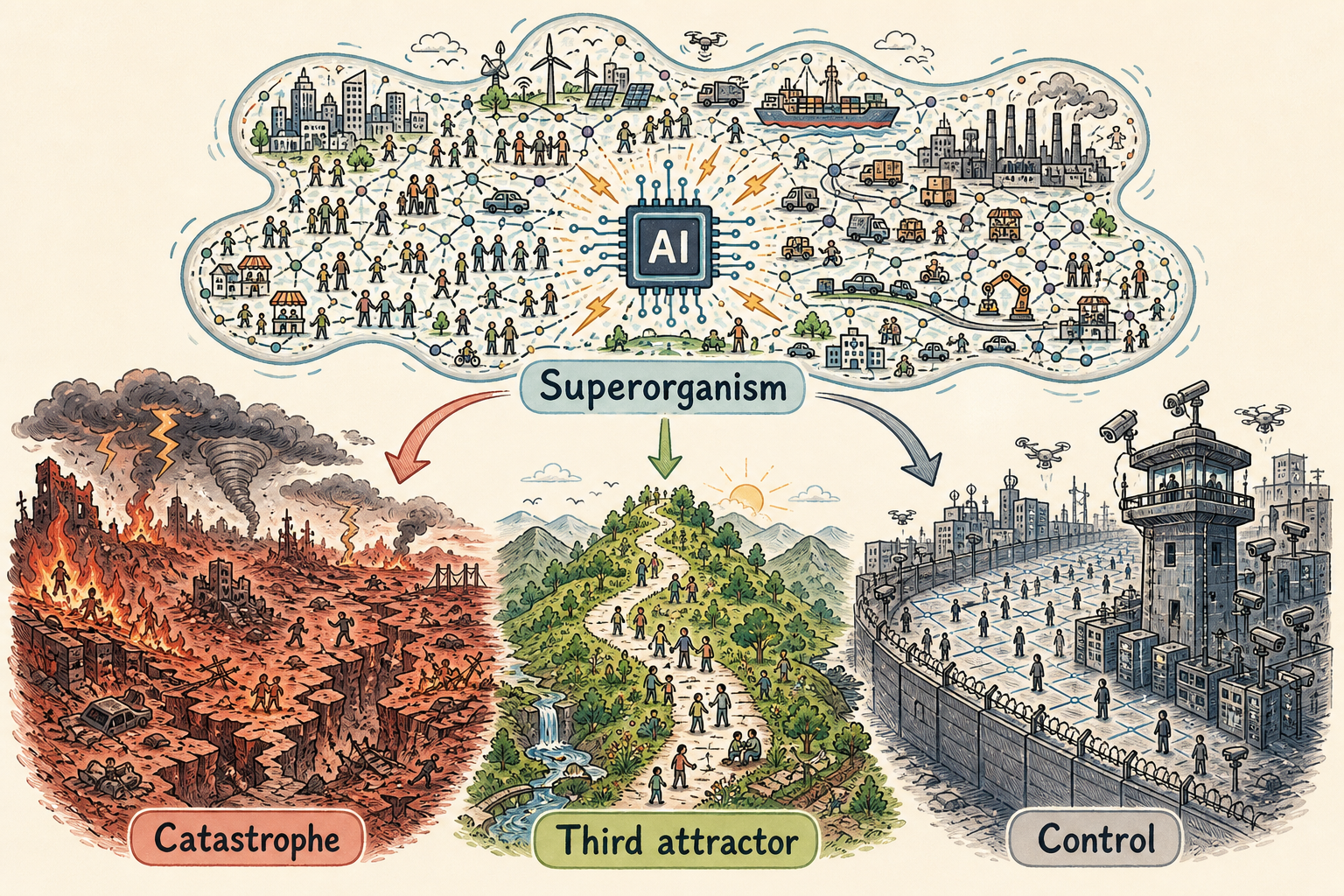
Scott Alexander gives a sharp micro-to-macro catalog of multipolar traps and a transhumanist endgame. Daniel Schmachtenberger (often with Liv Boeree, Nate Hagens, and others) embeds the same game-theoretic core in a civilizational systems story: humanity already behaves like a poorly steered superorganism driven by multipolar races; AI is rocket fuel for that superorganism’s misaligned metabolism. The bad guy is less a future demon in a server rack alone, and more the incentive ecology we already live inside, scaled.
Primary touchstones for this chapter: the Win-Win conversation Misalignment, AI & Moloch with Liv Boeree; Artificial Intelligence and the Superorganism with Nate Hagens (May 2023); Boeree’s public explainers on healthy vs unhealthy competition.
Moloch as structural misalignment (not only future ASI)
❓ How can Schmachtenberger say we “already have” something like misaligned AI?
In the Boeree conversation framing, Moloch is the pattern of race-to-the-bottom optimization embedded in markets, media, and geopolitics — a meta-cybernetic dynamic hard to regulate because regulators and firms are inside the same race. Misalignment is not introduced only when code exceeds human IQ; it is what happens when optimization targets (engagement, GDP slices, quarterly growth, kill-chain metrics) diverge from human and ecological flourishing, and selection favors agents who ride those targets.
Obligate structural pressure: Boeree/Schmachtenberger discussions of firms that must grow and compete (sometimes glossed as “obligate psychopath” dynamics in popular retellings) point at role requirements, not cartoon CEOs twirling mustaches. That matches Alexander’s refusal to reduce capitalism-Moloch to “greed.”
The superorganism
❓ What is the “superorganism,” and how does multipolarity define it?
In the Hagens dialogue, the superorganism is a way of seeing aggregate human civilization: energy-hungry, growth-seeking, boundary-blind, composed of competing parts whose local races produce a global metabolism. Schmachtenberger links multipolar traps to that metabolism: the race property is how the superorganism moves.
AI’s role: AI increases the efficiency and speed of sensing, persuading, trading, designing weapons, extracting resources, and optimizing the very metrics that already misfire. So AI risk is not only “new agent on the board”; it is acceleration of the existing misaligned agent (the superorganism), plus the later possibility of nonhuman competitors inside or above it.
This widens Alexander’s tech chapter: the river is not only “more opportunities to defect”; it is higher throughput on the defect pathways civilization already institutionalized.
Two attractors and a third
❓ What futures does Schmachtenberger say the dynamics point toward?
A recurring Schmachtenberger map (third-attractor talks; echoed in Boeree interviews):
- Catastrophe attractor — multipolar races + exponential tech → ecological overshoot, conflict, systemic breakdowns.
- Dystopian control attractor — in reaction, tight centralized surveillance and authoritarian stabilization (“order” purchased by crushing freedom). Popular commentary sometimes nicknames related centralization fears (“Norma” appears in some Boeree/Rutt-style discussions as a twin unhealthy pole to Moloch).
- Third attractor — a harder path: high coordination and high freedom, institutions and tech that solve multipolar traps without totalizing tyranny — wiser collective sensemaking, incentive redesign, intimate technology with different goal structures.
Alexander’s tyranny–discoordination axis is the same tradeoff in thinner strokes: monarchy/garden vs libertarian Moloch soup. Schmachtenberger insists the usable future is not picking one horn of the dilemma forever but building capacity for the third basin of attraction.
Capitalism, AI, and stacked races
❓ How do capital allocation and AI development form nested Moloch layers?
From the Win-Win chapter structure (Moloch framework → metacrisis → capitalism & Moloch → misalignment → incentive pressures → Moloch driving AI → pre-AGI risks):
- Layer 1: product and attention markets race.
- Layer 2: capital markets allocate to whoever wins Layer 1.
- Layer 3: states fear losing Layer 1–2 to rivals.
- Layer 4: AI development becomes the meta-tool that wins all previous layers.
Each layer’s X becomes input to the next. Safety and long-term stewardship are repeatedly non-X. Nested traps explain why ethical AI principles documents feel weak: they target individuals inside a stack that selects against costly principle-following.
Pre-AGI risks emphasized
❓ What goes wrong before superintelligence?
Schmachtenberger/Hagens-style lists include: accelerated misinformation and sensemaking collapse, autonomous and semi-autonomous weapons dynamics, labor and meaning shocks, energy and materials throughput, biosecurity tool diffusion, and tighter coupling of fragile global systems. These are Moloch-shaped when competitive deployment outruns governance. They matter even if AGI timelines slip — a crucial corrective to “only paperclips” discourse.
Healthy vs unhealthy competition (Boeree)
❓ How do we tell sports-like rivalry from Moloch?
Boeree’s public education thread (poker background → game theory):
- Healthy: shared rules, values preserved, absolute gains possible, defection punished, dignity of losers intact.
- Unhealthy (Moloch traps): scoreboards decoupled from collective goods; beauty-filter style races; engagement maxing; AI capability maxing without safety commons.
Instagram-face and breakfast-cereal style examples (in various Boeree talks) train intuition at small scale so AI-scale claims are less abstract.
Agreement and difference with Alexander
| Alexander 2014 | Schmachtenberger et al. | |
|---|---|---|
| Core mechanism | Multipolar traps / Moloch | Same, plus superorganism metabolism |
| Tone | Literary-analytic, LW-transhumanist | Metacrisis, sense-making, ecology |
| Endgame accent | Friendly singleton gardener (Elua) | Third attractor; redesign incentives; wisdom-bound intelligence |
| AI | Superintelligence seas | Pre-AGI acceleration + later SI |
| Authority tradeoff | Explicit tyranny vs discoordination | Two bad attractors + third path |
They are complements: Alexander is the crisp mechanism essay; Schmachtenberger is the civilizational dashboard and political psychology of living inside the superorganism.
Criticisms
❓ What are the strongest pushbacks on this framing?
- Vagueness: “Metacrisis” and “superorganism” can become unfalsifiable mood.
- Anti-growth bias risk: listeners may hear degrowth purity where the claim is about goal structure, not inventing stone tools.
- Implementation gap: third attractor is directionally right and operationally underspecified.
- Agency dilution: if “the system” did it, accountability evaporates — must still name firms, laws, and choices.
Good use keeps payoff matrices concrete (as Alexander does) while using Schmachtenberger for coupling and attractors.
Secondary Q&A strip
| Secondary | Answer |
|---|---|
| Is Moloch “evil AI” already? | Metaphor: misaligned optimization ecology, not literal AGI today. |
| Game B? | Cultural project-name overlapping third-attractor aspirations; not identical to a deliverable spec. |
| Why podcasts as sources? | Primary form of this body of work; treat as attributed talks, not lab papers. |
| Wisdom vs intelligence? | Recurring theme: unbound optimization (IQ/tools) without value-laden steering worsens Moloch. |
Superorganism as blind amoeba accelerating with AI; two cliffs (chaos vs control) and a narrow ridge between.