Last updated: 2026-08-01
02 — Multipolar Traps: The Core Mechanism
❓ What is a multipolar trap, and what single mechanism unites Alexander’s examples?
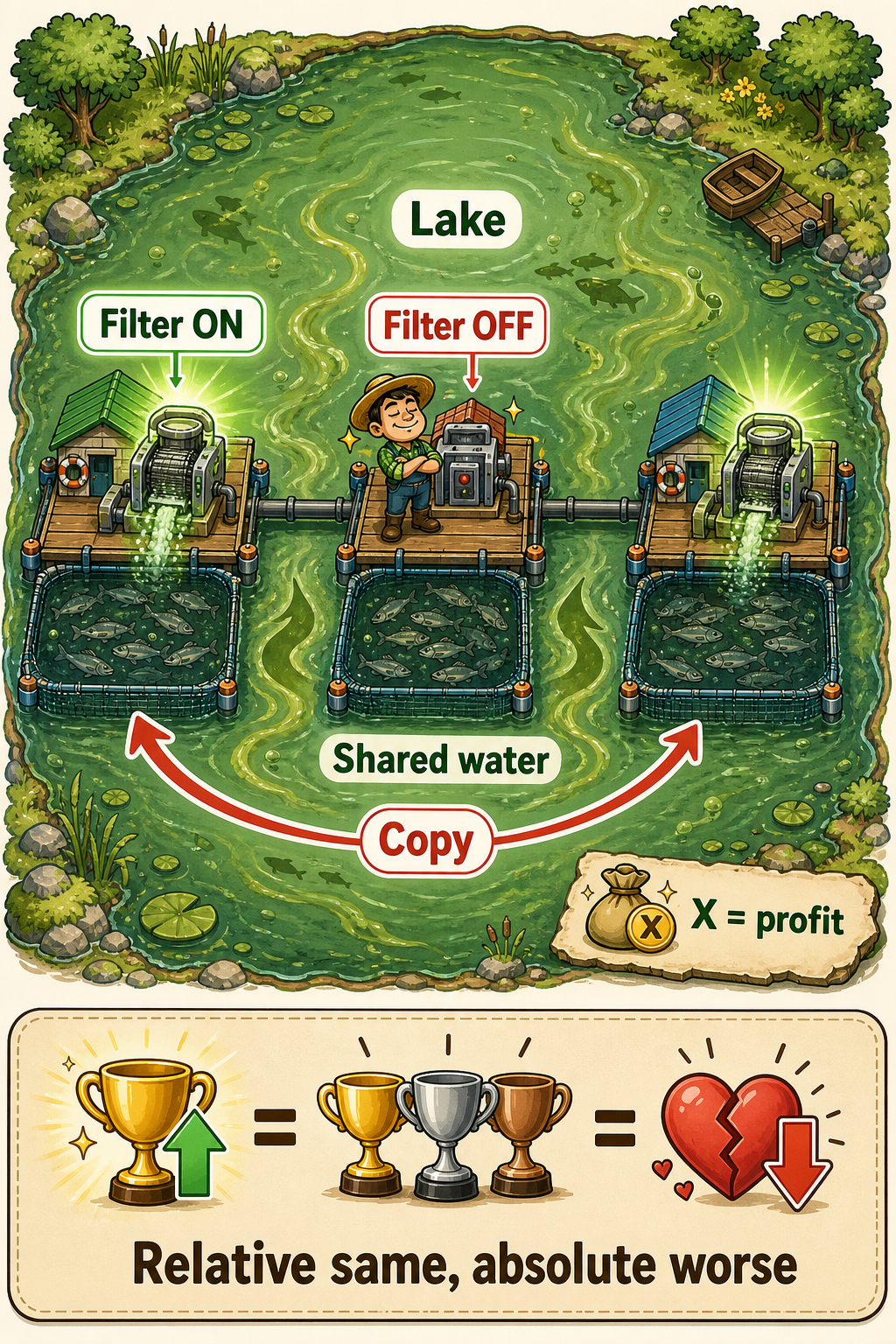
A multipolar trap is a multi-agent situation in which each participant has an incentive to take an action that, when widely taken, makes the group worse off — yet unilateral restraint loses. Alexander’s unifying principle:
In some competition optimizing for X, the opportunity arises to throw some other value under the bus for improved X. Those who take it prosper. Those who don’t die out. Eventually everyone’s relative status is about the same as before, but everyone’s absolute status is worse. The process continues until ingenuity cannot make things worse.
That is Moloch’s engine in one paragraph.
God-eye versus system-interior
❓ Why do “obvious” fixes never happen?
Almost every example has the same two viewpoints:
- God’s-eye-view: cooperate, keep filters on, shrink armies together, stop credential arms races.
- Within-system: my move is evaluated against competitors who may defect; if I alone cooperate, I lose.
Coordination is not a sermon problem; it is a commitment and enforcement problem. Without binding agreements (or equivalent social technology), the locally rational path is the collective wound.
Intense traps versus weak traps
❓ Are all multipolar failures races to subsistence?
No. Alexander splits roughly:
Intense competition (examples 1–10): values can be competed down toward subsistence or elimination — Prisoner’s Dilemma, dollar auctions, fish-farm pollution, Malthusian rats, cutthroat capitalism, two-income housing race, agricultural displacement of foragers, military arms races, cancer, regulatory race-to-the-bottom.
Weaker competition (11–14): not full collapse, but perverse failure to optimize — education signaling, scientific publication incentives, corporate welfare via electoral finance, Congress’s localism. People retain free time and surplus, yet cannot steer the institution toward the known better equilibrium. Moloch here feels less like famine and more like stolen free will.
Both are multipolar; intensity changes the floor.
Worked examples (mechanism, not catalog for its own sake)
Fish farms
❓ Why doesn’t voluntary filtering solve lake pollution?
Each farm’s waste slightly hurts everyone. Filters cost money. Steve disconnects and earns more; others copy; soon even Steve is poorer than under universal filtering. Pacts fail if Mike can free-ride. Self-interest never stably funds the filter without enforcement. X = profit; sacrificed value = clean shared water / long-run yield.
Arms races
❓ Why fund missiles that “only” sit in silos?
Absent reliable peace, under-spending risks conquest. From outside, mutual cuts look free money for hospitals. From inside, unilateral cuts look like vulnerability. X = security/competitive military position; sacrificed value = civilian prosperity.
Malthusian rats
❓ Why does art die on the island?
Any lineage that spends less on pure survival (or breeds less “for the common good”) is outbred or out-scrounged. X = genetic/lineage success; sacrificed value = art, restraint, sustainability. This is the pure evolutionary template Alexander maps onto markets and memes.
Education and science
❓ Why can’t smart people “just fix” college or journals?
Students optimize prestige for jobs; employers optimize defensible hiring signals; colleges optimize rankings. Scientists optimize publishable positives; journals optimize interest. Unilateral honesty or anti-signaling is punished. X = career/prestige metrics; sacrificed value = learning or truth-tracking efficiency.
Formal cousins (without pretending the essay is a textbook)
❓ How does this relate to Prisoner’s Dilemma and Nash equilibrium?
The Prisoner’s Dilemma is the two-player classroom version: defect dominates individually; mutual defect is worse than mutual cooperate. A Nash equilibrium is a profile of strategies where no one gains by deviating alone — which can be a miserable profile. Multipolar traps are the many-player, often repeated, often evolutionary generalization: equilibria that are stable yet awful, or dynamic races that erode non-competitive goods.
Tragedy of the commons is the shared-resource special case. Arms race is the security special case. Race to the bottom is the regulatory/tax special case. Moloch is the family name.
Healthy competition is real
❓ When is competition not Moloch?
When rivalrous effort raises absolute value along dimensions people actually want — better products, deeper science under norms that reward replication, sports under shared rules — and when defection on core values is punished fast enough that sacrifice-strategies do not invade. Liv Boeree and others later stress healthy vs unhealthy competition: the difference is whether the game’s scoreboard still tracks human-relevant goods or has decoupled into pure relative rank, engagement, or kill-chain metrics.
Markets and democracies sometimes bind optimization to human values (customers, voters). Alexander’s warning is that those bindings are fragile proxies, not metaphysical guarantees.
Why this is a good explanation
Hard to vary: Remove multipolar structure (single gardener with aligned power) and the trap dissolves into ordinary principal–agent or competence problems. Remove the value–X tradeoff and you have ordinary innovation. Remove selection/replacement and bad strategies need not spread.
Depth: Goes beneath “incentives matter” to selection dynamics and the god-eye / interior split.
Reach: Scales from lake farms to nuclear postures to AI labs.
Testability: Predicts that as monitoring and enforcement rise, trap severity falls; as new sacrifice opportunities appear, severity rises; unilateral virtue without coordination is unstable under intense competition.
Criticism note: Not every bad outcome is multipolar (some are monopoly abuse, pure error, or single-agent malice). Mislabeling weakens the concept.
Secondary Q&A strip
| Secondary | Answer |
|---|---|
| Can one good CEO refuse Moloch? | Only if sheltered from competition or if refusal becomes a winning signal. |
| Is government the automatic fix? | Government is a coordination tool that can itself fall into traps (examples 13–14). |
| Why “multipolar”? | Many poles of power/agency; contrast later with unipolar / singleton outcomes. |
| What ends a trap historically? | Technology shocks, norms, law, hegemony, exhaustion, or catastrophe — none guaranteed. |
Steve and Mike on the lake; rats abandoning art; mutual missile silos.