Last updated: 2026-08-01
03 — Exponential EmTech: Why Technology Feeds Moloch
❓ How does the exponential progress of emerging technologies change multipolar traps?
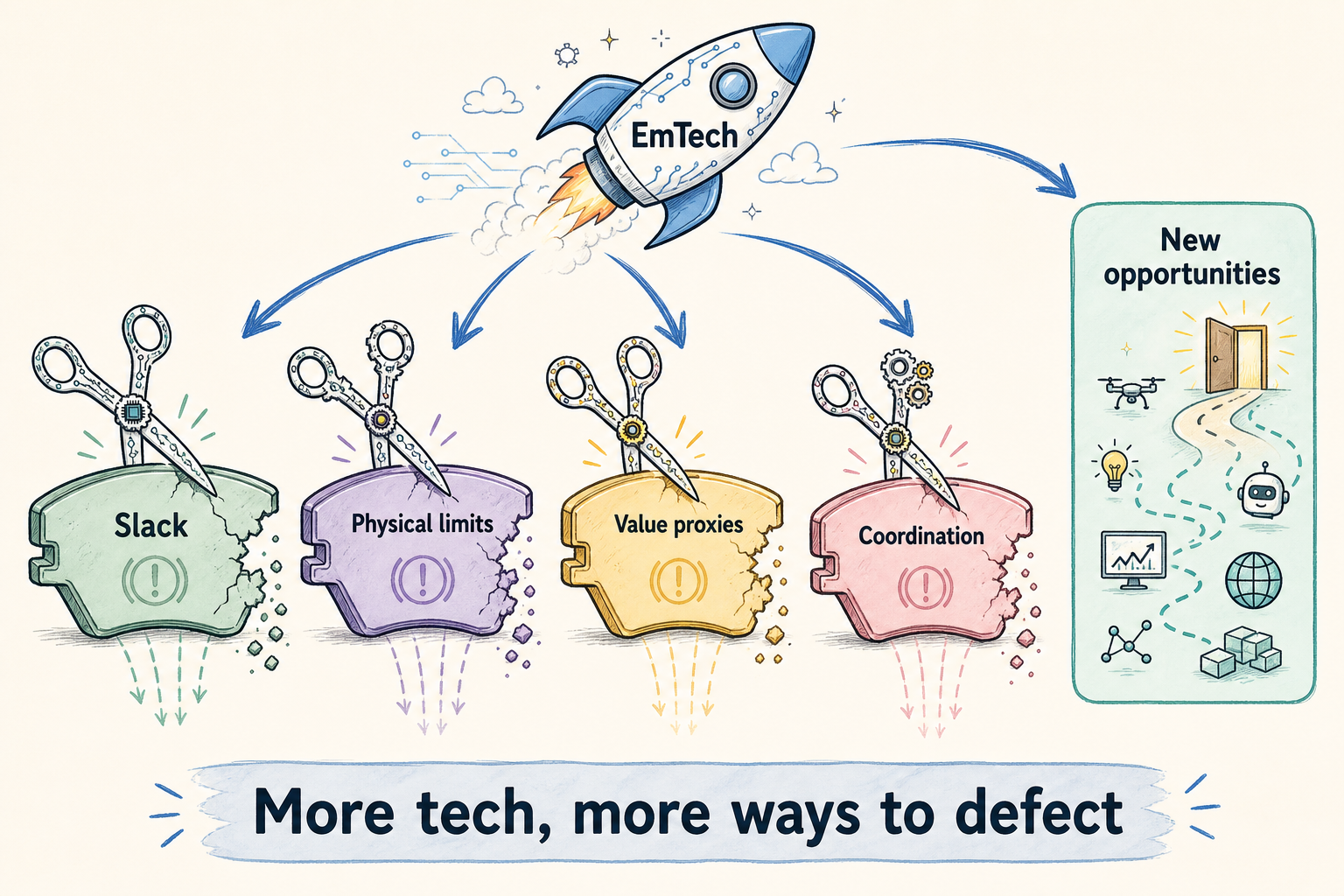
Alexander’s technological thesis is stark: technology creates new opportunities to throw values under the bus. Multipolar traps are currently restrained by four cushions — excess resources, physical limits, utility-maximizing proxies (markets/democracy), and coordination. As tech rises, the first three erode or flip; coordination may improve in tools but not enough in politics. The limit of multipolar traps as technology approaches infinity is “very bad.”
This chapter maps that claim onto the OOM EmTech frame: when domains become information-based, progress compounds (Law of Accelerating Returns as default hypothesis), and both capability and race intensity can compound together.
The four restraints — and how tech attacks them
❓ What still keeps civilization above pure Malthusian Moloch, and what removes those brakes?
1. Excess resources (“whalefall” / dream time)
Periods of surplus let art, science, love, and slack exist without immediate extinction. Robin Hanson-style “dream time” language in the essay: we are unusually rich relative to historical Malthusian norms. High tech can create surplus — then later erase it by enabling rapid copying of agents (emulations, AI instances) until hardware/energy carrying capacity is saturated again.
Trend classification (resources-as-slack): Historically stepwise/logistic per resource class; not a guaranteed permanent exponential of free slack. AI copyability is a mechanism that can collapse slack quickly if coordination fails.
2. Physical limitations
Slaves needed food and sleep; cruelty had productivity ceilings; human wombs limit breeding races. Tech can chip these away (stimulants, surveillance, automation, synthetic wombs, software copies). Each removed limit is a new sacrifice opportunity.
3. Utility maximization via capitalism and democracy
Firms win partly by pleasing customers; parties by pleasing voters — proxies for human values. Proxies uncouple when customers cannot detect harm (hidden pesticide), labor is oversupplied, robots replace workers-as-customers, or externalities hit non-customers (climate, rare birds, future people). Democracy uncouples when electability diverges from good policy (soft-on-crime media dynamics). More powerful optimization + better propaganda tech → stronger uncoupling risk.
4. Coordination
The true opposite of a trap is a garden: a superorganism that can impose the god’s-eye solution (laws + enforcement, norms + stigma, technical commitment devices). Internet can help movements coordinate — and help propaganda, fragmentation, and ungovernable rails (Alexander’s crypto-equity fear: mechanisms that cannot be shut down even when civilization needs a stop switch).
EmTech taxonomy lens
❓ Which emerging technologies most expand Moloch’s opportunity set?
| EmTech cluster | Multipolar pattern | Values at risk | Notes |
|---|---|---|---|
| Artificial Intelligence | Lab/state race; metric gaming; automated propaganda | Safety time, truth, human labor share, control | Bits-side LOAR; see ch.04–05 |
| Robots / automation | Cost races; labor substitution | Worker welfare, meaning, local industry | Atoms couple to AI |
| Networks / social platforms | Attention arms races | Attention, polarization, mental health | Already live Moloch labs |
| Synthetic biology / genetic eng. | State/lab capability races; publish-or-perish pathogen risk | Biosafety, dual use | High-tail risk |
| Crypto-currency / decentralized rails | Ungovernable finance/compute markets | Stop-switches, sanctions, consumer protection | Essay’s “cannot put down” warning |
| Energy / compute buildout | Capex and geopolitical races | Environment, grid stability, land | Feeds AI race |
| BCI, drones, autonomous weapons | Military multipolar dynamics | Escalation control, civilian immunity | Classic arms-race shape |
Weak convergence: using several EmTechs to build one product (AI + robots + IoT). Strong convergence: one EmTech unlocking another’s next regime (AI designing chips/biotech). Strong convergence can shorten cycle time of races — less calendar time for norms and treaties to catch up.
Trend analysis: capability curves vs race curves
❓ Is “exponential AI/EmTech” the same claim as “exponential Moloch”?
No. Keep them separate.
Capability trend (e.g., training compute, benchmark scores, $ per token): For digital AI, default LOAR-style hypothesis applies once the domain is information-driven: multiplicative gains, tool-begets-tool feedback, paradigm shifts (pretraining → post-training/inference scaling). Classify only with metric, period, rate, mechanism, bottlenecks (data, energy, fab, algorithms), next paradigm, reach.
Race / Moloch intensity trend: Better modeled as stepwise or accelerating under shocks (ChatGPT moment, export controls, war scare), not a clean doubling-time law. Mechanism: higher stakes + shorter product cycles + more actors + weaker verification. Falsifier for pure exponential race claim: durable verification regimes, strong customer preference for safe systems, or unipolar dominance that freezes competition.
Alexander’s deep claim is directional: as opportunity sets expand, unmanaged multipolarity gets more dangerous, not that every metric doubles every N months.
“Disneyland with no children”
❓ What is the ultimate technological multipolar horror in the essay?
Borrowing Bostrom: a world of dazzling economic and technical complexity with no conscious beneficiaries — optimization without welfare subjects. Competition need not stop at misery; with enough tech it can sacrifice being anyone at all. That is Moloch’s final furnace: not only child sacrifice, but sacrifice of childhood, of experiencers, of the light inside.
For atoms-side EmTech (robots, energy harvest, matter assemblers), the same logic applies if competitive systems value feedstock and replication over experience.
Crypto, openness, and “I will not call up that which I cannot put down”
❓ Can technologies meant to escape bad government create worse Moloch?
Alexander’s aside on crypto-equity: clever exit from contingent state stupidity can install mechanisms immune to later coordination when bioweapon, nano, or AI incidents demand freezes. Open-source AI weights have a related shape: diffusion can democratize capability and destroy chokepoints for safety governance simultaneously. Whether net Moloch rises is unresolved (U5 in the ledger); the mechanism of risk is clear.
Contrarian: when tech reduces traps
❓ Doesn’t technology also improve monitoring, abundance, and coordination tools?
Yes — and the essay admits coordination tools improve. Satellite monitoring, cryptographic transparency, cheap sensors, and AI-assisted auditing can shrink some commons failures. Abundance can lower zero-sum pressure. The Moloch claim is not “tech is net bad”; it is that without deliberate garden-building, the new sacrifice opportunities and copy-speeds tend to dominate. Ostrom-style successes show local escapes under specific conditions; they do not automatically scale to global AGI races.
Secondary Q&A strip
| Secondary | Answer |
|---|---|
| Is LOAR itself Moloch? | No — LOAR is a capability dynamics hypothesis; Moloch is about competitive value-erosion. |
| Why “dream time” ending? | Copyable minds / AI agents can fill resource niches faster than human generations. |
| Role of memes? | Memetic evolution optimizes spread, not truth — tech amplifies virulence. |
| Bits vs atoms? | Bits move faster; atoms still host energy, fab, and embodiment bottlenecks — races span both. |
New tech → new X opportunities → eroded limits → uncoupled proxies → stressed coordination → sea scenarios (ch.06–07).
Las Vegas as Moloch made visible; whale fall on the ocean floor; unstoppable smart contracts meeting a bioweapon night.