Last updated: 2026-08-01
01 — Who or What Is Moloch?
❓ Who or what is Moloch, and why does naming a “god of child sacrifice” help explain modern systems?
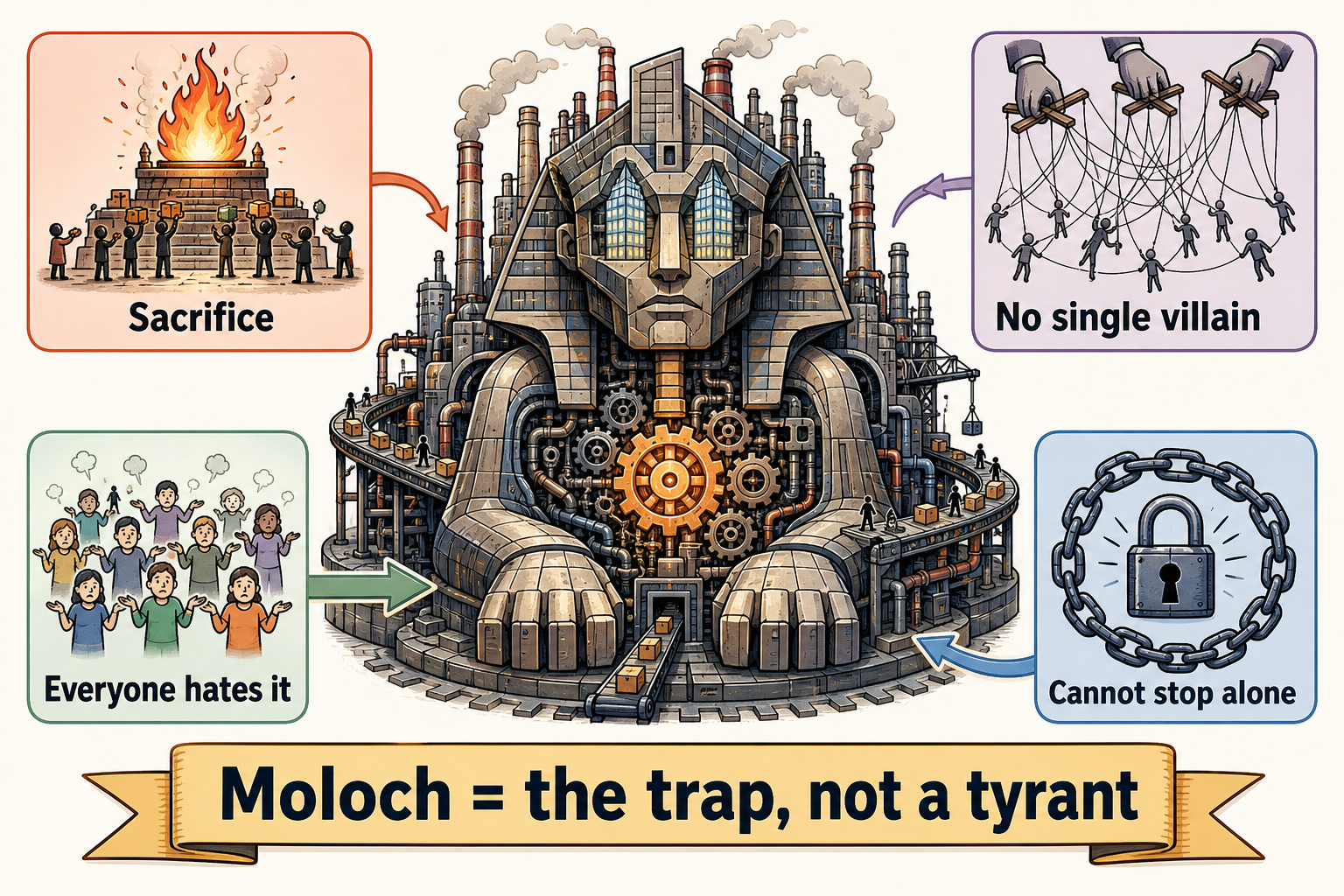
Moloch is not a conspiracy and not merely “capitalism.” In Scott Alexander’s 2014 essay Meditations on Moloch, Moloch is a personification of multipolar traps: situations where many agents, each acting in ways that make local sense, produce outcomes that almost everyone hates and no one can unilaterally stop. The name comes from the ancient figure associated with child sacrifice for power in war — and from Allen Ginsberg’s Howl, where Moloch is the cement-and-aluminum sphinx that “eats up brains and imagination.” Alexander’s punchline is blunt: Moloch is the god who always offers the same deal — throw what you love into the fire, and I will grant you power.
Why start with a name from myth and poetry?
❓ Why use a Canaanite demon and a Beat poem instead of only game theory?
Because the target phenomenon is easy to mis-explain as greed, stupidity, or a villain in a tower. Ginsberg’s Moloch feels like an agent — fingers of armies, blood of money, mind of machinery — precisely so that we notice the opposite: the system is not a person, yet it behaves with a kind of ruthless consistency. Alexander opens with C. S. Lewis’s question in a darker key: Earth could be fair; instead we get prisons, smokestacks, asylums. What does it? Ginsberg answers: Moloch.
He also quotes the Principia Discordia: everyone hates the evils of society; the Goddess says “then stop.” The sting is that stopping requires coordination. When coordination fails, it feels as if a demon forces the outcome. That feeling is the pedagogical point.
The dictatorless dystopia
❓ How can a world everyone hates still persist?
Alexander adapts a Bostrom-flavored thought experiment: a society where everyone must shock themselves eight hours a day, and anyone who refuses or fails to enforce the rule is killed by everyone else. Every citizen hates it. It endures. From a god’s-eye-view, the fix is obvious (all stop at once). From inside the system, unilateral exit is suicide. That pattern — not sadism — is the skeleton of Moloch.
Different from tyranny: a tyrant is one agent with a will. Moloch is distributed necessity: incentives that channel action even when leaders privately wish otherwise.
What Moloch is not
❓ Is Moloch just another word for capitalism or for evil people?
Alexander explicitly rejects a simple identity with capitalism. Capitalism is “a big piece” of many traps, but the catalog also includes arms races, Malthusian evolution, cancer, education signaling, science publication, congressional incentives. Marx (in Alexander’s brief nod) understood that competitive pressure can force behavior without requiring cartoon greed; “capitalists are greedy” is often a lazy paraphrase of a structural problem.
Moloch is also not “nature will always punish softness” in the Nick Land / Gnon sense. Later in the essay, Alexander turns Gnon-worship into a Gotcha: submitting to blind optimization does not make you free; it may only buy time before the same processes eat your values.
Elua: the contrast class
❓ If Moloch is the god of sacrifice-for-power, what stands against it?
Near the end, Alexander names Elua (from Jacqueline Carey’s Kushiel books): a god of flowers, free love, art, science, philosophy, “niceness, community, and civilization” — a god of soft human values. Other dark gods mock Elua’s lack of hell-monsters; somehow Elua is still here. The essay’s strategic hope is not that Moloch becomes nice, but that something on the side of human values becomes powerful enough to close Moloch’s offer.
Why this is a good explanation
Definition: Moloch names multipolar coordination failures in which competitive optimization for X systematically sacrifices other values until participants are worse off (or locked into waste) despite shared dislike of the result.
Explanation: The mechanism is selection under competition: defectors who sacrifice the value gain relative advantage; non-defectors are outcompeted; after diffusion, relative ranks re-equalize and the sacrificed value is gone. Personification is a teaching device, not a supernatural claim.
Different from: “People are selfish” (too vague; fails to predict when cooperation holds); “a cabal wants this” (wrong agent structure); “capitalism = Moloch” (too narrow; misses war, memes, science, biology).
Hard-to-vary test: Swap the mechanism for “random cruelty” or “lack of education” and the fish-farm, arms-race, and education examples stop fitting as one pattern. The constrained parts are multipolar competition, value–competitiveness tradeoff, and failed coordination.
Refutability: A case is not Moloch if unilateral improvement is stable, if a value cannot be traded for competitiveness, or if coordination already binds defectors cheaply. Healthy competition that raises absolute welfare without forced value sacrifice is a counterexample class.
Reach example: The same pattern appears in antibiotic overuse, social-media outrage optimization, and AI lab racing — domains Alexander did not need to invent separately once the mechanism is clear.
Criticism note: The metaphor can become a universal acid (“everything is Moloch”). Discipline requires naming X, the sacrificed value, the poles, and the missing coordination mechanism each time.
Significance of the abstraction
Treating coordination failure as an almost-agent clarifies EmTech strategy: exponential tools do not only “solve problems”; they multiply opportunities to defect. For AI especially, the scary object is not only a misaligned superintelligence in a basement — it is also a world that cannot stop racing toward systems nobody is ready to govern. Naming Moloch keeps attention on incentives and multipolar structure, not only on individual lab ethics.
Ginsberg’s cement sphinx; the self-shock republic; “throw what you love into the flames.”
Secondary questions answered in brief
| Question | Short answer |
|---|---|
| Why “child sacrifice”? | Because the trade is always: destroy a sacred value for competitive power. |
| Is Moloch conscious? | No — the point is the appearance of agency without a planner. |
| Does anyone “worship” Moloch? | Metaphorically: anyone forced to take the deal or be replaced. |
| Relation to tragedy of the commons? | Closely related subclass; Alexander’s set is broader (including races and weak-optimization failures). |