Last updated: 2026-09-24
Leftover lots
Parking can occupy twenty to forty percent of a city centre. If fewer cars sit in long-term parking, some of that land could be used for housing, shops, public space, or deliveries. That outcome is possible, but it is not automatic.
A parking garage does not become housing simply because it has empty spaces. Its structure may not suit another use, ownership may be divided, and conversion takes capital and permits. The benefit also disappears if driverless vehicles spend their unused time cruising instead of parking or charging away from busy streets.
Millspan’s garage two blocks inland is half empty while the curb outside Nia’s bakery is congested. The city has space, but it has not connected that space to the operating rules for empty cars.
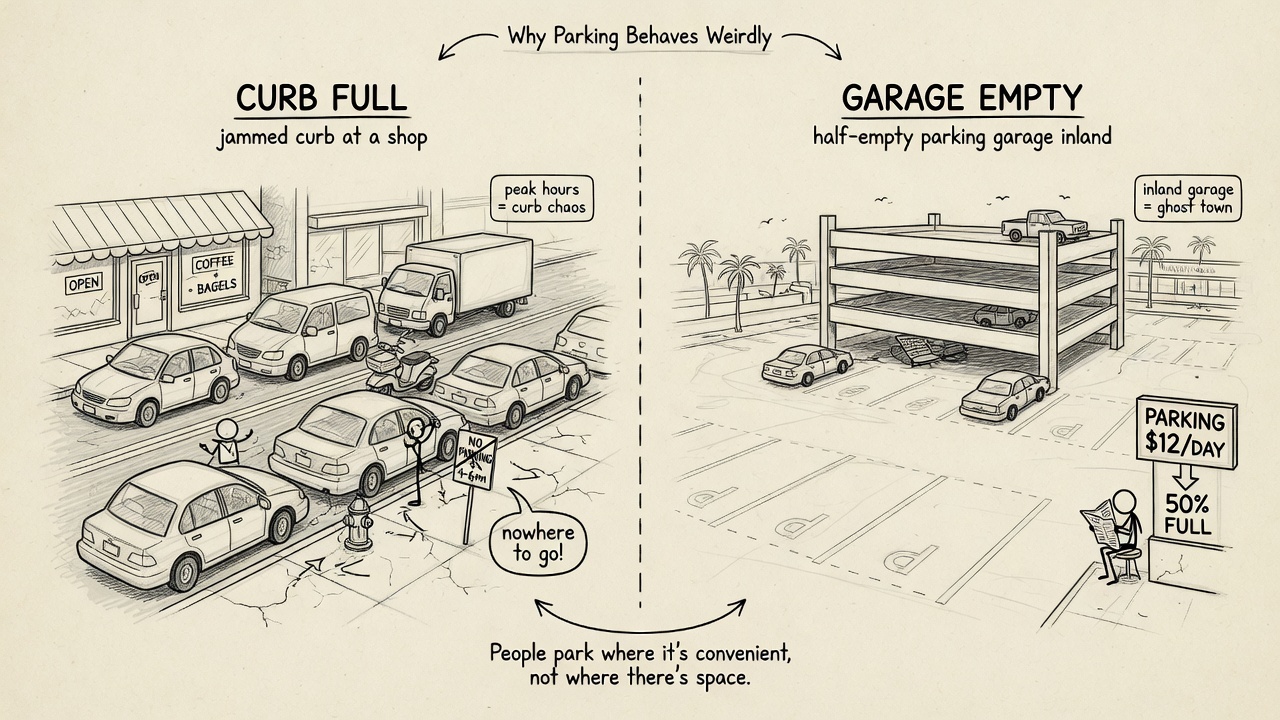
A workable approach treats the garage and curb as one system. The garage can provide an assigned waiting and charging area; the curb can remain available for short passenger pickups, buses, and deliveries. The next page asks for a local proposal that makes those rules usable.