Last updated: 2026-08-16
Parts can stay
A UK science roundtable in January 2025 spent its first key point on a cut, not a scare. Opposite-handed components and self-replicating organisms should not share one ban.
Mirror peptides can last longer in a body because ordinary digestive enzymes do not chew them. Researchers study opposite-handed antimicrobial pieces and short nucleic-acid tools called aptamers. One lab even used mirror DNA as a durable way to store information. Those are jobs. They do not require a living factory of the other hand.
A red line is the step you refuse: a cell that copies itself from opposite-handed parts. Genome-scale mirror DNA, a working mirror ribosome, a dividing chassis — those sit on the forbidden side. A short peptide in a vial does not.
If a rule hits every opposite-handed molecule, every legitimate drug program will fight it, and they will be right. If a rule aims at replication, the useful work can continue.
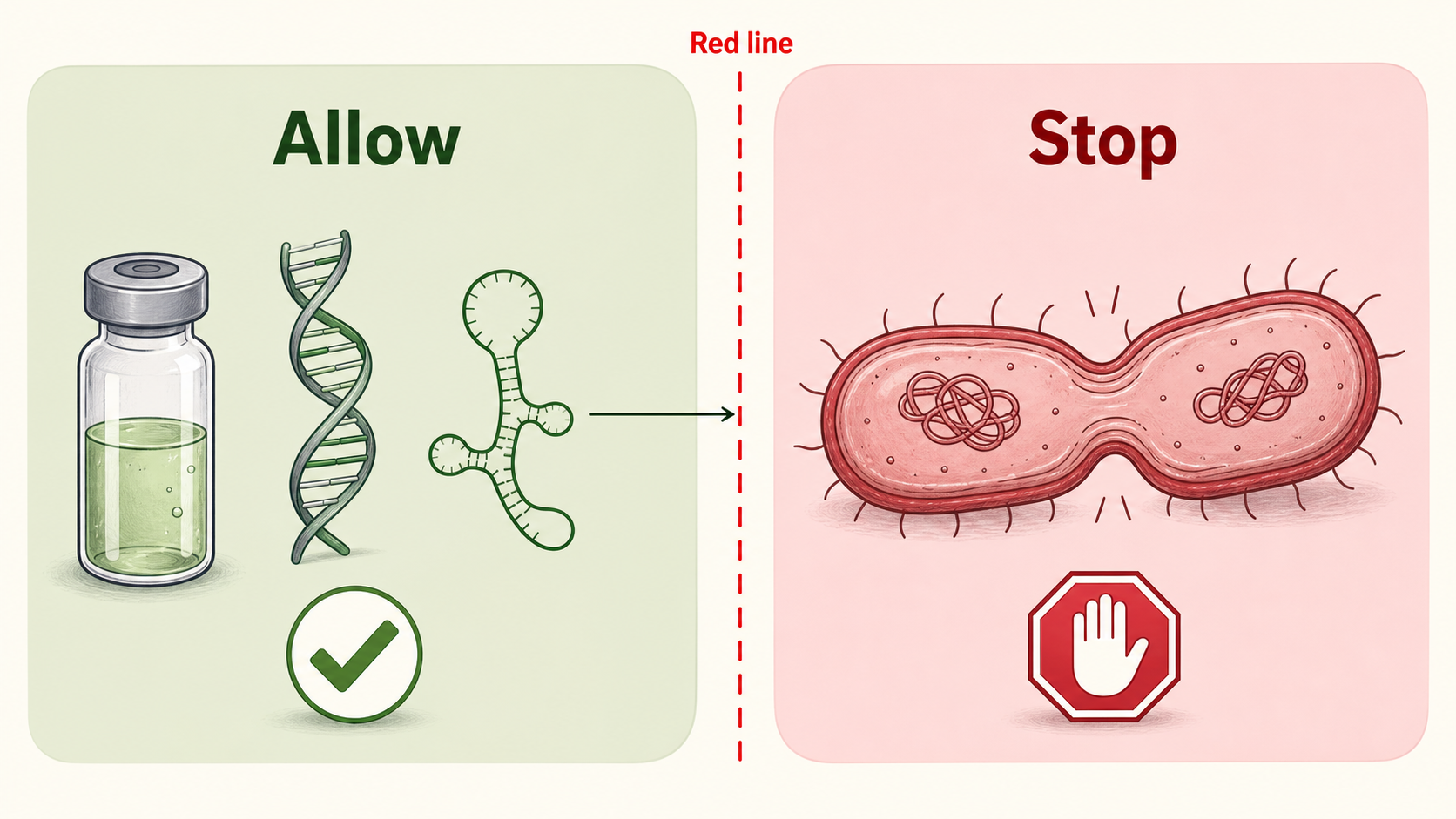
The whole later strategy only works if this cut stays sharp. Ban the organism. Do not declare war on the chemistry.
The tempting mistake is a blanket “mirror = forbidden.” That is sloppy, and sloppy rules get ignored.
That is what lets you see the remaining construction steps as a staircase, not a fog.