Last updated: 2026-08-16
The last steps are machines
Labs can already make short opposite-handed peptides and snippets of opposite-handed DNA. Some enzymes can copy that DNA. None of that is a bacterium that divides.
The missing pieces are machines. A genome long enough to run a cell. A ribosome — the factory that reads genetic text and builds proteins — of the other hand. A membrane that holds the parts together. And, underneath all of that, a still-unsolved puzzle even for ordinary chemistry: how to go from a drawer of molecules to a cell that copies itself.
Experts give two clocks, not a countdown. Without a crash program, maybe fifteen to thirty years. With a big, focused push, perhaps about a decade, at a cost on the order of hundreds of millions of dollars. That is a staircase with landings, not a measured doubling curve. Adjacent tools — cheaper chemistry, better design software — can shorten a step. They do not erase the landings.
The dangerous fact sits after the last landing. The first living cell is the hard gift. Changing that cell into something hardier is, on the same accounts, much easier than inventing it.
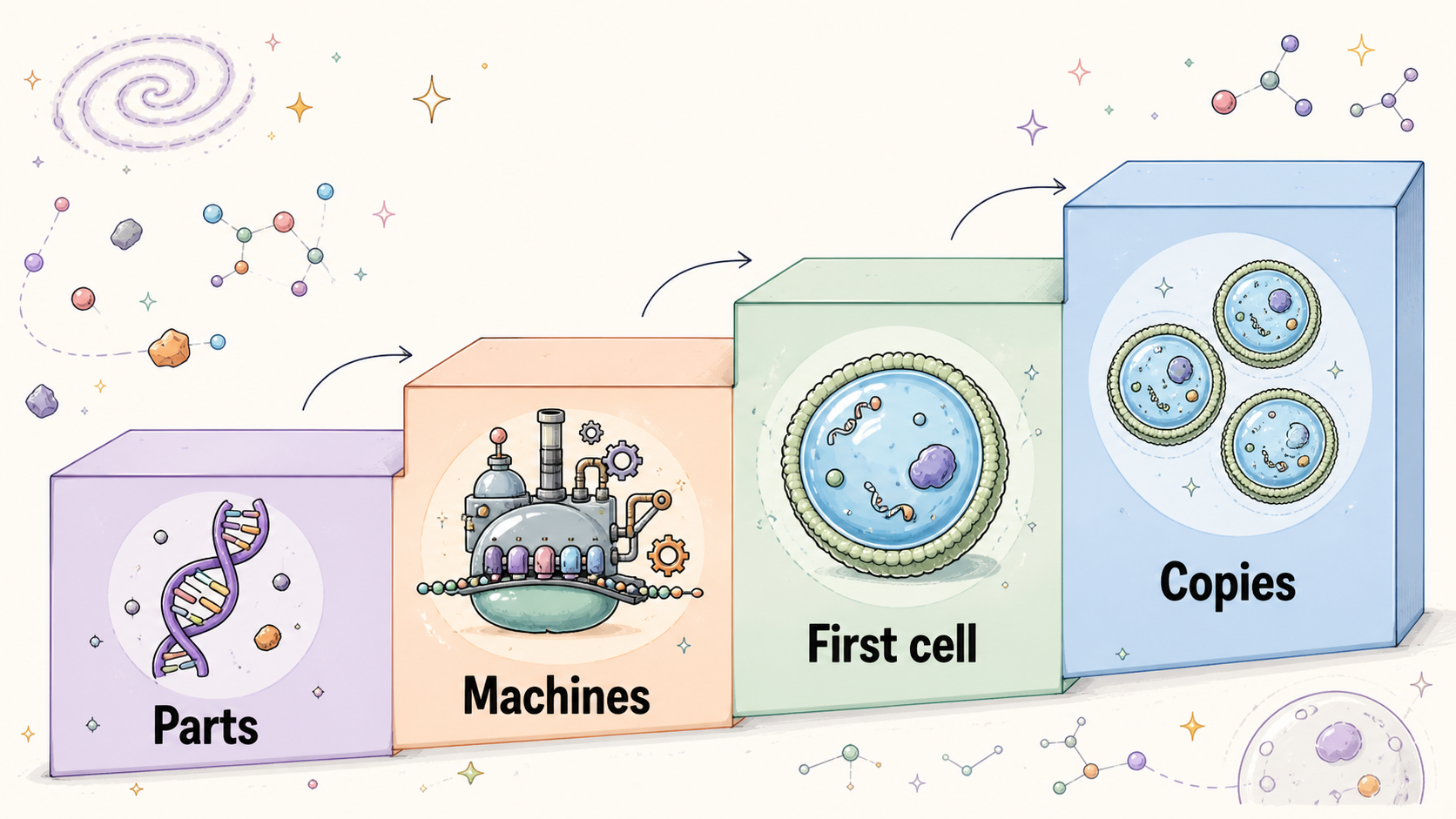
You can now see why “someday, maybe” is not an excuse to wait until the last step is cheap. Institutions are slow. Staircases can be left unbuilt.
The tempting mistake is to treat the topic as either a cartoon apocalypse arriving next Tuesday or as a story that will never leave the page.
That is what lets you ask what you would do after someone finished the staircase.