Last updated: 2026-09-20
Coin flips that become numbers
Writing models want ordinary numbers. The sampling chip only has coin flips.
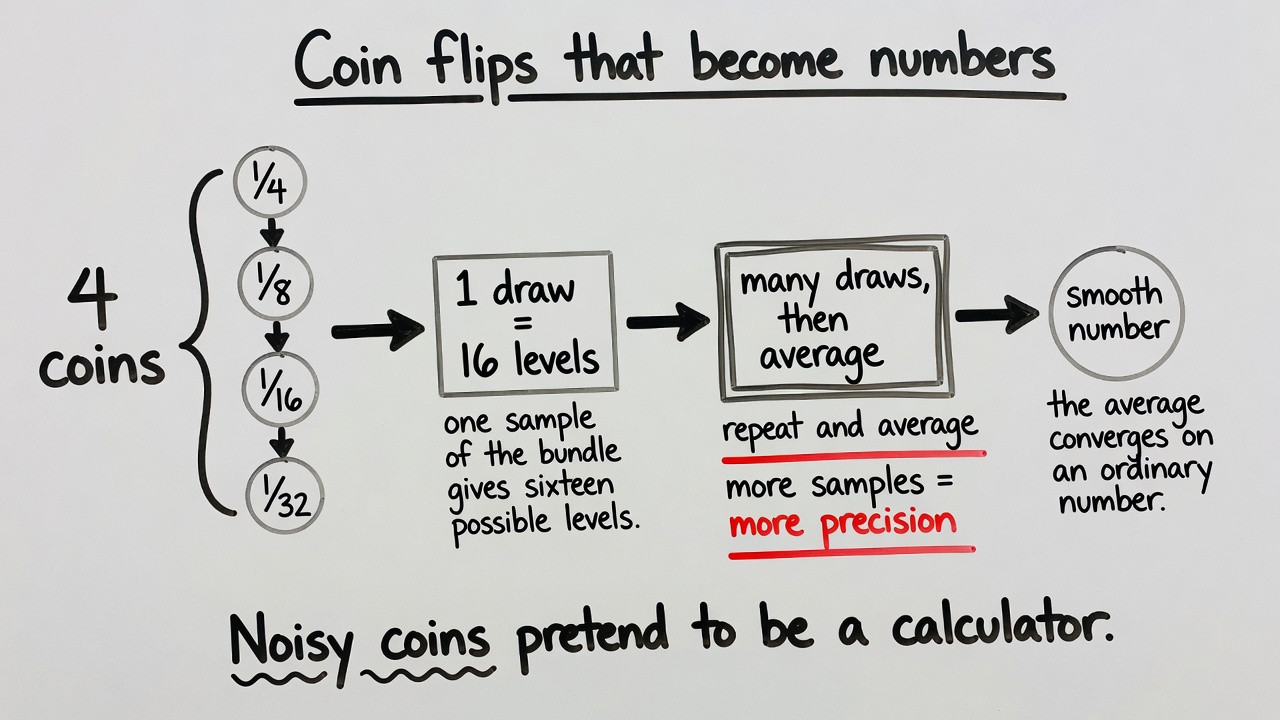
The trick is a bundle. Four coins, weighted like 1/4, 1/8, 1/16, 1/32, give sixteen possible levels on a single draw. Draw many times and average. The average converges on a smooth number. You can buy more precision at runtime by sampling longer — without changing the chip.
The primitive they actually run is even more specific. Condition one coin on its sixteen neighbors, average it, and you get a smooth squashing of a weighted sum — a tanh of a local field. Do that in parallel across outputs and you have a sparse “multiply, then squash” fused in hardware. That is the brick Z1T is made of.
They assume enough Z1 chips in parallel to place all of those bricks. They do not model how many cards that takes.
Noise is not a bug you hide. It is the cheap physics. Averaging is how a noisy street pretends to be a calculator.