Last updated: 2026-09-20
Who spends the joules
For a small four-block model (width 512, sequence 1024), Extropic estimates 294.52 nanojoules per token on the hybrid: 8.74 nJ of Z1 sampling and 285.78 nJ of FPGA work. Against an H100 doing the same next-token step densely, that is about 139× if the GPU is only 10% utilized, 28× at 50%, 14× if the GPU is theoretically maxed.
Look only at the layers that actually run on Z1 and the ratio jumps to hundreds or thousands. That is the tell. In this first hybrid, the FPGA is more than 95% of the energy. Put the vocabulary multiply on the FPGA too and the cost jumps to about 136 microjoules per token — the dense tail dominates.
These are models, not a measured production rack. Sampling energy is anchored to earlier pbit experiments on their X0 chips. The estimate ignores the cost of shipping data between Z1 and the FPGA, and it ignores how many Z1 chips you need to place every sample.
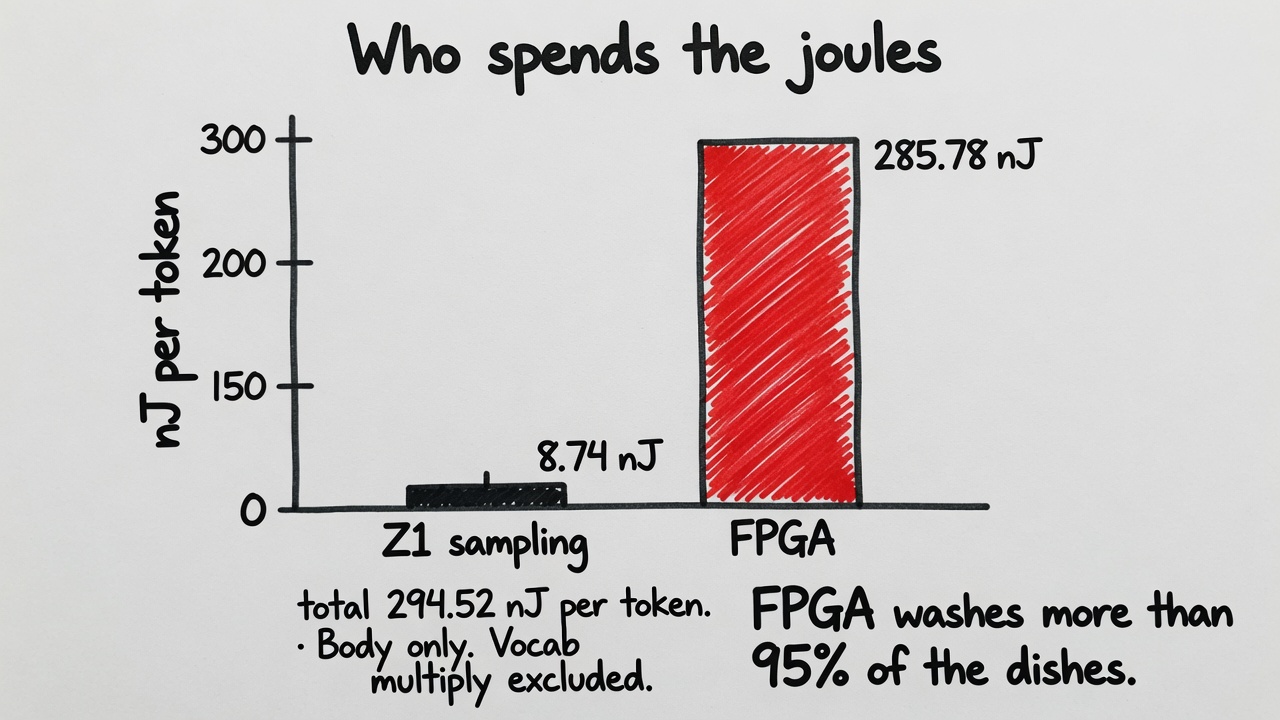
The comfortable story is “new chip runs the night board, electricity problem solved.” The real story is narrower. The leftover digital kitchen still washes most of the dishes. The larger prize they point at is a next chip that can swallow more of those leftover digital ops.